


Master Keying System: How Does It Work?

If a building has dozens of doors, giving every person a separate key for every area can quickly become difficult to manage. A master keying system provides a more organized way to control access by allowing different keys to open different groups of locks.
For example, an employee may have a key that opens only their office, while a manager may have a key that opens every office in the same department. A building administrator may have a higher-level key that can open doors throughout the property.
But how does a master keying system actually work? The answer is found inside the lock cylinders and in the way the keys are planned.
What Is a Master Keying System?
A master keying system is a planned arrangement of locks and keys that creates different levels of access within a property.
In a standard lock setup, one key is normally matched to one lock. With a master key system, a lock can be configured to accept its individual key as well as a higher-level key.
This means one person can have access to a single door, while another authorized person can use a master key to access several doors.
Master key systems are commonly used in:
- Office buildings
- Apartment complexes
- Hotels
- Schools and universities
- Hospitals
- Warehouses
- Retail properties
- Commercial buildings
The main idea is simple: each person receives only the level of access they need.
How Does a Master Keying System Work?
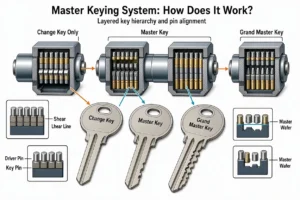
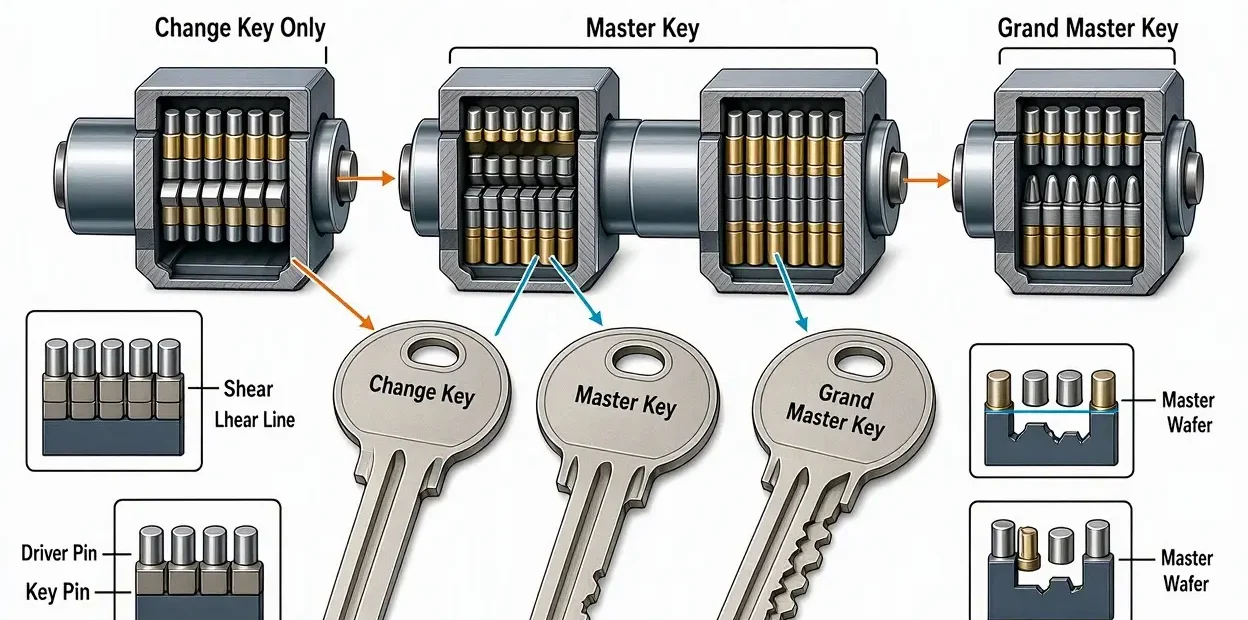
The easiest way to understand a master keying system is to think of it as a hierarchy.
At the lowest level is an individual or change key. This key normally operates one particular lock or a defined group of keyed-alike locks.
Above that is the master key. It can operate multiple locks within its assigned group.
For larger properties, additional levels can be added. A grand master key can operate several groups that each have their own master keys.
A typical structure may look like this:
Change Key → Master Key → Grand Master Key
Each level provides broader access than the level below it.
The important point is that the master key itself is not simply a “special” key that magically opens every lock. The lock cylinders are deliberately configured so that the authorized keys can operate them.
What Happens Inside the Lock?
Most traditional master key systems use mechanical lock cylinders based on pin-tumbler technology.
Inside a conventional pin-tumbler cylinder are sets of pins. A correctly cut key positions these pins so the cylinder can turn.
In a master keyed cylinder, the internal pin configuration is planned to recognize more than one authorized key pattern. This allows an individual key to operate its assigned lock while a master key can also operate the same cylinder.
The exact configuration depends on the lock type and the master key plan. For this reason, master keying is not simply about cutting one unusual key. The cylinders, keys and access plan all have to work together.
Understanding the Different Master Key Levels
A master key system can be very simple or can contain several levels of access.
1. Change Key
The change key is the lowest level in a traditional master key hierarchy.
It is usually assigned to an individual user and operates one particular lock or a specific group of keyed-alike locks.
For example, an employee may have a change key that opens only their office.
2. Master Key
A master key operates multiple locks within a defined group.
For example, an office manager may have a master key that opens all offices on one floor while employees have individual keys for their own rooms.
3. Grand Master Key
A grand master key sits above several master keys.
It can be designed to operate locks across multiple departments, floors or areas of a building.
For example, a property manager might have a grand master key that provides access across several departments.
4. Great Grand Master Key
Very large properties can use another level above the grand master key.
This type of hierarchy can be useful for large organizations with multiple buildings or complex access requirements. However, adding more levels also makes the system more complicated and requires careful planning. ASSA ABLOY’s master key design guidance describes two-, three- and four-level systems and notes that larger systems require particular attention to access planning.
A Simple Example of a Master Key System
Imagine a small office building with three departments:
- Accounting
- Marketing
- Human Resources
Each employee receives a key that opens their assigned office.
The accounting manager receives a key that opens the accounting offices.
The marketing manager receives a key that opens the marketing offices.
The HR manager receives a key for the HR area.
The building manager may receive a higher-level master key that can open all three departments.
This creates a simple access hierarchy without requiring the building manager to carry a large collection of separate keys.
The system can therefore provide different access levels while keeping the physical key system relatively straightforward.
Why Do Businesses Use Master Key Systems?
One of the biggest reasons is convenience.
A business may have dozens or hundreds of doors. Without an organized keying system, employees and managers could end up carrying large key rings.
A master key system can reduce that problem by matching keys to job responsibilities.
It can also make access easier to organize. For example, maintenance staff may need access to service rooms, while office employees may only need access to their own work areas.
A properly planned system can therefore provide:
- Simpler key management
- Different access levels
- Easier control of multiple doors
- Convenient access for authorized managers
- A scalable approach for larger properties
ASSA ABLOY describes master key systems as a structured and scalable way to organize access across buildings and sites.
Is a Master Key the Same as a Skeleton Key?
No. These terms are sometimes confused, but they describe different things.
A master key is created as part of a planned master key system. It is intended to operate a specific group of properly configured locks.
A skeleton key is a general term often used for a key that has been altered or designed to operate certain older or warded locks.
Modern master key systems are based on planned keying and cylinder configurations rather than simply using a generic key that opens many unrelated locks.
Can One Master Key Open Every Door?
It can, but it does not have to.
In a simple two-level system, a master key may operate every lock within that particular system.
In a larger property, however, access can be divided into multiple groups.
For example:
Individual Key → One Office
Department Master → One Department
Grand Master → Multiple Departments
This approach gives property owners more control over who can access different areas.
A well-designed system should therefore be based on actual access requirements rather than simply giving the highest-level key to as many people as possible.
What Is a Master Keying Schedule?
Before a master key system is installed, the access structure usually needs to be planned.
A master keying schedule or schematic records which keys are intended to operate which locks.
It can show:
- Door identification
- Key identification
- Access levels
- Master key relationships
- Individual change keys
- Future expansion requirements
This documentation is important because a master key system is not just a collection of physical keys. The access plan behind those keys is a major part of the system.
Professional master key design guides describe the schematic as a blueprint for establishing the relationship between keys and locks.
What Are the Benefits of a Master Keying System?
Better Key Management
Instead of carrying many individual keys, authorized managers can use one key for the areas they are responsible for.
Controlled Access
Different employees can receive different levels of access based on their roles.
Easier Administration
A clearly documented key hierarchy can make it easier to understand who should have access to specific areas.
Useful for Large Properties
Hotels, schools, apartment buildings and commercial facilities can have many doors and different access requirements. A master key system can organize those requirements into manageable groups.
Flexible Design
The system can be designed with two or more levels depending on the size and layout of the property.
Are There Any Disadvantages?
A master key system also needs careful management.
The most important concern is key control. If a high-level master key is lost or copied without authorization, it can potentially provide access to many areas.
There is also a trade-off between convenience and security. Creating additional access levels and multiple key relationships makes the system more complex.
For that reason, organizations should maintain accurate key records and limit high-level keys to people who genuinely require that access.
For higher-security applications, restricted or patent-protected key systems may also be considered to improve control over unauthorized key duplication.
Where Are Master Key Systems Commonly Used?
Master key systems are particularly useful where many people need access to different parts of the same property.
Common examples include:
Offices
Employees can access their own workspaces while managers can access a wider group of rooms.
Apartment Buildings
Residents can receive keys for their own units, while authorized building staff can have access to selected common or service areas.
Hotels
Guest keys can be limited to specific rooms, while authorized staff can have broader access according to their responsibilities.
Schools
Teachers, administrators and maintenance personnel may require different access levels.
Hospitals
Different departments and service areas may require different levels of controlled access.
Warehouses
Employees can access operational areas while supervisors and facility managers can have broader access.
How Is a Master Key System Designed?
The design normally begins with the property rather than the keys.
First, the doors and access areas are identified. Then the property owner or facility manager determines who needs access to each area.
After that, the locksmith or security professional can create a key hierarchy.
For example:
- List all doors and access areas.
- Identify who needs access to each door.
- Group doors according to access requirements.
- Establish master and change key levels.
- Create a master keying schedule.
- Configure the appropriate cylinders.
- Cut and issue the keys.
- Keep accurate records for future changes.
Planning the system before ordering cylinders and keys can help avoid problems when the property expands or access requirements change.
Can a Master Key System Be Expanded Later?
Yes, many systems can be expanded, but future growth should be considered during the original design.
Adding doors or changing access relationships later can be more complicated if the original system was not planned with expansion in mind.
For a growing business, it is therefore useful to discuss future doors, departments and access levels with the locksmith before the system is finalized.
Master Key System vs. Electronic Access Control
A traditional master key system uses physical keys and mechanical lock cylinders.
Electronic access control uses devices such as key cards, fobs, mobile credentials or biometric systems.
Both approaches can control access, but they work differently.
A mechanical master key system can be attractive when a property wants a straightforward physical system without installing electronic access equipment.
Electronic systems, on the other hand, can provide features such as electronic permissions, access logs and remote administration, depending on the system.
The right choice depends on the property’s layout, security requirements, budget and management needs.
Final Thoughts
A master keying system is essentially an organized way of giving different people different levels of access.
Individual users can have keys for specific doors, managers can have master keys for groups of doors, and larger properties can add grand master levels when necessary.
The key to making the system work properly is not simply the master key itself. It is the careful planning of the locks, cylinders, key hierarchy and access permissions behind it.
For businesses, apartment buildings, schools, hotels and other multi-door properties, understanding the access structure before installing a system can make key management much easier and more predictable.