A fresh set looks flawless on day one, then thins so gradually that the change only registers in photographs. That slow fade is built into how your own lashes grow, shed and renew themselves.
Your Own Lash Renewal Cycle Sets the Limit
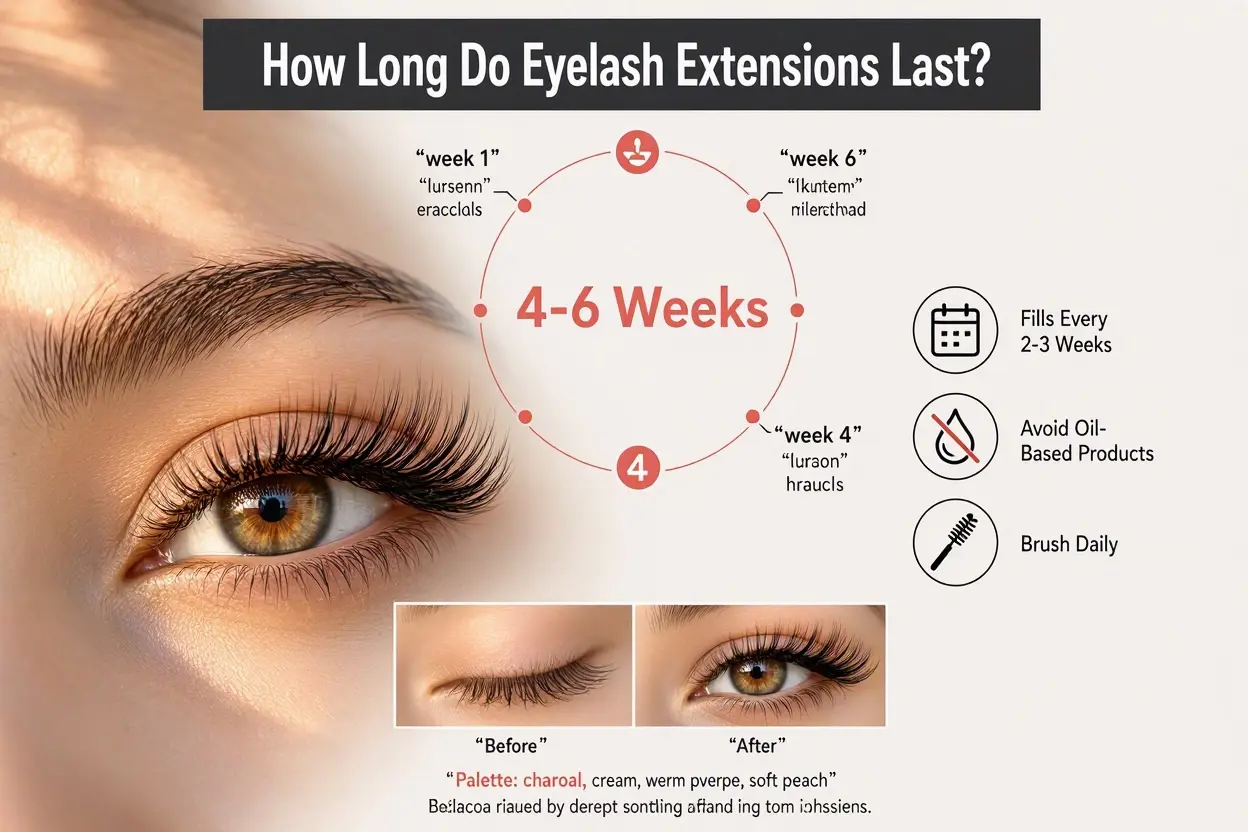
The honest headline answer comes in two parts. A set typically lasts about four to six weeks in total, yet it looks its fullest for only about two to three weeks of that span. The rest of the time is a long, gentle thinning, as the set drifts from polished to sparse. Anyone promised a flawless look for the whole span has been given a flattering version of how lashes actually behave.
The reason sits in your own biology. Every natural lash follows a growth cycle with three phases, known as anagen, catagen and telogen, spread over roughly sixty to ninety days from start to finish. Crucially, each lash runs on its own timetable. While one lash is young and growing, its neighbour may be resting, and another may be ready to fall. Your lash line is a rolling programme of renewal rather than a single crop that turns over all at once.
An extension changes none of that. Each false lash is bonded to one individual natural lash, and it stays only as long as its host stays. When the natural lash completes its cycle and sheds, the extension leaves with it, quietly and painlessly. Anyone learning how to take a good selfie to judge their own lash line in photographs will see these differences plainly, since the camera records thinning that the daily mirror glosses over. For the background science, the account of eyelash growth and structure explains the cycle in fuller detail. Loss is therefore gradual by design. You do not wake one morning to an empty lash line. You lose a few extensions here and there, day by day, exactly as you have always lost natural lashes without noticing.
Fullness Fades Long Before the Final Extensions Fall
A week by week picture helps set expectations more honestly than any single lifespan figure. In the first week, the set looks complete and even, with every intended lash in place. Small losses begin during that week, but they hide within the fullness, and most wearers notice nothing at all. Photographs taken then show the set at its very best.
By the second and third weeks, the thinning becomes faintly visible, especially towards the outer corners and along any spots where lashes happen to be shedding together. The set still looks good, and most people feel presentable without any help, yet the mirror shows a softer and less uniform line than day one did. This is the stretch most technicians describe as the set looking its fullest, and it is the stretch on which refill appointments are planned.
From the fourth week onwards, gaps grow harder to disguise. Remaining extensions sit further apart, lengths can look uneven where faster growing lashes have carried their extensions outward, and one eye may thin faster than the other. By the fifth or sixth week, what remains is usually a scattered handful rather than a set. That remnant can technically still be attached, which is why lifespan claims sound generous, but nobody would describe the look as full. The distinction between attached and attractive is the whole answer to the question.
Classic, Hybrid and Volume Sets Age at Different Rates
Style changes how a set wears, because different designs distribute loss differently. A classic set places one extension on each natural lash, giving a defined yet natural look. Its honesty is also its weakness, since every natural lash that sheds leaves a visible space. Classic sets often look even and lovely early on, then appear patchy sooner once thinning gathers pace.
A hybrid set mixes classic single extensions with small handmade fans, blending definition with softness. The fans help to bridge small gaps as shedding begins, so the decline tends to look more forgiving. A volume set goes further, applying a fan of several fine extensions to each natural lash, and the sheer number of fine lashes means individual losses hide within the density for longer. The line stays dark and full appearing well into the cycle, even though the underlying shedding rate is much the same.
Mega volume sets push density furthest of all, using larger fans of very fine extensions. They can hold their dramatic look impressively, yet they also place the greatest demand on the natural lash beneath, which is why the weight discussion in the next section matters so much. Style labels alone never guarantee longevity. A modest classic set applied lightly and well can outlast a heavy volume set applied carelessly, because the health of the natural lash, not the name of the style, decides how long anything stays attached.
Application Weight and Skill Decide How Gracefully a Set Wears
Two wearers can choose the same style and enjoy very different results, because application quality shapes everything. A skilled technician isolates one natural lash at a time, matches the extension weight and length to what that lash can safely carry, and bonds it cleanly at the right distance from the skin. Extensions applied that way shed in an orderly fashion, one natural lash at a time, and the set thins evenly.
Poor application ages badly in predictable ways. Extensions that are overly long or too heavy strain the natural lash and can pull it out before its cycle ends, taking the extension with it and leaving a gap that takes weeks to regrow. Lashes glued together in clumps tug uncomfortably as they grow at different speeds, twist the set out of line, and fall in bunches rather than singly. Twisting, drooping and uneven shedding are often application problems wearing the disguise of bad luck.
Adhesive behaviour plays its part as well. A well cured bond, applied in the right amount, holds steadily through the cycle. Too little adhesive gives a weak bond that releases early, while too much creates stiff, brittle attachments that feel uncomfortable and snap away. The wearer cannot control any of this after the appointment, which is why choosing a careful, properly trained technician matters more than any aftercare product. Longevity is largely decided in the salon chair, long before your own habits enter the story.
Daily Habits That Quietly Shorten a Set’s Life
Once a set is on, daily habits decide whether it reaches the longer or shorter end of its typical span. Water in the earliest stage is the first pressure point. Keeping lashes dry across roughly the first twenty four to forty eight hours is common aftercare advice, although exact curing guidance varies by adhesive, so follow the instructions your own technician gives rather than any universal rule.
Oil is the steady enemy of the bond. Oily cleansers, rich eye creams and oil based removers work into the attachment and loosen it over time, so extensions washed daily with oily products often shed well ahead of schedule. Rubbing does similar damage by force. Rubbing tired eyes, dragging a towel across the face, or picking at a twisted extension all pull lashes out before their time, and the temptation to tidy a stray extension with your fingers should be resisted firmly.
Sleep position leaves its mark too. Sleeping face down presses the lashes into the pillow for hours, bending extensions and stressing the bond, while side sleeping often thins the pillow side faster than the other, a pattern many wearers notice in the mirror without guessing the cause. Heat and steam round out the list, since saunas, very hot showers and steam from cooking can soften the bond and encourage curl loss. None of these habits ruins a set overnight. Together, they explain why one set lasts six calm weeks and another fades in three.
Refill Appointments Keep the Look Even and Supported
Refills exist because shedding never stops. A refill appointment removes outgrown extensions, replaces those lost since the last visit, and restores an even line before gaps take hold. Most wearers book refills every two to three weeks, a rhythm that matches the fullest looking window and keeps the set in its best stretch indefinitely, cycle after cycle.
Timing matters because a refill needs something to build on. Salon practice commonly asks for roughly forty to fifty out of every hundred extensions still in place before a session counts as a refill, although that threshold is a working rule that varies by technician rather than any clinical standard. Arrive with far less remaining and there is too little left to blend, so the appointment becomes a fresh set in all but name. Your technician will judge what is in front of them, and their assessment deserves trust.
Knowing when to stop refilling matters as much as knowing when to book one. If the remaining extensions are sparse, heavily outgrown or twisted at the base, a refill has too little sound structure to build on, and a fresh set will look better and wear more safely. A fresh set also gives the technician a clean view of your natural lashes, so weak or damaged lashes can be rested rather than loaded again. Many wearers alternate for a while, refilling through a season and then starting again from a clean line, and that rhythm protects the natural lashes that every future set depends upon.
Aftercare between visits keeps each refill worthwhile.
Cleanse the lash line gently with a lash safe cleanser, since clean lashes hold bonds better and keep the skin along the lid healthy. Brush through the set daily with a clean spoolie to keep extensions aligned and to catch early tangles. Choose water based products around the eyes and keep oils away. A lash lift offers the obvious comparison for anyone tiring of the timetable, since a lift works on your own lashes, is commonly said to last about six to eight weeks, and asks for far less upkeep, though it adds no length or density beyond your natural lashes and is usually paired with a tint for depth. The specialist safety material in the eye health guidance on extensions and safety gives a balanced view of both routes.
Warning Signs That Call for Removal and Professional Advice
Comfort is a safety signal, and a well applied set should feel like nothing at all. Persistent itching, burning, redness, swelling of the lid, watering, pain, or any discharge from the eye are not normal settling in symptoms. Neither is a feeling that the lashes pull or stab with every blink. Such signs can point to irritation, allergy to the adhesive, or infection along the lid, and they call for prompt advice from a medical professional or eye specialist rather than patience.
A patch test before a first full set is a sensible precaution, particularly for anyone with sensitive skin or a history of reactions to cosmetics, and a reputable technician will offer one without being asked. If a reaction does develop, the extensions should come off, but how they come off matters as much as how fast. Never pull, pick or tug extensions away yourself. Pulling removes natural lashes along with the extensions, can damage the follicle, and leaves the lash line thinner than shedding alone ever would.
Professional removal uses a dedicated remover that dissolves the bond gently, letting extensions slide away without force while your natural lashes stay in place. It is quick, comfortable and by far the safest route, whether the reason is a reaction, a badly applied set or simply a wish to stop. Treat any salon that shrugs at pain or urges you to push through discomfort as a warning in itself. Your eyes are worth more than any set, and a set that has to end early is a small loss beside an avoidable injury.