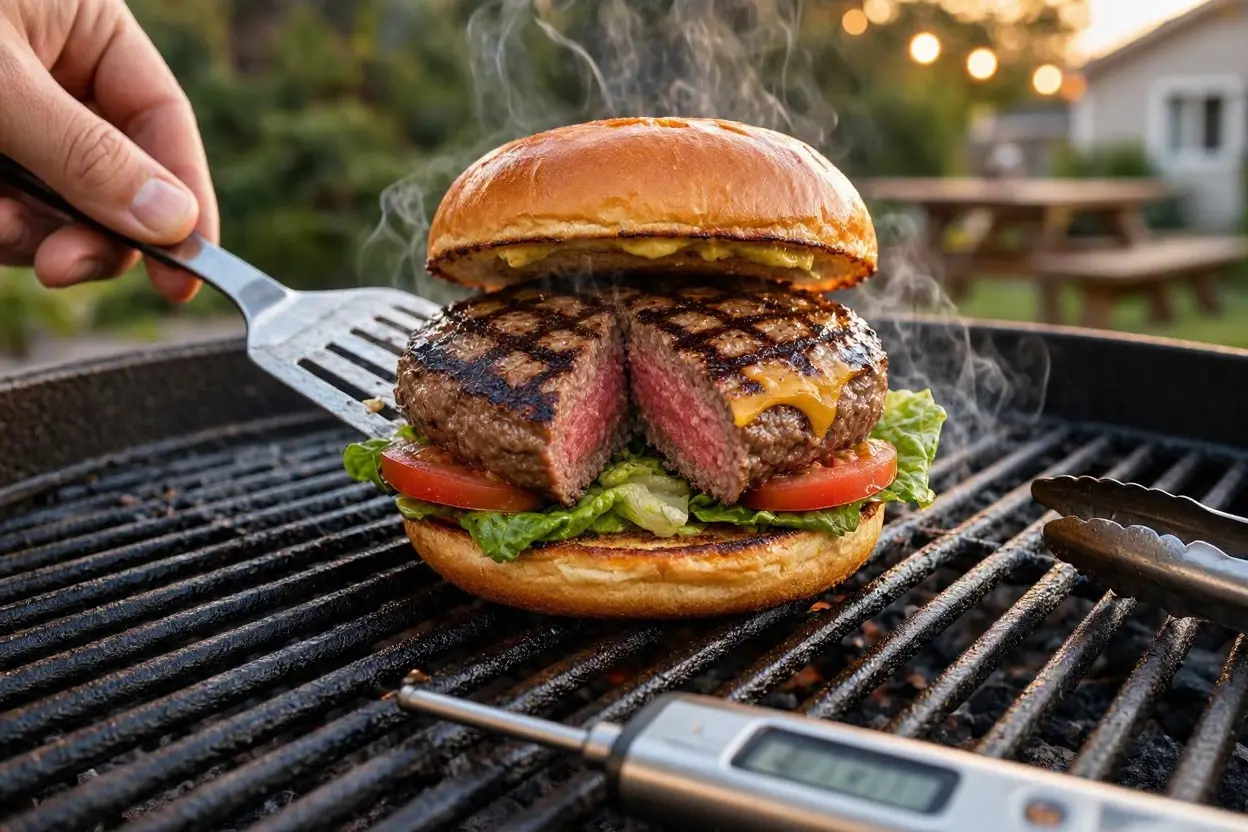
A great grilled burger is a study in restraint, from the way the meat is handled to the moment it leaves the heat. Get the touch right and the middle stays tender while the outside earns its deep, savoury crust.
Fat Content Decides How Juicy the Finished Burger Turns Out
A burger lives or dies by the mince you buy, long before the grill is lit. The blend that grilling cooks return to again and again is eighty twenty, meaning eighty parts lean meat to twenty parts fat, and that fat is not an indulgence to apologise for. It is what bastes the patty from the inside as it cooks, carrying flavour and keeping the texture moist even over fierce heat.
Chuck is the cut most often recommended for the job, because it brings a deep beefy taste alongside that helpful fat. Leaner mince, however worthy it looks in the packet, tends to dry out on the grates and can turn dense and grey tasting, especially if it spends even a little too long over the flames. Very fatty blends, by contrast, shrink hard and flare the grill as they drip.
Whatever you buy, keep it cold until the moment you shape it. Warm fat smears under your hands, sticks to everything, and works its way out of the mixture instead of staying distributed through it, which leaves the cooked burger greasy on the surface and dry inside. Cold mince handles cleanly, holds together with minimal fuss, and gives you a patty that behaves predictably once it meets the heat.
Gentle Shaping Keeps the Texture Light
Divide the cold mince into even portions and shape each one with the lightest touch you can manage. Roll it loosely, then flatten it into a round a little wider than the bun, because patties pull inwards as they cook and a burger that starts slightly oversized lands close to the right size when it comes off the grill.
Aim for a thickness of about three quarters of an inch to one inch. Much thinner and the inside races past the point you wanted before the outside has browned properly. Much thicker and the surface can scorch while the middle still lags behind, leaving you tempted to leave it on far too long and dry out the very juiciness you were trying to protect.
The small trick that separates neat results from domed ones is a shallow dent made with your thumb in the middle of each patty. Burgers swell upwards as they cook, and that dent gives the swelling somewhere to go, so the finished patty stays flat, sits properly in the bun, and holds its toppings instead of shedding them down your hands at the first bite.
Work on a tray lined so the patties do not stick, keep them chilled while the grill heats, and resist any urge to season or reshape them repeatedly. Readers kitting out a compact cooking space might also be weighing up choosing an air fryer for a small UK kitchen as a backup for rainy days, but for the classic charred edges and smoky depth, the grill remains the instrument these patties were shaped for.
Simple Seasoning Applied at the Last Moment Works Best
Good beef needs remarkably little help. Salt and pepper, applied generously to the outside of the patties just before grilling, will deliver more flavour than a long list of ingredients mixed through the meat ever could. Seasoning the surfaces builds the savoury crust, while the interior stays tasting purely and simply of beef.
Timing matters here. Salt draws moisture out of meat when it is left sitting on it, so salting well in advance can leave the surface damp and the texture altered before cooking even begins. Season at the last moment, once the grill is hot and the patties are about to go on, and the salt does its work on the crust instead of against the meat.
Mixing additions into the mince itself is a common habit worth unlearning. Chopped onion, breadcrumbs, egg, sauces and spice blends all change what you are making, usually towards a meatloaf or kofta style patty that needs binding and behaves differently over heat. There is nothing wrong with those dishes, but a grilled burger in the classic sense is better served by keeping the meat plain and putting the personality into the toppings afterwards.
Fierce Direct Heat Builds the Craved Crust
Preheat the grill thoroughly to medium high or high heat before any meat goes near it. A properly hot grate sears the surface on contact, creating the browned, savoury crust that defines a grilled burger, while a lukewarm grill steams the patty in its own juices and leaves it pale, flabby and reluctant to release when you try to turn it.
Prepare the grates as carefully as the meat. Scrub them clean with a stiff brush while they are hot, removing the burnt remnants of previous meals that would otherwise stick to fresh food and taste bitter, then oil them lightly. A folded piece of kitchen paper held in tongs and dipped in a neutral oil does the job neatly, though a light hand matters because excess oil drips and flares.
A Single Confident Flip Protects the Juices
Lay the patties over the direct heat and then leave them alone. This is the hardest part for many cooks, because the instinct to nudge, slide and check is strong, yet every movement interrupts the sear and risks tearing a surface that has not yet set. A patty releases itself from the grate when its crust is properly formed, so patience is rewarded with a clean lift.
Never press the meat down with a spatula. The sizzle that follows looks satisfying and sounds like cooking, but what you are hearing is juice and melted fat being squeezed out onto the coals, where it flares and is lost for ever. That liquid belonged inside the burger. Pressing a whole batch this way can turn promising patties dry and tough in under a minute.
Flip once, and flip confidently, when the first side has a deep brown crust. As a starting guide only, a patty of the thickness described earlier usually needs roughly three to four minutes per side, but treat those minutes as a rough map rather than a promise. Thickness varies, grills vary, coals fade and gas burners have hot spots, so time alone should never be the judge of when a burger is done.
A Thermometer Reading Settles Every Argument About Doneness
Colour is a liar when it comes to minced beef. A burger can look reassuringly brown outside while staying undercooked within, and it can also retain a pink blush inside after reaching a safe temperature, depending on the meat and the conditions on the grill. The only reliable judge is a food thermometer, used properly and read without wishful thinking.
Thin patties defeat the usual top down approach, because the probe tip can push straight through and read the grate instead of the meat. The sideways trick solves this neatly. Slide the thermometer in horizontally through the edge of the patty so the tip settles in the very middle, hold it briefly, and read the temperature at the thickest point of the interior.
Culinary guides commonly describe medium rare as about one hundred thirty to one hundred thirty five degrees Fahrenheit, a level many diners enjoy in a whole steak. For minced beef, however, that description must be placed firmly beside the official recommendation, because the safety picture for ground meat is entirely different, as the next section explains in full. Serving a burger at the medium rare level is not a choice the safety guidance supports for home cooking.
Official Safety Guidance Sits Above Personal Preference for Minced Beef
The reason thermometers matter so much with burgers lies in how mince is made. A steak carries bacteria on its surface, and searing destroys them. Grinding, however, distributes those surface bacteria throughout the meat, so the middle of a burger needs to reach a safe temperature just as much as the outside does. That single fact explains the whole cautious approach.
Per guidance from the United States Department of Agriculture, ground beef burgers should be cooked to one hundred sixty degrees Fahrenheit, measured with a food thermometer. That figure sits far above the culinary medium rare range described earlier, and the gap between the two numbers is exactly where home cooks need to be honest with themselves about which standard they are following and why.
The British position points the same way. According to the Food Standards Agency guidance on cooking food safely, burgers should be cooked through at home, and pink burgers belong only in restaurants operating specific, tightly managed safety controls designed for that style of service. An ordinary home grill does not replicate those controls, so the home rule stays simple and clear.
Hygiene around the grill deserves the same seriousness. Never return cooked burgers to the plate that carried them out raw, because that surface holds raw meat juices and will contaminate food that is ready to eat. Use a clean plate, wash hands after handling raw mince, and keep cooked and uncooked food apart throughout, from preparation to serving.
Briefly Toasted Buns and Thoughtful Toppings Complete the Build
Cheese goes on during the final minute of cooking, laid over the patty while it is still on the heat so it melts into the surface rather than sitting on top as a cold slice. A brief lid down moment helps it drape properly. Cheddar brings sharpness, milder cheeses melt more smoothly, and either works far better than cheese added after the burger has cooled on the plate.
Buns deserve a minute of attention too. Split them and toast the cut sides briefly on the grill until they turn golden and feel slightly crisp. That toasting is not mere decoration. A toasted surface resists soaking far better than a soft fresh one, so the bun holds together to the last bite instead of collapsing around the fillings halfway through the meal.
Build toppings with balance in mind rather than height for its own sake. Something fresh and crunchy, such as lettuce or sliced onion, something sharp like a pickle or a mustard based sauce, and something rich such as mayonnaise will cover most tastes without burying the beef. The meat should remain the loudest flavour in every mouthful, which is the reward for all the restraint exercised earlier. For broader background on the dish itself, the history and varieties of the hamburger make enjoyable reading while the grill cools.
Served promptly, on warm toasted buns, with the cheese still glossy and the crust intact, a simply seasoned burger cooked to a properly checked temperature needs no apologies and no elaborate garnish. Keep the mince cold, season late, flip once, never press, and let the thermometer have the final word.