


How Many People Died in Hiroshima and Nagasaki? (Death Toll Estimates)

The atomic bombings of Hiroshima and Nagasaki killed an estimated 150,000 to 246,000 people by the end of 1945. Most estimates put the Hiroshima toll at 90,000 to 166,000 and the Nagasaki toll at 60,000 to 80,000. No exact figure exists. Records were destroyed, the cities’ populations were not precisely known, and many victims died weeks or months later from burns, injuries and radiation sickness.
The Quick Answer
| City | Date | Estimated deaths by end of 1945 | Roughly how many on day one |
|---|---|---|---|
| Hiroshima | August 6, 1945 | 90,000 to 166,000 | 70,000 to 80,000 |
| Nagasaki | August 9, 1945 | 60,000 to 80,000 | about 40,000 |
| Combined | about 150,000 to 246,000 | about half of all deaths |
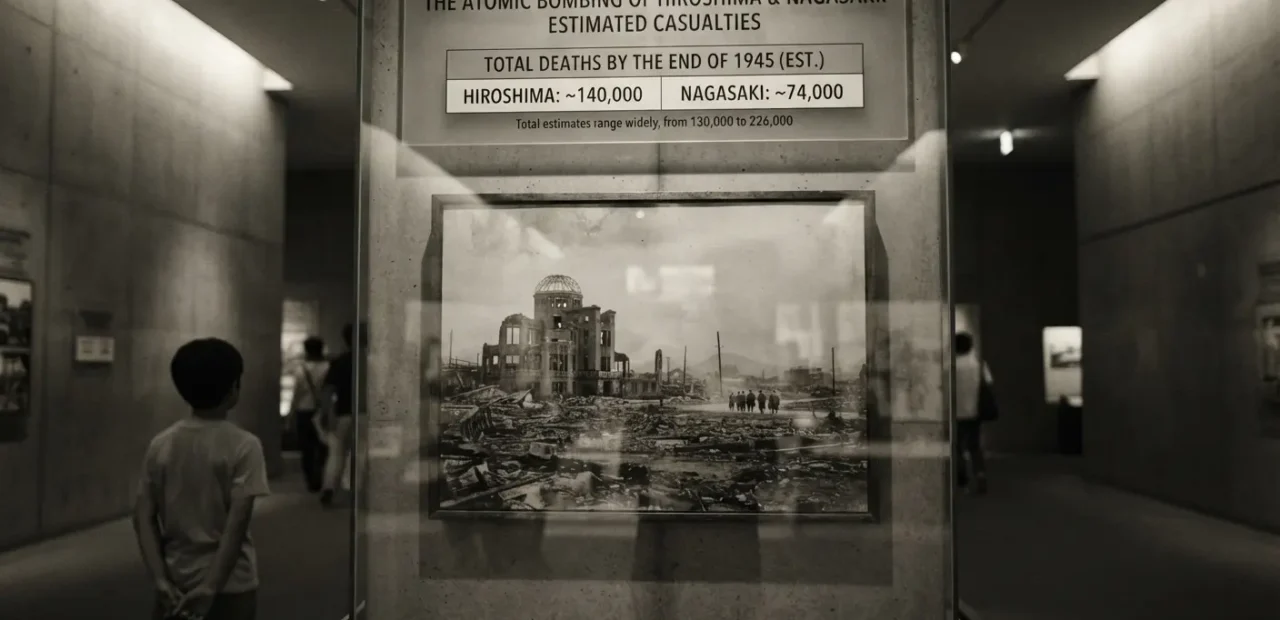
Many references use round headline figures, such as about 140,000 for Hiroshima and about 74,000 for Nagasaki. These come from a mid-range estimate in Hiroshima’s case and from a 1949 Nagasaki city committee count.
Hiroshima: Death Toll
On August 6, 1945, a US B-29 dropped a uranium bomb named “Little Boy” over Hiroshima, with an explosive yield of about 15,000 tons of TNT.
- Immediate deaths: an estimated 70,000 to 80,000 people died on the first day.
- By the end of 1945: the toll rose to between 90,000 and 166,000 as people died from burns, injuries and acute radiation sickness.
- Population: estimates of the city’s population at the time vary widely, from about 255,000 to 343,000, which is one reason the percentage killed is also uncertain.
- Damage: the blast and fires destroyed roughly 70% of the city’s buildings.
- Medical collapse: about 90% of doctors and nurses were killed or injured, and most hospitals could not function.
Nagasaki: Death Toll
On August 9, 1945, a plutonium bomb named “Fat Man” was dropped on Nagasaki, with a yield of about 21,000 tons of TNT.
- Immediate deaths: about 40,000 people were killed at once.
- By the end of 1945: estimates range from 60,000 to 80,000, with at least 30,000 more dying from injuries and radiation.
- The 1949 count: a Nagasaki city committee recorded 73,884 deaths, which is the figure often quoted.
- Damage: about 40% of the city’s buildings were destroyed or severely damaged. Hills shielded parts of the city, which is part of why the damage was smaller than the bomb’s larger yield might suggest.
Why the Numbers Vary So Much
Historians and organisations give different totals for several reasons:
- Destroyed records. Offices, hospitals and registers were wiped out, and many families and entire neighbourhoods were killed together.
- Uncertain populations. Wartime evacuations, troop movements and temporary workers meant nobody knew exactly who was in each city that morning.
- Military personnel. Some counts include soldiers stationed in or near the cities, and others do not.
- Forced labourers. Tens of thousands of Korean and other conscripted workers were in the cities. Their numbers are among the most uncertain. Estimates for Hiroshima run as high as about 30,000 Korean workers killed, although this figure is acknowledged to be very uncertain.
- Time cut-off. Some sources count deaths up to a few months after the bombing, some to the end of 1945, and others include deaths from radiation-related illness in the following years.
- Early surveys. Some early Allied and Japanese studies omitted whole groups, such as military personnel and workers who were not residents.
This is why you will see “70,000” from early US military estimates and “140,000” from later independent ones for Hiroshima. Both are real estimates, made at different times with different methods.
Long-Term Deaths and Health Effects
The figures above mostly cover the first few months. Survivors, known in Japan as hibakusha, continued to suffer and die for decades:
- Radiation sickness killed many in the weeks after the bombings.
- Cancers, including leukaemia and later solid tumours, occurred at higher rates among survivors.
- Chronic illness, scars and injuries affected many for life.
- Social discrimination was also reported against hibakusha, in areas such as marriage and employment.
Some estimates of total deaths, including later cancer and radiation-related deaths, are higher than the 1945 figures. One source gives a total of more than 230,000 when long-term effects are included. Attributing individual later deaths to the bombs is difficult, which is why most summaries stick to the 1945 totals.
How Does This Compare With Other Bombing Raids?
It is often noted that the March 9 to 10, 1945 firebombing of Tokyo caused a larger area of fire damage and greater loss of life than either atomic bombing, and is described as the deadliest single air raid in history. Estimates for Tokyo range from about 80,000 to over 100,000 deaths in a single night. The atomic bombings stand out because each was caused by a single weapon, and because of the lasting effects of radiation.
Who Were the Victims?
The victims were overwhelmingly civilians: ordinary residents, including women, children and the elderly. Estimates suggest tens of thousands of children were among the dead. Others included:
- Japanese soldiers and military personnel stationed in the cities
- Korean and other conscripted labourers
- Small numbers of foreign nationals and prisoners of war, including Allied prisoners held near the cities
Why the Bombs Were Dropped: A Brief Note
The reasons and justification for the bombings remain debated:
- Supporters argue the bombs helped end the war quickly, and that an invasion of Japan would have cost more lives on both sides.
- Critics argue Japan was already near surrender, that the bombings were unnecessary, and that they raised serious moral and legal questions, including whether they were war crimes.
Historians continue to discuss these questions, and this article focuses on what happened and the scale of the loss. A dedicated article on the decision itself would cover the debate in more detail.
Hiroshima vs Nagasaki: Key Facts Side by Side
| Hiroshima | Nagasaki | |
|---|---|---|
| Date | August 6, 1945 | August 9, 1945 |
| Bomb name | Little Boy | Fat Man |
| Bomb type | Uranium | Plutonium |
| Yield | about 15 kilotons of TNT | about 21 kilotons of TNT |
| Immediate deaths | about 70,000 to 80,000 | about 40,000 |
| Deaths by end of 1945 | 90,000 to 166,000 | 60,000 to 80,000 |
| Approx. pre-bomb population | 255,000 to 343,000 | about 195,000 to 240,000 |
Remembering the Victims
Both cities are now centres of peace remembrance. Hiroshima Peace Memorial Park and the Nagasaki Peace Park hold museums, memorials and annual ceremonies every August, and the cities’ mayors regularly call for the abolition of nuclear weapons. The names of identified victims are recorded in memorial registers, which are updated each year as deaths among survivors are confirmed.
Conclusion
The atomic bombings of Hiroshima and Nagasaki killed an estimated 150,000 to 246,000 people by the end of 1945, with Hiroshima’s toll at 90,000 to 166,000 and Nagasaki’s at 60,000 to 80,000. Roughly half died on the first day, and the rest in the following weeks and months. The true number can never be known exactly, because records were destroyed and the populations were uncertain, and many survivors died or suffered illness in later years. When you see a single figure, treat it as one estimate within this range.
FAQs
How many people died in Hiroshima and Nagasaki in total?
Estimates range from about 150,000 to 246,000 by the end of 1945. Some sources quote figures such as 214,000 or more than 230,000.
How many people died in Hiroshima?
Between 90,000 and 166,000 by the end of 1945, with roughly 70,000 to 80,000 dying immediately.
How many people died in Nagasaki?
Between 60,000 and 80,000 by the end of 1945, with about 40,000 dying immediately. A 1949 city count recorded 73,884.
How many people died instantly?
About half of the total deaths occurred on the first day, roughly 110,000 to 120,000 across both cities by common estimates.
Why are the death tolls only estimates?
Records were destroyed, population numbers were uncertain, and counts differ on whether to include soldiers, forced labourers and later deaths.
Were most victims civilians?
Yes. The large majority were civilians, including many women and children.
How many children died in Hiroshima and Nagasaki?
Some estimates suggest around 38,000 of the dead were children, though this figure is uncertain.
Did people keep dying after 1945?
Yes. Survivors (hibakusha) had higher rates of cancers and other illnesses, and some later deaths are linked to radiation exposure.
Was the Tokyo firebombing deadlier?
The March 1945 Tokyo firebombing is often described as the deadliest single air raid, with estimates of 80,000 to over 100,000 dead in one night.
What does hibakusha mean?
It is the Japanese word for the survivors of the atomic bombings, meaning “explosion-affected people.”
How many bombs were dropped?
Two: “Little Boy” on Hiroshima on August 6, 1945, and “Fat Man” on Nagasaki on August 9, 1945.
When did Japan surrender?
Emperor Hirohito announced Japan’s surrender on August 15, 1945.