
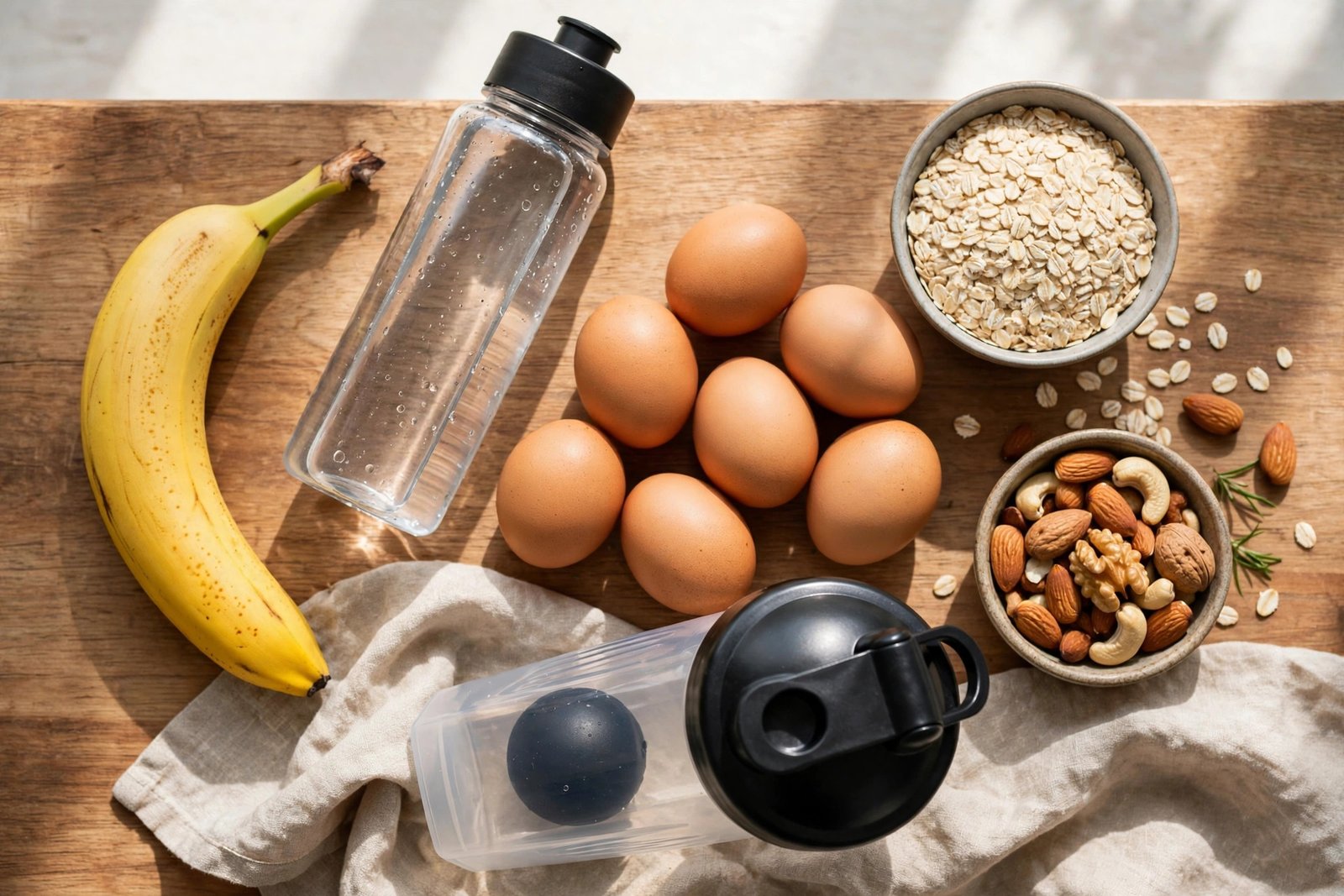
Sports nutrition is drowning in noise: supplement ads promising superhuman recovery, influencers demonising entire food groups, and “superfoods” that cost more than they deliver. The basics underneath are refreshingly simple — and now is exactly the right time to learn them, because every training session you do without fuelling properly is a session that delivers less than it should. This guide strips sports nutrition to what actually matters for beginners: energy, protein, hydration, timing, and the honest truth about supplements.
You will learn how fuelling actually works, the protein question settled with numbers, hydration strategy, pre- and post-workout eating, the supplement reality check, and how to build your personal fuelling plan.
Energy: the foundation everything rests on
Exercise runs on energy, and energy comes from food — there is no hack around this. Your body stores limited glycogen (carbohydrate) in muscles and liver, roughly 90–120 minutes’ worth of moderate exercise, plus effectively unlimited fat stores that burn slower. This is why carbohydrate availability governs performance in sessions over an hour: run out of glycogen and you “bonk” — the sudden, miserable collapse that is entirely preventable.
For beginners training under an hour, normal meals suffice — no special fuelling needed. Your regular diet already stocks the glycogen; just do not train fasted if you feel weak doing so (some people thrive fasted, most beginners do not — experiment). For longer sessions, fuelling becomes a skill: 30–60g of carbohydrate per hour for efforts of 1–2.5 hours, rising to 60–90g for longer. The practical translation: a banana (~25g carbs) per hour, or sports drink, or whatever your stomach tolerates. The cardinal rule — practised in training, never new on event day — applies to nutrition as strictly as to kit. Daily eating patterns matter as much as session fuelling: everyday foods that support gut health build the digestive resilience that heavy training demands.
Protein: how much you actually need
Protein rebuilds the muscle damaged by training — and active beginners need more than sedentary people, but far less than supplement marketing suggests. The evidence-based range: 1.2–1.6g per kilogram of bodyweight daily for endurance athletes, 1.6–2.2g for strength athletes. For a 75kg person doing general fitness: roughly 100–130g daily. That is entirely achievable from food: a chicken breast (~50g), Greek yoghurt (~20g), two eggs (~13g), lentils, milk, and nuts across the day add up fast.
Timing is overrated and total intake underrated: the “anabolic window” panic (protein within 30 minutes or gains evaporate) has been largely debunked — total daily protein distributed across 3–4 meals matters far more than precise timing. One genuinely useful habit: include 20–40g of protein in the meal after training, mostly because it anchors the day’s intake. Vegetarians and vegans need slightly more attention (combining sources for complete amino acid profiles) but no supplements as a rule. And the kidney-damage scare around high protein applies to pre-existing kidney disease, not healthy people — though megadoses beyond ~2.5g/kg offer no additional benefit and just cost money. If cholesterol is a concern alongside fitness goals, eating to lower cholesterol naturally pairs well with a protein-adequate diet.
Hydration: the performance lever beginners ignore
Dehydration of just 2% of bodyweight measurably impairs endurance, strength, and cognitive performance — and most beginners train chronically under-hydrated without realising. The strategy is simple: drink to thirst through the day (pale-yellow urine is the practical gauge), 400–600ml in the 2 hours before training, and 150–250ml every 15–20 minutes during sessions over an hour.
For sessions under 90 minutes in moderate conditions, water suffices. Beyond that — or in heat — add electrolytes: sodium is the critical one, lost heavily in sweat, and plain water on very long efforts can dangerously dilute blood sodium (hyponatraemia). Weigh yourself before and after long sessions occasionally: each kilogram lost is roughly a litre of fluid to replace, plus 1.5× for full rehydration. Post-exercise, water plus a normal meal (which contains sodium) handles most recovery needs. The fancy hydration science matters for marathoners; for beginners, the win is simply drinking enough, consistently — the most neglected performance enhancer in amateur sport.
Pre- and post-workout eating, simplified
Pre-workout (2–3 hours before): a normal balanced meal — carbohydrate-rich, moderate protein, low fat and fibre (fat and fibre slow digestion and can cause gut distress). Good options: porridge with banana, rice with chicken, toast with peanut butter. Pre-workout (30–60 minutes before): only if hungry — something small and carby: a banana, a few dates, white toast. Avoid: anything new, anything heavy, anything high-fibre.
Post-workout: eat a proper meal within a couple of hours — protein plus carbohydrate (the classic: chicken and rice, or eggs on toast, or a lentil curry). The urgency is overstated for casual training but the habit is valuable: consistent post-training eating supports recovery far more than any supplement. Daily structure beats session micromanagement: three solid meals with protein, carbohydrates matched to training volume (more on hard days, less on rest days), plenty of vegetables, and water throughout. That unglamorous pattern outperforms every “optimised” protocol followed inconsistently. The NHS Eatwell Guide remains the soundest free framework for the overall diet, and the British Dietetic Association publishes evidence-based sports nutrition fact sheets.
Supplements: the honest reality check
Of the multi-billion-pound supplement industry, a handful of products have solid evidence: creatine monohydrate (the most studied sports supplement in existence — safe, cheap, effective for strength and power, ~3–5g daily); caffeine (genuine performance enhancer — a strong coffee 45–60 minutes pre-training works as well as expensive pre-workouts); vitamin D (many UK residents are deficient, especially in winter — deficiency impairs everything); and protein powder (convenience, not magic — useful if you struggle to hit protein targets from food).
Everything else ranges from weakly evidenced to outright scams: fat burners, testosterone boosters, BCAAs (redundant if protein intake is adequate), and detox products (your liver detoxes for free). The supplement hierarchy for beginners: fix diet first, fix sleep second, consider creatine/caffeine/vitamin D third, ignore everything else. And a safety note: supplements are poorly regulated — choose third-party tested products (Informed Sport certification) to avoid contamination, which has ended athletic careers through failed drug tests. Food first, always; supplements are the final 2%, not the foundation.
Conclusion
Sports nutrition basics: fuel sessions with adequate carbohydrate, eat 1.2–2g/kg of protein daily from real food, hydrate consistently, eat proper meals around training, and treat supplements with deep scepticism beyond creatine, caffeine, and vitamin D. Now is the right time to learn this because every session from here on can be properly fuelled. Master the boring fundamentals and the marginal gains take care of themselves.
Frequently Asked Questions
Should I eat before morning workouts?
If the session is under an hour and you feel fine fasted, it is optional. For longer or harder sessions, eat something small and carby 30–60 minutes before — most beginners perform better fuelled.
Do I need protein shakes?
No — they are convenience, not necessity. If you hit your protein target from food, shakes add nothing. They are useful for people who struggle to eat enough protein, not magical.
How much water should I drink when exercising?
150–250ml every 15–20 minutes during exercise, more in heat. Day to day, drink to thirst and check urine colour — pale yellow is the target.
Are energy gels necessary?
Only for sessions over ~90 minutes. For shorter training, real food and water suffice — gels are race-day tools for long efforts, not daily requirements.


