Robbie Williams Net Worth, Biography, Age, Family and Career
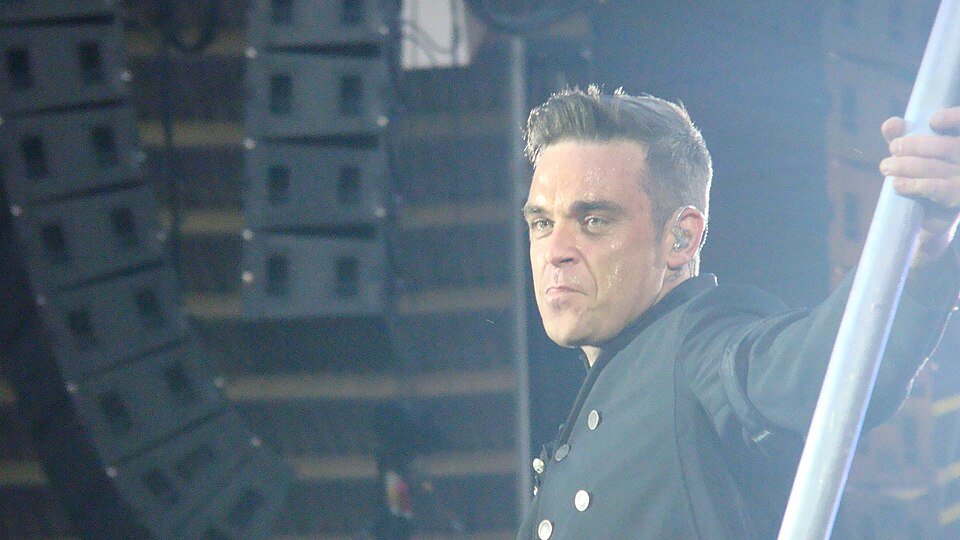
Robbie Williams is a singer and songwriter who left Take That in 1995 to become the best-selling British solo artist of his generation, with a catalogue of albums that has now produced a record sixteen UK number ones. Celebrity Net Worth estimates his net worth at $300 million. In January 2026 his album BRITPOP took him past the record he had shared with the Beatles, and in November 2026 he was performing in Australia on the tour that supports it.
Growing Up in Stoke-on-Trent, with a Comic Father
Robert Peter Williams was born on 13 February 1974 in Stoke-on-Trent, Staffordshire. His father, Peter Williams, performed as a comic and singer under the name Pete Conway and later became the licensee of a pub near Port Vale’s ground; his mother, Janet Farrell, worked in a variety of jobs, including floristry and running licensed premises, as the family circumstances changed. His parents separated when he was three, and he was raised principally by his mother in Stoke-on-Trent, attending Mill Hill Primary School and then St Margaret Ward Catholic School in Tunstall.
He performed in school productions and in amateur stage shows in the Potteries, and worked at weekends in the ordinary employments of a Stoke teenager. In 1990, at sixteen, he was selling double glazing when his mother showed him an advertisement for auditions for a new boy band being assembled by the manager Nigel Martin-Smith. He auditioned, sang a Jason Donovan song, and was taken on as the youngest and last-recruited member of the group that became Take That. He left school without qualifications; the examination route that the advertisement interrupted was never resumed, and his education, by his own cheerful account in interviews over thirty years, ended at the audition door.
Take That’s first eighteen months were spent in the gruelling circuit of schools, clubs and personal appearances that British pop management then used to build a following before chart success. The group’s breakthrough came in 1992, and by the middle of the decade Williams was one of the most recognisable young performers in Britain — and, by his own later account and those of his bandmates, increasingly unhappy inside the discipline the group’s schedule imposed.
Ayda Field and Four Children
Williams met the actress Ayda Field in 2006, on a blind date arranged by friends, and proposed to her in November 2009. They married on 7 August 2010 at his home in Los Angeles. The bank label of wife is confirmed: Field, now Ayda Field Williams, is his wife of sixteen years, and the couple renewed their vows in 2024. In November 2026 he told the Sydney audience that his wife and children had, in his word, saved his life — a reference to the addictions of his earlier career that he has discussed publicly for many years, including periods of rehabilitation in 1997 and 2007 and a sobriety he has maintained, with stated lapses and recoveries, into the present decade.
The couple have four children. Theodora Rose, known as Teddy, was born in September 2012. Charlton Valentine, known as Charlie, was born in October 2014. Colette Josephine, known as Coco, was born in September 2018 with the help of a surrogate, as was their youngest, Beau Benedict, born in February 2020; the couple spoke publicly on both occasions about a long and difficult road to completing their family. The children are kept substantially out of the public eye, appearing in their parents’ public accounts, when they appear at all, without their faces shown.
His parents’ separation when he was three is the founding fact of the family story he tells: a father whose own performing career under the name Pete Conway gave the young Williams both an example and a warning, and a mother who raised him in Stoke and recognised, in the 1990 audition advertisement, the opportunity he might not have taken himself. His father died in 2020; Williams has spoken about their reconciliation in the last years of Peter Williams’s life and about the standards repertoire they shared, which stands behind the two swing albums in his catalogue.
His Instagram account, @robbiewilliams, is run in a markedly personal register — artwork, family occasions in the protected form described in this profile, tour material and direct addresses to his audience — and has been the channel for several of his most discussed public statements, including his announcements about his health and his father’s death.
Take That, Angels and the Knebworth Nights
1990–1995: Take That
Take That became the defining British pop group of the first half of the 1990s. After early singles underperformed, a cover of It Only Takes a Minute reached the top ten in 1992, and the albums Take That & Party (1992) and Everything Changes (1993) established the group at home before Nobody Else (1995) carried them across Europe. Their singles of the period — Pray, Relight My Fire, Babe and Back for Good, the last a number one in dozens of countries — were principally sung by Gary Barlow, with Williams the group’s most conspicuous personality and its occasional lead voice, as on Everything Changes. His drinking and drug use escalated through 1994 and 1995; he was warned about his condition before a European awards performance, failed to attend rehearsals, and in July 1995, on the eve of a world tour, he left the group. Take That continued as a quartet and disbanded the following spring.
1996–1999: Freedom, Life thru a Lens and Angels
His first solo single, a cover of George Michael’s Freedom, reached number two in 1996, but the year that followed was consumed by legal dispute with his former management and label and by addiction that brought him into rehabilitation. The recovery was made on record: Life thru a Lens (1997), written largely with the producer Guy Chambers, began slowly, and its fourth single, Angels, released in December 1997, transformed it. Angels reached only number four but became the defining British pop song of its era, voted the best single of the previous twenty-five years at the 2005 Brit Awards, and the album eventually spent forty weeks in the top ten. I’ve Been Expecting You (1998) consolidated the position with Millennium, his first solo number one, No Regrets and She’s the One, a number one in 1999. At Knebworth’s smaller predecessors — the great outdoor shows at Slane Castle and elsewhere — he was by 1999 playing to audiences Take That had never reached.
2000–2005: Sing When You’re Winning, Escapology and Knebworth
Sing When You’re Winning (2000) produced Rock DJ, Supreme and Kids, his duet with Kylie Minogue. Swing When You’re Winning (2001), an album of standards recorded in tribute to the Rat Pack repertoire his father admired, included Somethin’ Stupid, a number-one duet with Nicole Kidman. In October 2002 he signed a new agreement with EMI reported at £80 million, then the largest contract in British music history; the figure was the value of a multi-album arrangement, not a payment, and it is recorded here on that basis. Escapology (2002), his last full album with Chambers, produced Feel, Come Undone and Something Beautiful. In August 2003 he played three nights at Knebworth to a combined audience of 375,000, then the largest event of its kind by a British performer. Intensive Care (2005), written with Stephen Duffy, was a more reflective record, and the accompanying world tour of 2006 sold 1.6 million tickets in a single day, a Guinness World Record.
2006–2012: Rudebox, Recovery and the Take That Reunion
Rudebox (2006), an electronic and dance-leaning album, was received by much of the British press as a failure, a verdict its million-plus sales did not entirely support, and the tour that followed ended with Williams exhausted and again in rehabilitation in 2007. Reality Killed the Video Star (2009), produced by Trevor Horn, restored his chart position — Bodies reached number two — and in 2010 the reconciliation with Take That, foreshadowed by his Brit Awards lifetime honour that February, was completed: the five-man group recorded Progress (2010), the fastest-selling British album of the century to that point, and toured it in 2011 in the largest stadium production then mounted in Britain. Williams’s own part in the reunion was warmly received, and the feud that had defined a decade of profiles was publicly closed. He left the group’s touring line-up again thereafter, on friendly terms, as family life took precedence.
2013–2019: Take the Crown, Swings and the Heavy Entertainment Show
Take the Crown (2012) returned him to number one as a solo artist, carried by Candy, his first solo number-one single in eight years. Swings Both Ways (2013) resumed the standards format and became the thousandth number-one album in British chart history. A series of three albums of outtakes and unreleased material, Under the Radar, was issued directly to his audience between 2014 and 2019. The Heavy Entertainment Show (2016) was his twelfth UK number-one album, and the stadium tour that followed it in 2017 played across Europe. In 2018 he performed at the opening ceremony of the football World Cup in Moscow, an appearance that placed him, briefly and improbably, at the centre of the largest sporting event in the world.
2020–2026: XXV and BRITPOP
XXV (2022) marked twenty-five years of his solo career with orchestral re-recordings of his best-known songs and became his fourteenth UK number-one album, equalling the solo record then held by Elvis Presley. The achievement was a prelude. His thirteenth studio album, BRITPOP — a record he described as the album he had wanted to make when he left Take That in 1995, made with guitar-band instrumentation and guests including Tony Iommi of Black Sabbath — was announced in May 2025 and released early, on 16 January 2026, three weeks ahead of schedule. It debuted at number one, his sixteenth UK number-one album, taking him past the total of fifteen he had previously shared with the Beatles and making him the artist with the most number-one albums in British chart history. The Britpop tour reached Australia in November 2026, where, at his Sydney concert, he spoke at length from the stage about his family and about wondering, at 52, how long the performing life should continue — remarks reported as affectionate rather than valedictory, with further dates still to play.
Following the Money to $300 Million
Celebrity Net Worth estimates his net worth at $300 million. Estimates derived from the Sunday Times Rich List in recent years have placed him in the region of £230 million, broadly comparable once the currencies are reconciled, and no Forbes competing total is published; the CNW figure is the lead attribution here, with the sterling estimates recorded as the nearest cross-check rather than as a contradiction. The foundations are record sales reported at more than 75 million albums worldwide, the largest British touring grosses of his era, and the EMI agreement of 2002, whose £80 million headline value, as noted in this profile, was a contract total and not income received in a single sum.
Property has been a substantial and unusually profitable part of his affairs. His London house is Woodland House in Kensington, bought in 2016 for a reported £17 million, a large detached house with extensive gardens; the upkeep of mature London gardens of that scale in dry summers is a practical education in water management, of the kind systematised for beginners in guidance on drought-resistant gardening for beginners. In Wiltshire he bought Compton Bassett House in 2009 for a reported £8.5 million and sold it about a year later on returning to Los Angeles. His American transactions were larger still: a Beverly Crest estate bought for a reported $32 million in 2015 was sold in 2022 to the rapper Drake for a reported $75 million, and a Holmby Hills estate was sold in 2024 for a reported $65 million. Gross gains on individual sales are recorded here as transaction prices, not as additions to the net-worth estimate, which already reflects his overall position as the tracker calculates it.
At 52, with the chart record outright his and a family he credits with his survival, Williams occupies a position no profile of him in 1997 would have predicted: the most successful British solo artist in chart history, performing the album he says he always intended to make, and speaking from the stage less about escape than about home.
What the Record Shows About Robbie Williams
| What the Record Shows About Robbie Williams | Details |
|---|---|
| Born | 13 February 1974, Stoke-on-Trent, Staffordshire, United Kingdom |
| Age | 52 years old |
| Height | 5 ft 11 in (1.80 m) |
| Weight | No reliable published figure exists |
| Wife | Ayda Field (married 2010) |
| Children | Four: Theodora, Charlton, Colette and Beau |
| Net Worth | Estimated $300 million (Celebrity Net Worth) |
| @robbiewilliams |