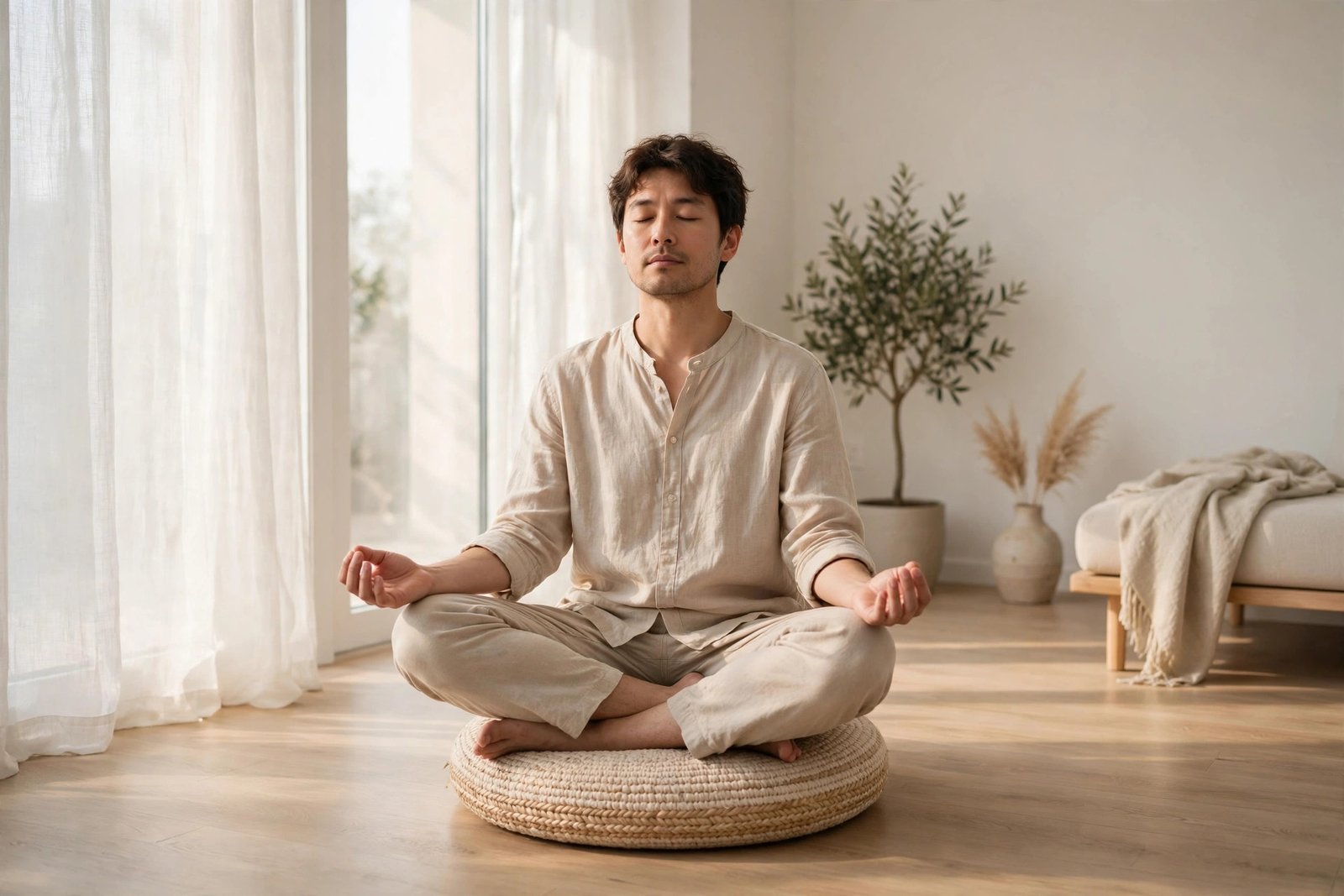
Almost everyone who tries meditation for the first time does it wrong — not because the instructions are complicated, but because the goal is misunderstood. Beginners sit down, try to “empty their mind,” discover their mind has other plans, conclude they are bad at meditating, and quit within a week. This is like trying to learn the piano by attempting a concerto on day one and quitting because your fingers would not cooperate. Learning to meditate properly means understanding what meditation actually is, why the “empty mind” idea is a myth, and how to build the skill the way it has been built for 2,500 years: gradually, with the right technique for your temperament.
What Meditation Actually Is
Meditation is attention training. That is the whole secret, and everything else is commentary. You choose an object of attention (the breath, a sound, a bodily sensation), you rest your attention on it, your mind wanders (it will, constantly — this is normal and not failure), you notice the wandering, and you gently return. Each return is one rep, the way one press-up is one rep. The wandering is not the enemy of the practice; noticing the wandering IS the practice.
This reframes the beginner’s experience completely. A “bad” meditation with fifty wanderings and fifty returns is fifty reps of the exact skill you are training. The person who sits in blissful stillness for twenty minutes got a nice rest; the person who wrestled their attention back fifty times got a workout. The struggle is the mechanism.
The Main Styles: Pick Your Door In
Mindfulness of breath (best default for beginners)
Sit comfortably, close your eyes or soften your gaze, and rest attention on the physical sensation of breathing — the air at the nostrils, or the rise and fall of the belly. When you notice you are thinking, silently note “thinking” and return to the breath. Start with 5–10 minutes. This is the most researched style (the basis of MBSR — mindfulness-based stress reduction, developed by Jon Kabat-Zinn), with the strongest evidence for anxiety and stress reduction.
Body scan (best for physical tension and sleep)
Lie down and move attention slowly through the body, from toes to crown, simply noticing sensations without trying to change them. Excellent for beginners because the moving focus gives the mind less room to spin, and superb as a pre-sleep practice. The NHS mindfulness guidance includes free body-scan audio guides.
Loving-kindness / metta (best for self-criticism and relationships)
Silently repeat phrases of goodwill — first toward yourself (“may I be happy, may I be healthy”), then a loved one, then a neutral person, then a difficult person. It feels awkward for about a week, then something shifts: research shows measurable increases in positive emotion and social connection within a few weeks of practice. Particularly powerful for people whose inner monologue is hostile.
Walking meditation (best for restless bodies)
Walk very slowly, attending to the sensations of each step — lifting, moving, placing. Ideal for people who cannot sit still, and a legitimate primary practice, not a consolation prize. Ten minutes of slow walking meditation in a garden or park counts fully.
The Beginner’s Protocol: First 30 Days
Days 1–7: 5 minutes daily, breath focus, same time and place (habit anchoring matters more than duration). Expect constant wandering; count returns, not minutes of stillness. Days 8–14: extend to 10 minutes. Add one body scan session (lying down, 15 minutes) mid-week. Days 15–21: 10–15 minutes daily. Experiment: try loving-kindness twice this week and notice the difference in flavour. Days 22–30: settle on your primary style at 15 minutes, with one longer 20-minute session on a weekend.
The non-negotiable rules: daily beats long (5 minutes daily outperforms 35 minutes weekly — consistency builds the neural pathways); same time, same place (reduces the daily “when shall I meditate?” negotiation that kills habits); never meditate to “feel calm” (some sessions will be stormy; the benefit accrues across weeks regardless of individual session quality).
What the Research Actually Shows
Honesty about the evidence: meditation is well-supported but not magic. Meta-analyses (notably Goyal et al., JAMA 2014, covering 47 trials) find moderate evidence for mindfulness meditation reducing anxiety, depression and pain — effects roughly comparable to antidepressants for mild-to-moderate anxiety, without side effects. Stress reduction effects are consistent. Claims beyond that — enlightenment in a weekend, manifesting wealth, curing serious illness — are marketing, not science.
The dose-response finding matters for beginners: benefits typically become noticeable at 8+ weeks of regular practice, which is exactly the length of standard MBSR courses. This is not a technique that pays off in three days. It is a training programme with a two-month horizon — worth knowing upfront so you do not quit at week three, right before the curve bends.
Common Beginner Traps
Trying to stop thoughts: impossible, and attempting it creates tension — the exact opposite of the goal. Thoughts are weather; you are learning to watch weather, not to stop rain. Wrong posture suffering: you do not need full lotus. A chair with feet flat and spine naturally upright is perfect. Pain is a distraction, not a credential. App-hopping: Headspace, Calm, Insight Timer and Waking Up are all fine — pick one and stay for the 30 days. Judging sessions: “good” and “bad” meditations are a misunderstanding; the only bad meditation is the one you skip. Meditating only when stressed: using meditation solely as emergency calm-down misses the point — the practice builds baseline resilience; the calm in crisis is a side effect of months of training.
If anxiety is part of what brings you to meditation, reducing anxiety without medication covers the broader toolkit, and coping with seasonal affective disorder addresses the winter-specific dimension many beginners face.
Free Resources Worth Using
You do not need to pay. The UCLA Mindful app (free) offers research-grade guided meditations. Insight Timer has thousands of free guided sessions. The Oxford Mindfulness Centre publishes free introductory materials from the programme behind much of the clinical research. Locally, many Buddhist centres and community groups offer free or donation-based introduction sessions — learning posture and technique in person for one session accelerates everything. Paid apps are convenient, not necessary.
Conclusion
Learning to meditate properly means abandoning the “empty mind” myth and embracing the real mechanism: choosing an attention object, noticing when you wander, and returning — fifty times a session if needed, because the returns are the reps. Pick one style (breath focus is the safest default), practise 5–15 minutes daily at the same time and place, expect nothing for the first month, and trust the two-month horizon the research describes. Meditation is not a relaxation hack; it is attention training with 2,500 years of field testing and a growing clinical evidence base. Start with five minutes tomorrow morning. Your wandering mind is not the obstacle. It is the gym.
Frequently Asked Questions
How long should a beginner meditate?
5–10 minutes daily for the first two weeks, building to 15–20 minutes by the end of the first month. Daily short sessions outperform occasional long ones because the skill is consistency of returning attention, which is trained by frequency.
Is it normal that I can’t stop thinking?
Completely normal — and not the goal to fix. The mind generates thoughts the way the heart beats; meditation trains you to notice thoughts without being captured by them. A session with constant wandering and constant returning is a highly productive session.
Should I use an app or meditate in silence?
Apps are excellent training wheels for the first month — guidance prevents the “am I doing this right?” anxiety. But graduate toward unguided sessions (even 10 silent minutes) within 6–8 weeks; the real skill is self-directed attention, and guidance becomes a crutch if never removed.
Can meditation help with anxiety?
Yes — mindfulness meditation has moderate-strength evidence for reducing anxiety symptoms, comparable to first-line treatments for mild-to-moderate cases. It is not a replacement for professional help with severe anxiety or trauma (where unguided meditation can occasionally be destabilising — seek guidance), but as a complement or for everyday anxiety it is among the best-supported self-help tools available. The charity Mind offers balanced guidance on mindfulness for mental health.
What is the difference between mindfulness and meditation?
Meditation is the formal practice (sitting, focusing, returning); mindfulness is the quality of present-moment awareness that the practice develops, which then infuses daily life — eating, walking, listening. You meditate to become mindful the way you train to become fit: the session builds the capacity you use everywhere else.