
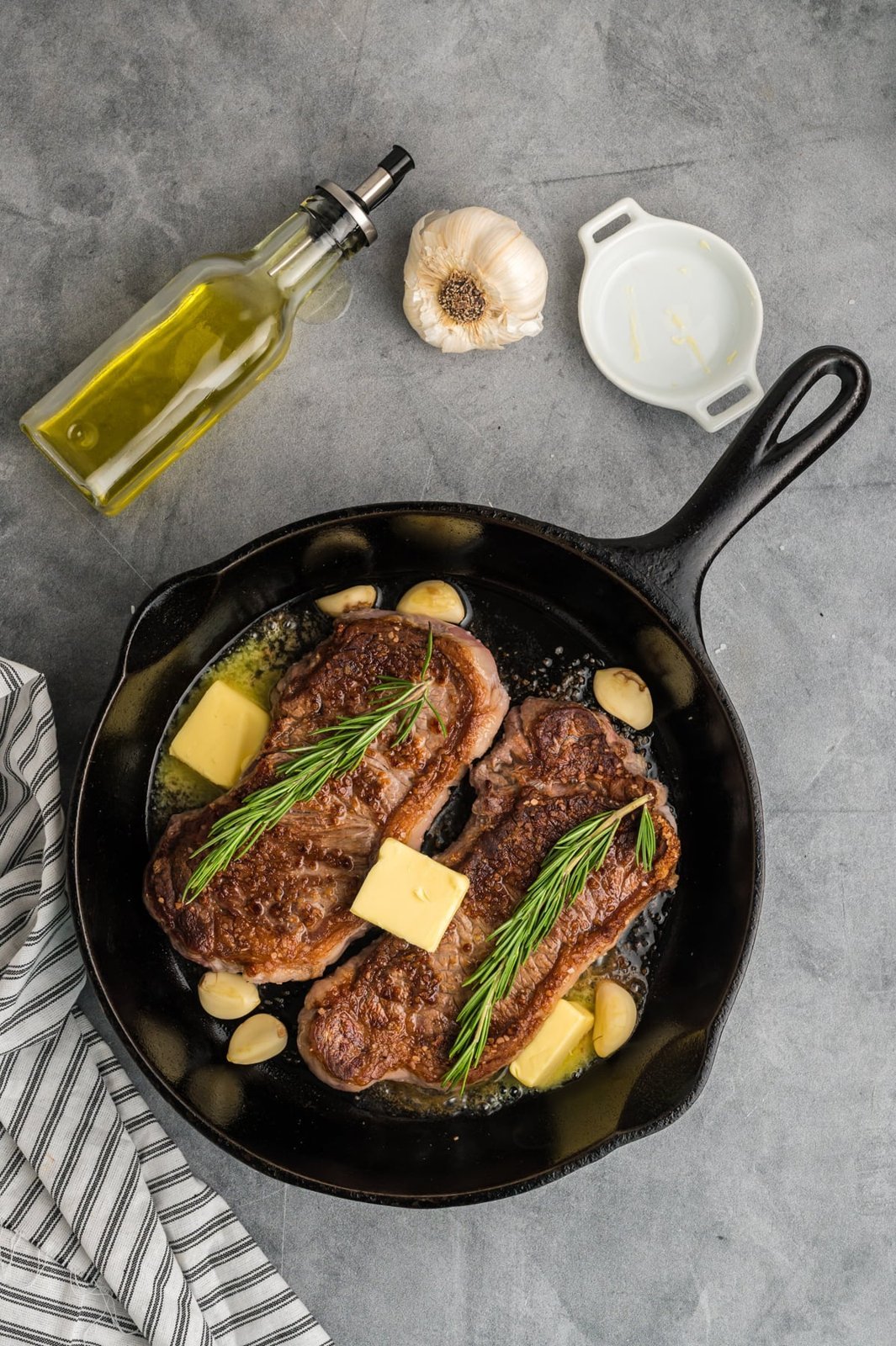
Restaurant steak has that crust — deep brown, almost charred, giving way to a pink, juicy interior. When people ask how do I cook a steak perfectly on a home hob, they want that contrast, and the good news is it’s entirely achievable: the steakhouse method translates perfectly to a domestic kitchen with one heavy pan.
I’ve cooked hundreds of steaks, ruined a fair few learning, and the method below is the synthesis of everything that works — including the counterintuitive flip-often technique that changed my steak game forever. Here’s the complete method.
How do I cook a steak perfectly on a home hob? Start with the steak
The steak matters more than the technique: buy thick — minimum 2.5cm, ideally 3–4cm. Thin steaks overcook before they can develop a crust; thickness is what allows the contrast of charred exterior and pink interior. Ribeye (marbled, flavourful, forgiving), sirloin (leaner, beefier), or fillet (tender, mild) — all work; buy the best grade you can afford and look for marbling, the white fat flecks that melt into flavour. Bring the steak to room temperature for 45–60 minutes before cooking — a fridge-cold steak cooks unevenly, grey band outside, raw centre.
Season simply and aggressively: coarse salt and cracked black pepper, generously, just before cooking. (Salting well ahead — 40+ minutes — also works via dry-brining, drawing moisture out then reabsorbing it seasoned; salting 5 minutes before is the worst option, leaving surface moisture that steams instead of sears.) Pat the steak bone-dry with kitchen paper — surface moisture is the enemy of browning, and this single step improves crust more than any fancy technique. Oil the steak, not the pan: a thin coat of high-smoke-point oil (groundnut, sunflower) on the meat itself.
- Minimum 2.5cm thick — thickness enables the crust/pink contrast
- Room temperature 45–60 minutes before cooking
- Pat bone-dry; season aggressively just before (or 40+ min before)
- Heavy pan: cast iron or thick-based stainless, smoking hot
- Oil the steak, not the pan
The sear: hot, fast, flip often
Get the heaviest pan you own — cast iron is ideal — screaming hot: it should just start to smoke. Lay the steak away from you (no oil splatter on arms), and press it down for 10 seconds for full contact. Then here’s the counterintuitive part: flip every 30–45 seconds, not once. Frequent flipping cooks the steak faster and more evenly, develops crust on both sides simultaneously, and virtually eliminates the grey overcooked band — food science (thank Harold McGee and J. Kenji López-Alt) has settled this: the single-flip dogma is wrong.
Add the flavour bomb in the last 2 minutes: a generous knob of butter, 2 crushed garlic cloves, and thyme or rosemary sprigs. Tilt the pan and baste the foaming butter over the steak continuously — 60 seconds of basting adds the nutty, aromatic richness that separates good steak from great. Total cooking time for a 3cm ribeye to medium-rare: roughly 4–5 minutes. But don’t trust time — trust temperature: 52°C for rare, 57°C medium-rare, 63°C medium, measured in the centre with an instant-read thermometer (£15, the tool that ends all steak arguments). Pull 3–5°C early; carryover cooking finishes the job.
Resting and serving
Rest the steak 5–10 minutes on a warm plate, tented loosely with foil — this is non-negotiable. Cooking drives juices toward the centre; resting lets them redistribute. Cut too soon and the juices flood the board instead of staying in the meat — the difference between a juicy steak and a dry one with a puddle. While it rests, deglaze the pan: a splash of red wine or stock, scrape up the fond, whisk in cold butter for a 60-second pan sauce that tastes like a steakhouse.
Slice against the grain (look for the lines in the meat; cut across them) for maximum tenderness — this matters enormously for sirloin and flank cuts. Serve simply: the steak is the event. Classic accompaniments — triple-cooked chips or a baked potato, watercress or a sharp green salad to cut the richness, and your pan sauce or a proper béarnaise if you’re feeling grand. And the blue-cheese butter trick for next time: mash blue cheese into soft butter, roll into a log, chill, and melt a disc over the resting steak. You’re welcome.
Cuts guide: what to buy and why
The cut determines the experience as much as the cooking. Ribeye: the flavour king — heavy marbling bastes the meat from within, forgiving of slight overcooking, the steakhouse default. Sirloin: leaner, beefier, firmer bite — needs precise temperature control (the thermometer matters most here) but rewards with deep beef flavour. Fillet: the tenderest, mildest — buttery texture, less flavour; the cut for those who prize tenderness above all, and the least forgiving of overcooking (there’s no fat to protect it).
The value cuts: rump — the flavour bargain, chewier but deeply beefy, best served rare to medium-rare and sliced thin against the grain; flat iron (the butcher’s secret — tender, marbled, half the price of ribeye, ask for it specifically); onglet/hanger — the ‘butcher’s steak’, intensely flavoured, best rare; and bavette — the thin, flavour-packed cut that takes marinades brilliantly and must be sliced thin. The buying rules: thickness over 2.5cm always, marbling over leanness for flavour, dry-aged if the budget allows (21+ days — concentrated, nutty, transformative), and a good butcher over a supermarket for anything special — the advice alone is worth it.
- Ribeye: flavour king, marbled, forgiving — the default
- Sirloin: leaner, beefier — needs precise temperature
- Fillet: tenderest, mildest — don’t overcook it
- Flat iron / onglet / bavette: the value cuts with top-tier flavour
- Buy: 2.5cm+ thick, well-marbled, dry-aged if possible
The perfect home steak
Thick steak, room temperature, bone-dry surface, screaming-hot heavy pan, flip every 30 seconds, butter-baste at the end, thermometer not guesswork, rest properly. Seven steps between you and steakhouse steak — no grill, no gadgets, just method.
For the full roast dinner context, make a proper sunday roast at home is the Sunday roast guide, and best way to marinate chicken overnight covers marinating chicken. For cut and technique guides, BBC Good Food’s recipe collection is excellent.
The steak-buying rule: the best steak is the one matched to the method — thick ribeye for the hob-sear, flat iron for the adventurous, fillet for the tenderness-obsessed. Buy well, cook by thermometer, rest properly. The steakhouse isn’t doing anything you can’t do — it just does it every day. Now you can too.


