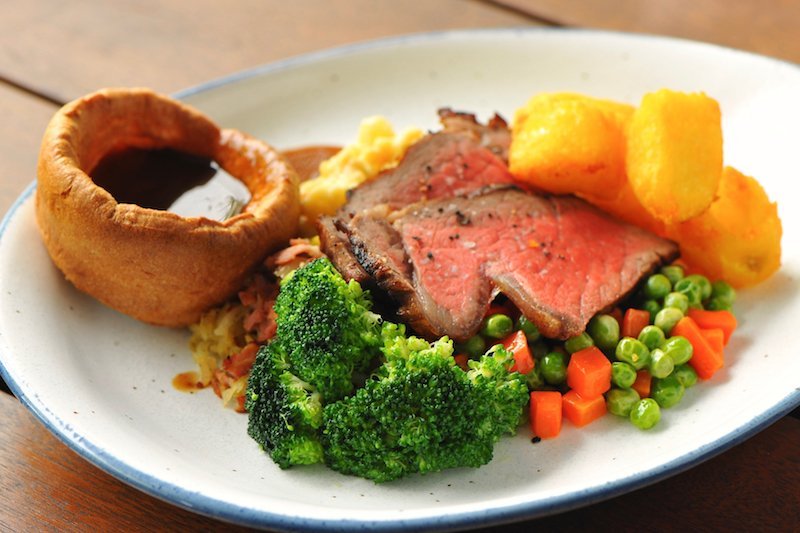
The Sunday roast is Britain’s greatest culinary institution — and its most stressful to cook. When people ask how can I make a proper sunday roast at home, what they’re really asking is how to get everything hot, crispy and ready at the same time without a meltdown.
I’ve cooked Sunday roasts for twenty years, from student-house chaos to Christmas-dinner-for-twelve, and the secret isn’t talent — it’s the backwards timing plan and a few non-negotiable techniques. Here’s the complete guide: the meat, the potatoes, the Yorkshires, the veg, and the gravy that ties it all together.
How can I make a proper Sunday roast at home? Start with the timing plan
Every roast disaster is a timing disaster. The method: decide your serving time, then work backwards. Write it down — literally, on paper, stuck to the fridge. Example for a 3pm serve with a 1.8kg chicken: 1:00 potatoes into the oven (they need the full hour+), 1:15 chicken in (90 minutes at 190°C fan), 2:30 chicken out to rest (30 minutes minimum — resting is non-negotiable, it redistributes the juices), 2:35 Yorkshires in (they need a screaming-hot oven, 220°C), 2:45 veg on (boil/steam while everything else happens), 2:55 gravy from the meat juices, 3:00 serve. The oven does temperature gymnastics; you just follow the plan.
The resting rule deserves emphasis: meat carved straight from the oven bleeds its juices onto the board instead of keeping them. Rest beef and lamb 20–30 minutes tented in foil, chicken 15–20, and the meat stays hot — internal temperature actually rises a few degrees (carryover cooking), so pull it 5°C below target. Use the resting time productively: that’s when the Yorkshires and roasties get their final blast and you make the gravy. A roast where everything’s ready at once isn’t luck; it’s a written plan.
- Pick serving time, work backwards, write the plan down
- Meat rests 20–30 min tented in foil — non-negotiable
- Potatoes need 60–75 min; Yorkshires need a 220°C oven
- Pull meat 5°C below target (carryover cooking)
- Gravy last, from the meat juices, while everything rests
The meat: choosing and cooking
Beef (sirloin or ribeye joint), lamb (leg or shoulder), pork (shoulder for crackling, loin for lean), or chicken — all work with the same principles. Buy the best you can afford; a £25 joint from the butcher outperforms a £12 supermarket one more than any technique can compensate. Bring meat to room temperature for an hour before cooking (cold meat cooks unevenly), season aggressively with salt and pepper, and sear the outside first — either in a hot pan or 15 minutes at maximum oven heat — for the Maillard crust that makes roast meat taste like roast meat.
Temperature, not time, is how you judge doneness — a £15 meat thermometer is the best roast investment you’ll ever make. Beef: 52°C rare, 57°C medium-rare, 63°C medium (pull 5°C early). Lamb leg: 58–60°C for pink. Pork: 63°C minimum, but shoulder cooked low-and-slow to 90°C+ gives pull-apart crackling magic. Chicken: 74°C in the thickest thigh part. Baste once or twice during cooking, and don’t open the oven door every ten minutes — every peek drops the temperature 15°C.
Potatoes, Yorkshires, veg and gravy
Roast potatoes: Maris Piper or King Edward, peeled and cut evenly, parboiled 8–10 minutes until the edges fluff, drained and roughed up in the colander (the fluffy edges become the crispy bits), then into smoking-hot fat — goose fat, beef dripping or vegetable oil heated in the tray for 10 minutes first. Don’t crowd the tray, turn once at 30 minutes, and give them a full hour. Yorkshires: equal volumes egg, milk and plain flour with a pinch of salt, rested 30 minutes, poured into smoking-hot oil in a muffin tin, oven at 220°C, door shut for 20 minutes — no peeking, ever.
Veg: keep it simple and seasonal — honey-glazed parsnips and carrots roasted alongside the potatoes, steamed greens (broccoli, green beans) finished with butter, cauliflower cheese if you’re feeling generous, and red cabbage braised with apple for winter. Gravy: the meat juices are liquid gold — pour off excess fat, deglaze the tray with a glass of wine or stock, scrape up every browned bit, whisk in flour (or cornflour slurry), simmer to thickness, season boldly. Bisto has its place (no shame), but real gravy from the tray takes five minutes and tastes like the roast itself, concentrated.
Vegetarian and alternative roasts worth serving
The roast isn’t only about meat — and the vegetarian options have grown up far beyond the nut roast joke (though a good nut roast, dense with mushrooms, nuts and herbs, deserves its defence). The centrepiece contenders: whole roasted cauliflower — rubbed with spiced butter or romesco, roasted whole for 60–90 minutes until deeply caramelised, carved at the table like a joint; mushroom Wellington — duxelles, spinach and chestnuts in puff pastry, as impressive as beef Wellington at half the effort; and the stuffed squash — butternut or crown prince filled with wild rice, chestnuts, cranberries and sage.
The rules for alternative roasts: they need the same ceremony — carved at the table, served with all the trimmings (the roasties, Yorkshires and gravy don’t care what’s in the middle), and they need richness — butter, nuts, cheese, pastry, the flavour carriers that make a centrepiece feel like an event. A whole cauliflower with tahini and pomegranate, surrounded by the full roast spread, satisfies vegetarians and intrigues carnivores — which is exactly what a great roast should do. And for the meat-eaters going lighter: a butterflied leg of lamb roasts in half the time, and a big piece of salmon en croûte feeds a crowd elegantly.
- Whole roasted cauliflower — the vegetarian centrepiece, carved at table
- Mushroom Wellington — impressive, half the effort of beef
- Stuffed squash with wild rice, chestnuts, cranberries
- Same ceremony: all the trimmings, carved with pride
- Butterflied lamb or salmon en croûte for lighter meat options
The proper Sunday roast
Written backwards timing plan, rested meat judged by thermometer, fluffy-edged roasties in hot fat, un-peeked Yorkshires, and gravy from the tray. It’s a project, not a recipe — but it’s the project British Sundays were made for.
For the crispiest potatoes specifically, secret to crispy roast potatoes is the deep dive, and make yorkshire puddings rise every time guarantees Yorkshire puddings that rise. For recipe inspiration, BBC Good Food’s recipe collection has the classics perfected.
The roast philosophy, meat or not: it’s the ceremony that makes it — the timing plan, the resting, the trimmings, the gravy, the table full of people. Get the ritual right and the centrepiece almost doesn’t matter. Almost. (Get the roasties right too. The roasties always matter.)