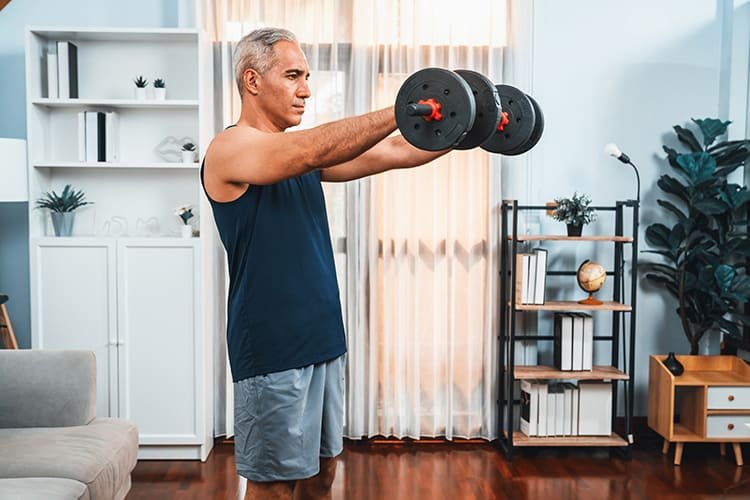
You don’t need a gym membership, a squat rack or anyone shouting “one more rep!” at you to build real muscle. Some of the strongest people I know trained exclusively in their living rooms. If you want to build muscle with home workouts and no gym, the principles are exactly the same as in any fancy fitness centre: progressive overload, enough protein, and consistency. The equipment is just cheaper.
Here’s the science in one sentence: muscles grow when they’re challenged beyond what they’re used to, then given protein and rest to rebuild bigger. That challenge can come from a £200 barbell or a £15 set of resistance bands — your muscles can’t tell the difference. What matters is that the challenge keeps increasing over time.
The home muscle-building toolkit (under £50 total)
- Resistance bands set (£10–£20). The single best home investment. Multiple resistance levels, anchor to a door, and they provide tension through the full range of motion. Start here if you buy one thing.
- A pair of adjustable dumbbells (£25–£40). For rows, presses and carries. Second-hand on Facebook Marketplace or Gumtree for half that.
- A pull-up bar (£15–£25). Doorframe-mounted, no screws. The best upper-body tool that exists — work up to it with band-assisted variations.
- Your bodyweight (free). Press-ups, squats, lunges, planks, glute bridges — the foundation everything else builds on.
- A sturdy chair and a backpack. Step-ups, dips, Bulgarian split squats; load the backpack with books for weighted carries and squats.
How to build muscle with home workouts: the programme
Three full-body sessions a week, 30–45 minutes each, with at least one rest day between. Here’s a session template:
Session A (push + legs)
- Press-ups (or knee press-ups → full → feet-raised): 3 sets of 8–15
- Bulgarian split squats (back foot on chair): 3 sets of 10 each leg
- Overhead press (bands or dumbbells): 3 sets of 10–12
- Glute bridges (progress to single-leg): 3 sets of 15
- Plank: 3 sets of 30–60 seconds
Session B (pull + legs)
- Band rows or dumbbell rows: 3 sets of 10–12
- Goblet squats (dumbbell or loaded backpack): 3 sets of 12–15
- Pull-up negatives or band pull-downs: 3 sets of 5–8
- Romanian deadlifts (dumbbells/backpack): 3 sets of 12
- Side plank: 3 sets of 30 seconds each side
Alternate A and B across your three weekly sessions. Rest 60–90 seconds between sets. The NHS exercise hub has video demonstrations of the fundamental movements if your form needs checking.
The progression rules (this is where growth happens)
- Add reps first. When you can do 3×15 comfortably, it’s time to make it harder.
- Then add difficulty. Knee press-ups → full → feet raised → backpack-weighted. Bodyweight squats → split squats → Bulgarian split squats → weighted.
- Then add load. Heavier band, heavier dumbbell, more books in the backpack.
- Track it. A notes app with date, exercise, sets and reps. If the numbers aren’t going up over weeks, neither are your muscles.
- Deload every 6–8 weeks. One easy week at half volume. Your joints will thank you and you’ll come back stronger.
Eat and recover like you mean it
- Protein: 1.6–2.2g per kg of body weight daily. For a 75kg person that’s 120–165g. Our guide to vegetarian protein sources shows how achievable this is even without meat — and meat-eaters have it easier still.
- Eat enough overall. Building muscle in a steep calorie deficit is brutally hard. Aim for roughly maintenance calories or a small surplus (+200–300).
- Sleep 7–9 hours. Growth hormone does its best work during deep sleep. Training hard on five hours is spinning your wheels.
- Rest days are growth days. Muscles rebuild between sessions, not during them. Three hard sessions beat six mediocre ones.
If you’re over 50 and starting out, read our low impact workout guide first for the joint-friendly approach, and timing your workouts can help if fat loss is part of the goal.
The 12-week home muscle plan: what progress looks like
Muscle building rewards patience and punishes programme-hopping. Here’s a realistic 12-week framework using nothing but bodyweight, bands and household items.
Weeks 1–4: learn the movements. Three full-body sessions a week, 30–40 minutes. Press-ups (hands on a raised surface if needed), bodyweight squats, glute bridges, band rows, dead bugs, plank. Two to three sets of 8–12 reps each, resting 60–90 seconds. The goal isn’t exhaustion — it’s clean form and consistency. Expect mild soreness for the first two weeks (normal), then your body adapts. Take a “before” photo and measurements now; you’ll want them in week 12.
Weeks 5–8: add volume and difficulty. Same exercises, harder versions: full press-ups, split squats, single-leg glute bridges, slower tempos (3 seconds down on every rep — this alone transforms bodyweight training). Add a fourth set to the main lifts. Sessions stretch to 45 minutes. This is where most people quit because the novelty fades — having the routine written down and scheduled like an appointment is what carries you through.
Weeks 9–12: progressive overload, properly. By now you need a progression system: backpack-weighted press-ups and squats (books work), band-resisted everything, single-leg variations, reduced rest periods. Aim to beat last week’s numbers slightly — one more rep, a slower tempo, a harder variation. Track it in a notebook or phone app; “did I do more than last time?” is the entire science of muscle growth.
The nutrition non-negotiables: protein at 1.6–2.2g per kg body weight daily (the muscle-building range with the strongest evidence), spread across 3–4 meals; a slight calorie surplus or at least maintenance — you cannot build significant muscle in a steep deficit; creatine monohydrate (3–5g daily, £10 for months’ supply) is the most evidence-backed supplement in existence and worth considering; sleep 7+ hours, because growth hormone does its work overnight.
Realistic expectations: beginners can gain 1–2kg of muscle in 12 weeks with consistent training and eating. It won’t look dramatic in the mirror at week 6 — muscle building is a slow compounding process. But at week 12, comparing photos and strength numbers, the change is unmistakable. That’s the point where it becomes self-sustaining: visible progress is the best motivation there is.
Your takeaway: consistency beats equipment
To build muscle with home workouts, train three times weekly with progressive bodyweight and band exercises, eat 1.6–2.2g of protein per kilo, sleep properly, and track your numbers. In 12 weeks of consistent work, the mirror will tell you everything you need to know — no gym required.