Heat escaping through your walls, roof and floors is money escaping through your walls, roof and floors — the average uninsulated UK home loses around a third of its heat through the walls and a quarter through the roof. Insulation is the least glamorous home improvement imaginable: invisible, unphotogenic, impossible to show off at dinner parties. It is also the highest-return fabric investment most homes can make, with paybacks measured in years and comfort improvements felt the first evening. The question is how long the whole thing takes — from decision to cosy — when you’re doing it cheaply. This guide gives you the real timeline.
The Priority Order: What to Insulate First
Insulation follows a strict ROI hierarchy. Do it in this order and every pound works hardest:
- Loft (attic): cheapest, fastest, highest return. Topping up to 270mm costs £300–£600 professionally (£100–£200 DIY) and saves ~£200–£300 a year. The undisputed first move.
- Cavity walls: for the ~70% of UK homes with unfilled cavities — £500–£1,200, saving ~£200–£350 a year. Injected in a day.
- Floors: suspended timber floors (common in pre-1930s homes) lose 10–15% of heat — underfloor insulation £500–£1,000 DIY-able. Solid floors are harder (digging up = expensive; skip unless renovating anyway).
- Solid walls: internal or external wall insulation for pre-1920s solid-wall homes — £5,000–£15,000, the big one, with 5–15 year paybacks. The “cheaply” route here is doing it room-by-room during redecoration.
- Draught-proofing throughout: technically not insulation but inseparable — £100–£200 of materials, immediate comfort gain.
The Timeline: Decision to Cosy
Week 1: Assessment (2–3 hours of your time)
Check your EPC for the recommended measures. Physically inspect: loft hatch (is there 270mm of insulation, or the sad 50mm of 1985?), walls (brick pattern — stretcher bond usually means cavity, header-stretcher Flemish/English bond usually means solid; or check wall thickness at a window — ~260mm+ suggests cavity), floors (lift a corner of carpet — floorboards or concrete?). Get two quotes for the professional jobs (cavity wall, external wall). Call Home Energy Scotland (0808 808 2282) or check ECO4/Warmer Homes eligibility — the government’s Simple Energy Advice service also gives tailored recommendations by postcode — free measures change the maths entirely.
Weeks 2–3: The DIY wins (one weekend each)
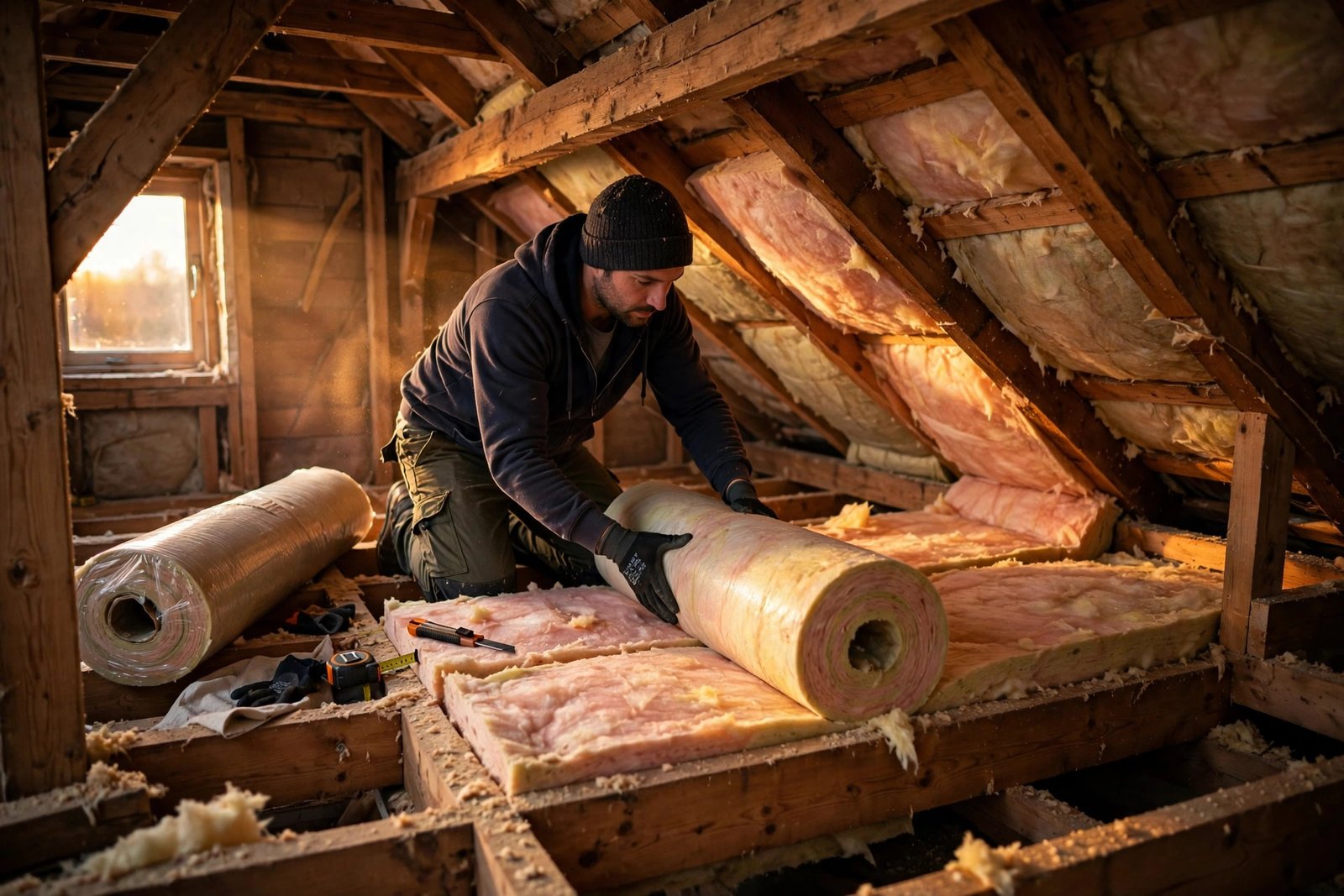
Loft top-up (1 day): rolls of mineral wool (£5–£8/m²) laid between and across joists — genuinely a one-day job for an average loft, no specialist skills. Keep insulation clear of eaves (ventilation gap) and don’t squash it (compressed insulation insulates poorly). Draught-proofing blitz (1 day): brush strips, sealant, chimney balloon, letterbox cover — the full sweep. Pipe and tank insulation (half day): foam pipe lagging (£1–£2/m) on hot pipes, cylinder jacket (£20–£30). By end of week 3, the cheap measures are done and the house already feels different.
Weeks 4–8: The professional jobs (days of work, weeks of scheduling)
Cavity wall insulation (1 day of work): the install itself is a single day — small holes drilled, insulation blown in, holes made good. The lead time is the variable: 2–6 weeks from quote to install depending on demand and the required pre-survey (borescope check that cavities are clear and suitable — essential; unsuitable cavities, e.g., exposed locations or rubble-filled, must not be filled). Underfloor insulation (1–2 days): for suspended floors, fitted from below (cellar/crawl space) or above (floorboards up — coordinate with redecoration).
Months 3–12: The big one (solid wall insulation, if needed)
Internal wall insulation (IWI): applied room by room — each room takes 3–5 days (fitter) plus redecoration. The cheap route is doing it during planned redecoration — the marginal cost of insulated plasterboard over standard is modest when the room is already being stripped. External wall insulation (EWI): 1–2 weeks of scaffolding and rendering, £8,000–£15,000 — rarely “cheap,” but ECO4 and Scottish schemes fund it for eligible households. Plan EWI around other exterior work (re-rendering, re-roofing) to share scaffolding costs.
The Cheaply Playbook: Minimising Cost at Each Stage
- DIY what is safe to DIY: loft insulation, draught-proofing, pipe lagging, radiator reflectors — all genuinely DIY-able, saving 50–70% over professional quotes.
- Never DIY: cavity wall fill (needs certified installers and guarantees — cowboy cavity fill causes damp disasters), electrics-adjacent work, anything structural.
- Grants first: ECO4 (England/Wales, supplier-funded, for low-income/vulnerable), Warmer Homes Scotland, Home Energy Scotland interest-free loans — check before paying for anything. A surprising number of households qualify for free cavity and loft insulation.
- Bundle: scaffolding shared between EWI and roof work; floor insulation done when floors are up for other reasons; IWI done during redecoration.
- Secondhand materials: insulation offcuts on Marketplace/Freegle — common from extension projects, often free.
For the bill-focused companion view, reducing heating bills this winter covers the behavioural half, and cutting small-business energy bills extends the logic commercially.
When You’ll Feel It: The Results Timeline
Immediately: draught-proofing — the end of cold draughts across ankles and necks, felt the same evening. First cold snap: loft insulation — rooms hold heat noticeably longer; the heating cycles less. First quarter: the bills — compare like-for-like quarters (degree-day adjusted if you’re keen) and the savings show: typically £300–£600/year for the full cheap package. First winter: the comfort transformation — even temperatures, no cold spots, the thermostat 1–2°C lower for the same comfort. Years 2–5: full payback on the DIY/professional cheap measures; the house is quieter too (insulation dampens sound — the unadvertised bonus).
Conclusion
Insulating your home cheaply takes one weekend for the DIY wins (loft top-up, draught-proofing — immediate comfort gain), 4–8 weeks including scheduling for cavity wall insulation (the single best professional value), and months only for solid-wall insulation done room-by-room during redecoration. Total cheap-package cost: £500–£1,500 DIY-heavy (£0 with grants), saving £300–£600 a year with paybacks of 2–5 years — plus the comfort dividend that no spreadsheet captures. Start with the loft hatch inspection this weekend. The insulation is up there waiting; the heat is currently going through it.
Frequently Asked Questions
Can I install loft insulation myself?
Yes — it’s among the most DIY-friendly home improvements: unroll mineral wool between joists (100mm) then across (170mm) for 270mm total, wearing mask, gloves and eye protection. Keep eaves ventilated, don’t cover downlights (use fire-rated covers), and board a walkway rather than compressing insulation under stored boxes.
Is cavity wall insulation risky?
Done properly by certified installers after a borescope survey: very low risk, high reward. Done badly (filled unsuitable cavities — exposed elevations, rubble, existing damp): it can cause damp bridging. The safeguards are the pre-survey, the 25-year CIGA guarantee from registered installers, and never using uncertified operators. The horror stories are nearly all uncertified work.
How do I know if my walls have cavities?
Age is the best guide: pre-1920 mostly solid; 1920s–1980s mostly cavity (unfilled); post-1980s usually filled at build. Check brick pattern (uniform stretcher = cavity likely) and wall thickness at windows/doors (~260mm+ suggests cavity). A borescope survey (£50–£100, often free with quotes) gives certainty.
What grants are available for insulation?
ECO4 (England/Wales) can fund loft, cavity and solid-wall insulation for eligible low-income/vulnerable households via energy suppliers; Warmer Homes Scotland offers similar; Home Energy Scotland provides interest-free loans. Eligibility is broader than many assume — check before paying. The Energy Saving Trust maintains current scheme listings.
Does insulation help in summer too?
Yes — insulation slows heat transfer both ways, keeping homes cooler in heatwaves (increasingly valuable as UK summers warm). Loft insulation is particularly effective against summer overheating from the roof. Combined with night-time ventilation (cool air in, hot air out), an insulated home rides heatwaves far better.