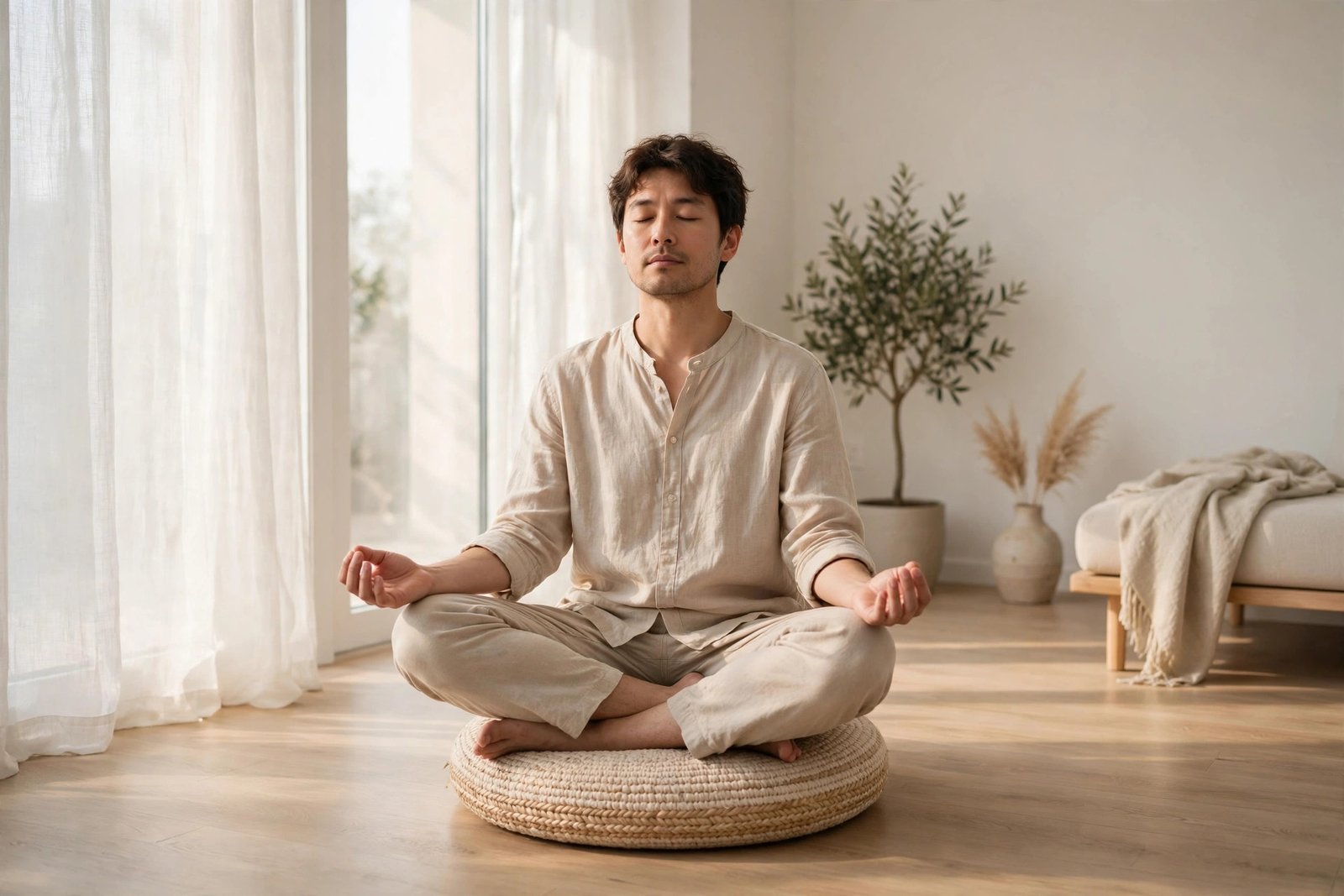
Quiet attention grows through returning, again and again, to one simple focus.
Meditation is often pictured as an empty mind in perfect stillness, and that picture discourages almost everyone who tries it. A beginner sits down, thinks about shopping, work and an old argument within moments, and concludes that the whole practice must belong to calmer people. The misunderstanding sits in the picture itself. Meditation trains attention the way physical training strengthens a muscle: through repeated, ordinary effort. The wandering is not the failure of the exercise. Noticing and returning is the exercise, performed again and again.
Phase One: Choosing Where Attention Will Rest
Every session begins with a home base, a place where attention is invited to rest. The breath is the classic choice because it is always present, gently changing and easy to sense without special equipment. Some people follow the coolness at the nostrils, others the gentle movement of the belly or chest. Bodily sensation offers another base: the weight of the body on a chair, warmth in the hands, or sounds arriving and fading in the room. Choosing one base for a sitting keeps the practice simple and gives the returning somewhere clear to return to.
Posture supports the choice more than it decorates it. Sit in a way that feels upright, stable and reasonably comfortable, on a chair, cushion or bench, with no need for elaborate positions that quickly become a distraction of their own. Eyes may rest softly open or closed, depending on light, setting and personal comfort. Anyone who has fiddled with digital tools will recognise the value of a clean workspace, and even removing reference images in Krita software follows the same principle as this opening phase: clear the surroundings, settle on one focus, and let everything else wait outside the frame for a while.
Keep the chosen base for the whole sitting, even when a different sensation seems more interesting halfway through. Chasing novelty is simply wandering dressed as curiosity. A modest session, honestly kept, teaches more than an ambitious session abandoned in frustration. Decide the length beforehand using a gentle timer if that helps, then honour the decision without negotiation. With the base chosen and the body settled, the real work of noticing can begin.
Phase Two: Noticing Drift Without Harsh Self Judgement
Drift arrives quickly and wears many costumes. Planning dresses as productivity, replaying conversations dresses as learning from mistakes, and daydreaming dresses as rest. Beneath the costumes, the pattern is identical: attention has left the chosen base and followed a thought into its story. The moment of noticing that shift is the most valuable moment in the whole practice. It is the instant where automatic following becomes conscious seeing, and it deserves recognition rather than scolding. A returning meditator has not failed; a returning meditator has just completed the central movement successfully.
Judgement, though, loves to follow noticing through the door. An inner commentator may declare the session ruined, the mind unusually hopeless or the method unsuited to such a restless temperament. Treat those declarations as thoughts too, because that is exactly what they are. Labelling the drift softly, with a word such as thinking, remembering or planning, can loosen its grip without starting an argument with it. Then attention is free to move. Writers surveying meditation practices for training attention and awareness describe this noticing and returning cycle as the shared engine beneath many different traditions and styles, however varied their outer clothing may appear.
Some sittings feel stormy from beginning to end, with attention pulled away constantly and calm nowhere in sight. Those sittings still count, and in one sense they offer the richest training ground of all, because each drift provides another chance to notice and practise the return. A still sitting, by contrast, may offer fewer repetitions and occasionally turns out to have been light sleep wearing a respectable disguise. Measuring a session by its calmness therefore misleads. Measure it instead by honesty: attention wandered, wandering was seen, and the seeing was met with patience rather than abuse.
Phase Three: Returning Gently and Beginning Again
The return itself should be plain and kind. Once drift has been noticed and softly labelled, guide attention back to the breath, the body or the chosen sound, without replaying where it went or demanding to know why. Curiosity about the wandering can wait until after the sitting, and often loses its urgency entirely by then. Begin again as if the return were the first moment of the session, because in practical terms it is. Fresh starts are not a consolation prize inside meditation; they are the method, repeated until beginning again feels ordinary.
Force spoils the movement. Dragging attention back with clenched effort creates a wrestling match, and the mind responds to wrestling by pushing harder. A lighter touch works better: acknowledge, release, return. Some teachers compare the motion to guiding a puppy back onto a path, firmly, repeatedly and without anger at the puppy for being young. The comparison holds because repetition is guaranteed. Attention will wander during the next sitting, and the one after that, for experienced practitioners as well as beginners. Skill shows not in preventing the wandering but in shortening the absence and softening the homecoming.
Breathing can help the return when the mind feels especially tangled. Following one full breath closely, from its beginning through its natural pause to its end, gives attention a short complete journey to travel. If thoughts crowd in during that single breath, simply start the next one with the same care. Over a sitting, these small renewals accumulate into a steadier quality, not a forced silence but a friendlier relationship with whatever passes through.
Phase Four: Trying Different Styles With Curiosity
Once the basic cycle of focus, drift and return feels familiar, other styles can be explored one at a time. A body scan moves attention slowly through regions of the body, noticing warmth, tingling, pressure or numbness without demanding that any of it change. The scan suits people whose minds race at night or who carry tension unnoticed in the shoulders, jaw and hands. Walking practice takes the same attention outdoors or along a hallway, resting it on the sensations of lifting, moving and placing each foot at an unhurried pace, which suits restless temperaments that stiffen when asked to sit.
Kindly phrases offer another direction. Silently wishing safety, health and ease for oneself, then for a benefactor, a neutral person and eventually a difficult one, trains the emotional tone of attention rather than its narrowness. The phrases are not spells and their wording matters less than the sincere intention behind them. Descriptions of mindfulness as present moment awareness explained in plain terms stress this non judgemental quality: experience is noticed as it is, whether pleasant, unpleasant or neutral, without an immediate campaign to fix, chase or banish it. Each style adjusts the balance between focus and openness.
Curiosity should govern the exploring, while restlessness should not. Swapping styles every few days because a sitting felt dull usually means the styles never get a fair trial, since early sittings with any approach feel clumsy. Give each approach a settled run of ordinary days, note honestly how attention behaved, and keep the comparison kind. Some people settle permanently on the breath, others rotate between sitting and walking with the seasons, and both outcomes are respectable. The style is a vehicle. What matters is whether attention is being trained inside it, returning patiently whenever it wanders away.
Phase Five: Anchoring Practice to Daily Routine
A practice that floats unattached through the day tends to sink beneath errands, messages and fatigue. Anchoring it to an existing routine gives it shelter: after washing in the morning, before the first screen of the day, following a midday walk, or as the final quiet act before sleep. The anchor matters more than the hour itself, because anchors survive busy weeks better than intentions do. Choose a time when interruption is unlikely and the body is neither stuffed with food nor desperate for rest, then guard that small appointment as seriously as any other commitment.
Place helps memory as much as timing does. Sitting in the same chair, cushion or corner teaches the body to settle faster, because the surroundings themselves become part of the cue. Keep whatever is needed within reach so preparation never becomes a project: a cushion that lives in its spot, a timer already charged, a door that can be closed. Short sittings, honestly kept every day, build the habit more reliably than occasional long heroic efforts that leave the sitter drained and reluctant. The habit grows through rhythm and familiarity, quietly compounding like any other form of regular training.
Missed days deserve a practical response rather than a dramatic one. A broken streak is information, usually about timing, workload or an anchor that never fitted real life in the first place. Adjust the anchor, shorten the sitting if needed, and resume at the next ordinary opportunity without doubling later sessions as punishment. The goal is a practice woven into life as it is actually lived, among ordinary interruptions and ordinary tired evenings.
Phase Six: Letting Sessions Vary Without Quitting
Maturity in practice looks less like permanent calm and more like flexibility. Some sittings feel spacious, some feel like supervising a busy station, and many feel entirely unremarkable. All three kinds belong to a living practice, because the mind brings its weather with it: grief, excitement, illness, deadlines and joy all colour attention. Expecting identical sessions sets a trap that ordinary variation will spring sooner or later. Letting sessions vary, while continuing to sit down for them, is how the practice survives real life instead of requiring life to become a retreat first.
Common traps are worth naming plainly. Fighting thoughts turns meditation into an argument the sitter always loses. Enduring painful posture confuses discomfort with virtue and can injure knees, backs and patience alike. Grading every sitting feeds the very self judgement the practice is meant to soften, and chasing special experiences turns quiet attention into another shopping trip. Practising only when already overwhelmed makes learning harder, rather as learning to swim during a storm would. Seeing these traps clearly, and stepping around them with a little humour, protects the long road better than intensity ever will.
In the end, the measure of the practice is not what happens on the cushion but what quietly changes around it: a pause before replying, a breath taken in a queue, a moment of anger noticed before it becomes a sentence. Those small transfers show attention training doing its work in the wild. Keep the focus simple, return without bitterness, vary the style with patience and let ordinary days count. Quiet attention is not seized in a single breakthrough. It grows the way it is practised, through returning, again and again, with as much gentleness as can honestly be managed.