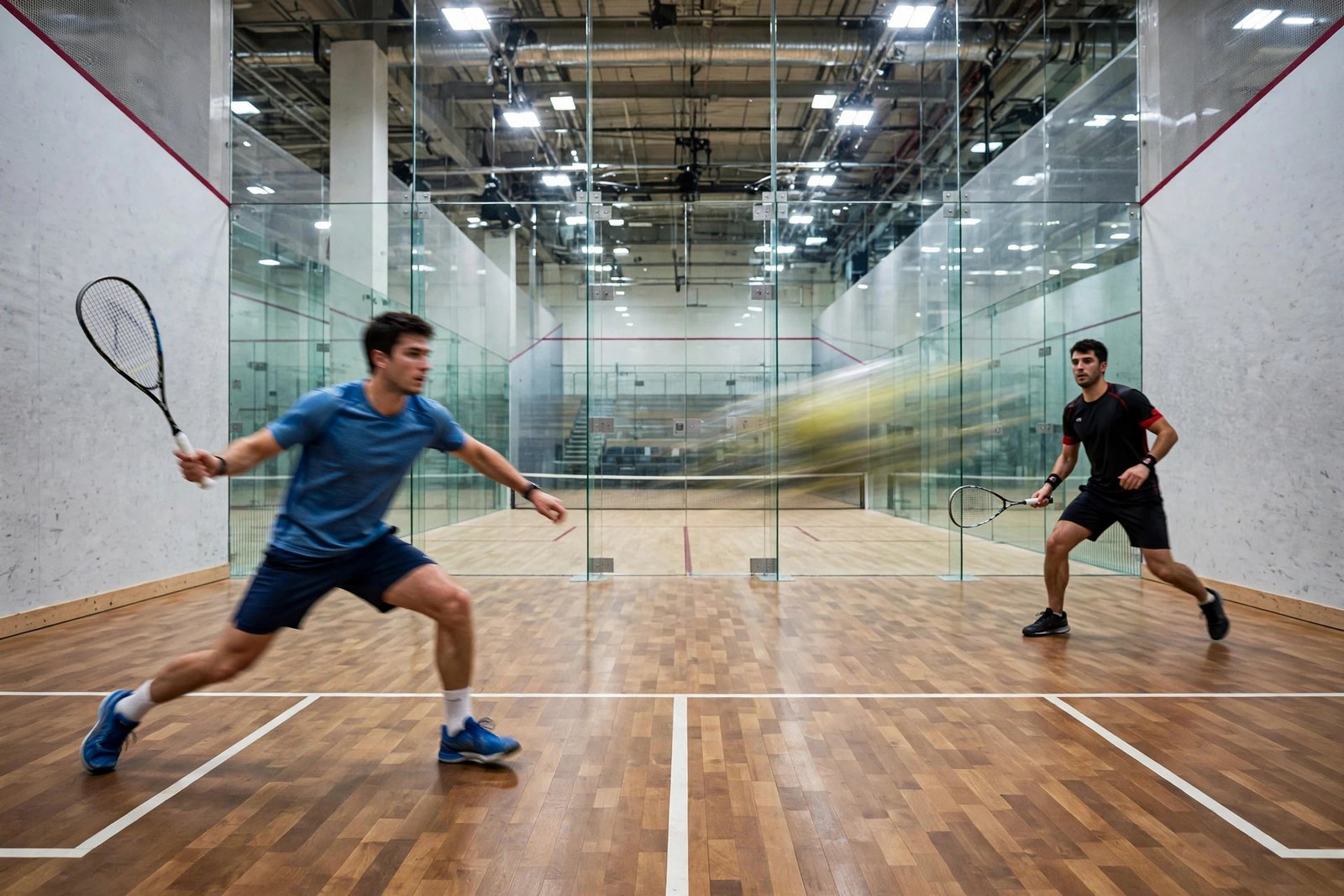
New squash players often spend their early sessions chasing spectacular shots while the ball keeps sailing past, when steadier habits would win rallies far sooner.
Squash punishes flashy beginnings kindly but firmly. The court is small, the ball is quick, and rallies reward whoever controls position and watches properly. Most beginner frustration traces back to a handful of correctable habits rather than any lack of athletic gift. Work through those habits in order — ball choice, swing size, watching, positioning, shot selection and warming up — and rallies lengthen quickly. Points follow lengthened rallies, because opponents at every level eventually miss when they are made to keep playing.
Grabbing the slow ball meant for experts
The mistake begins in the sports shop or the club cupboard, where a beginner picks up the slowest, deadest ball because it looks like the serious option. That ball barely bounces when cold, skids low, and demands a hard, precise swing just to reach the front wall. Rallies die after a shot or two. Both players spend the session fetching rather than playing, technique collapses into swiping, and the sport feels far harder than it actually is.
The correct way is almost embarrassingly simple: choose a livelier ball made for slower, developing play. It bounces higher, stays warm more easily and gives you time to set your feet and swing in balance. Families weighing starter equipment face the same logic as anyone choosing music lessons for children thoughtfully: the beginner version is not a lesser version, it is the version designed for learning, and confidence grows quickly when early attempts succeed often enough to hold attention.
Warm the ball properly at the start of every session with gentle rallies down the middle, and replace balls that have gone shiny or split. Background reading in squash rules courts and play describes a racket game for two or four players in a four-walled court with a small hollow rubber ball, and that bounce shapes the whole geometry of a rally. Graduate to slower balls only when your rallies stay long and your swing stays controlled without extra effort.
Swinging big when compact strokes work better
New players often swing as if the front wall owes them money. The racket sweeps in a huge arc, the wrist flaps, the shoulder rises, and the ball sprays wherever timing happens to send it. Big swings also recover slowly, leaving you stranded while the return passes. In a confined court, that wind-up is doubly costly: your opponent reads it early, and your partner in doubles has every reason to duck.
Compact strokes fix almost everything at once. Prepare the racket early, keep the swing short, hold the wrist firm, and strike through the ball with a controlled follow-through towards your target. Think of pushing the ball firmly rather than swatting it. Power in squash comes largely from timing, body rotation and the ball’s own pace, not from arm violence. Practise against the front wall alone, aiming for rhythm: same preparation, same contact point, same smooth recovery, repeated until calm becomes automatic.
A short beginner course or a few lessons pay for themselves here, because grip and swing faults harden quickly when practised alone for months. A coach watching your forehand for ten minutes can spot a thumb in the wrong place or a racket face opening at contact. Correct those details early and solo practice becomes productive instead of repetitive error. Film a short rally on a phone if you can; the difference between the swing you feel and the swing you make is often startling, and seeing it once teaches faster than hearing it described repeatedly.
Finding people to play deserves attention in Durham, because squash improves fastest against varied opponents rather than a single familiar partner whose habits you memorise. Club nights, internal leagues graded by standard and beginner social sessions all supply that variety, and clubs generally welcome newcomers warmly since every club needs fresh players. University facilities often open courts to the public at quieter hours, which suits learners wanting relaxed practice without an audience. Introduce yourself, be honest about your level, and accept invitations to play slightly stronger opponents occasionally; you will lose, learn the geometry of better length, and discover how much time good positioning appears to create.
Watching the opponent instead of the ball
Beginners stare at the opponent, the front wall, or the spot where they hope the ball will be, and then react late when it arrives somewhere else entirely. Squash is unusual because the ball spends time travelling away from you and behind you. If you stop watching it, you lose the information needed to move early: its height off the back wall, its pace, and whether it will bounce kindly into your hitting zone or die awkwardly in a corner.
Build the habit of turning your head and keeping eyes on the ball until it reaches your racket, even glancing back over your shoulder as it passes you towards the rear wall. Experienced players seem to have extra time largely because they gather this information early and start moving before the bounce. Watch your opponent only through awareness of where they stand, not by fixing your gaze on them while the rally is live.
Understanding racket design across court sports helps a little with grip and balance, but no equipment compensates for losing sight of the ball. Solo drills train watching as well as hitting: boast the ball to yourself, track it around the angles, and call its target aloud before striking. In games, give yourself one simple intention per session, such as watching every back-wall rebound all the way onto your strings. Rallies feel slower within weeks, not because the ball slowed, but because your information arrived sooner.
Standing wherever the last shot finished
After hitting, beginners tend to admire their shot from wherever they struck it, which is usually a corner, a side wall, or deep at the back. The opponent then plays into the wide open middle and the rally ends. Squash is governed by position: whoever controls the central area, just behind the short line, reaches most balls in the fewest steps and chooses where the next shot goes.
Make returning towards that central base an automatic part of every stroke. Hit, recover, rebalance, and be ready to move in any direction before your opponent contacts the ball. Recovery steps should be quick and light rather than a flat-footed walk back while watching hopefully. If your shot pins the opponent deep, your base can edge forwards slightly; if you are stretched defensively, recover with even more urgency, because a loose return is coming to punish hesitation.
Movement patterns deserve practice away from matches. Ghosting — moving to corners and back to base without a ball — looks strange and builds exactly the footwork rallies demand. Keep it short, smooth and balanced rather than lunging wildly. Good positioning also keeps you safe and courteous: a player returning to base gives the opponent room to play, while a player lingering in the swing path causes lets, collisions and arguments that spoil the enclosed court’s etiquette.
Hunting winners instead of playing deep
The scoreboard tempts beginners into heroics. Down a few points, they aim for nicks, attempt volley kills from impossible positions, and try to end rallies that patience would have won two shots later. Most points at beginner level end through error, not brilliance. The player who sends the ball deep, tight to a side wall and safely above the tin collects those errors like rent.
Deep length is the beginner’s best attacking weapon. A straight drive that passes your opponent and dies towards the back corners forces weak boasts, awkward back-wall attempts and rushed returns from poor balance. Cross-courts that land deep and wide open the court without flirting with the tin. Once an opponent is pinned behind you, a shorter ball becomes genuinely dangerous, because they must sprint forwards from a deep position rather than stepping onto a ball served up invitingly.
Shot selection improves when you judge by your own position first. Balanced and in front? You may choose. Stretched and late? Play safe height and depth, recover, and live for the next shot. Coaches call this respecting the rally, and it transforms scoring: fewer tins, fewer gifts, longer pressure. Winners still happen in squash, but at this level they usually arrive as the final touch on a rally your depth and patience had already decided.
Etiquette and safety weave through every beginner habit discussed so far, and they deserve naming plainly. Call your own faults honestly, get out of an opponent’s swing path, and stop play whenever a stray ball or a body blocks a safe shot rather than gambling on a spectacular finish. Wear clothing that lets you lunge without restriction and shoes that grip without marking the court, and consider eye protection seriously while your awareness of rebounds is still developing. None of this is stuffiness. In a small enclosed court where two people swing rackets at speed, courtesy is simply collision prevention wearing good manners, and beginners who learn it early are invited back everywhere.
Arriving cold for explosive lunging rallies
The final mistake happens before the first serve. Squash demands sudden lunges, twists and sprints from a standing start, yet beginners wander on court, hit a few balls and launch into full-speed rallies with cold calves, stiff hips and an unprepared back. Soreness the next day gets blamed on the sport itself, and occasionally a strained muscle ends a promising start for weeks.
Arrive early enough to raise your temperature gradually: light jogging or cycling, dynamic movements for hips, knees and ankles, and easy lunges that grow deeper as warmth builds. Then use the opening rallies to warm the ball and your timing together, hitting cooperatively down the middle before points begin. Save long static holds for after play, when muscles are warm and the session’s explosive work is finished.
Cooling down and basic courtesies close the session well. Walk, breathe, stretch gently, and note anything that felt tight or sore so the next warm-up can address it. Shake hands, call scores honestly, and clear the court promptly for the next booking. Beginners who warm up properly, choose the livelier ball, swing compactly, watch relentlessly, recover to base and play deep before playing clever discover the real pleasure of squash in Durham or anywhere else: rallies that breathe, games that swing both ways, and improvement you can feel from one week to the next.