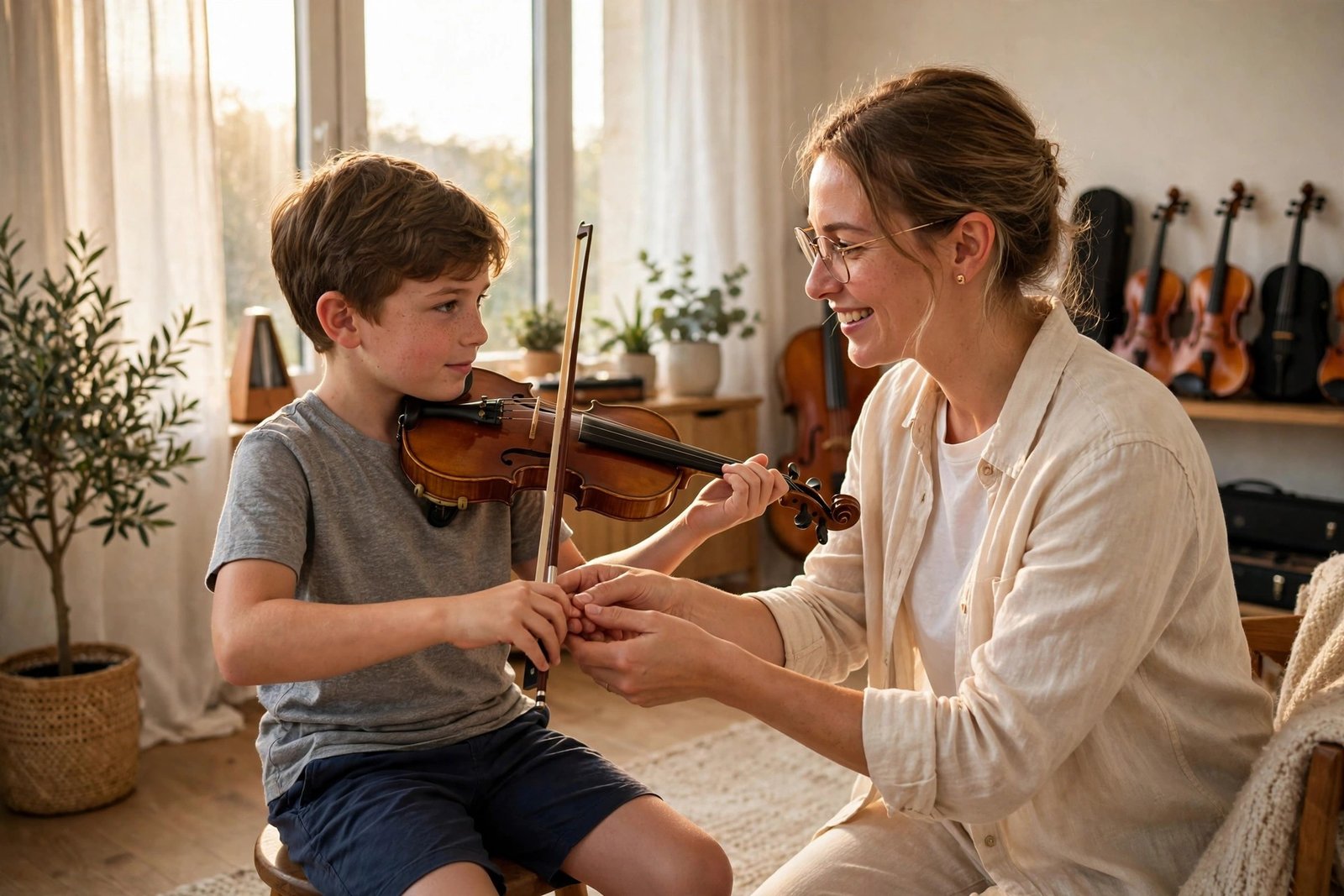
Your seven-year-old has been humming constantly, your teenager just asked for a guitar, or maybe you simply want to give your child the gift you never had. Choosing music lessons for kids feels momentous — and the options are bewildering: private teachers, music schools, school programmes, online lessons, group classes. Prices from free to £50 an hour. Instruments from recorders to drum kits.
As a complete beginner to all of this, where do you start? This guide walks you through the decisions in order — instrument, format, teacher, and expectations — with UK-specific practicalities and honest costs. Get these right and you give your child one of life’s great gifts; get them wrong and you buy an expensive ornament and a resentful child.
Decision 1: The Instrument (Let the Child Lead, Within Reason)
The research is clear on one point: the best instrument is the one the child wants to play. Motivation dwarfs all other factors — the “ideal” instrument a child resents is worthless, while the unfashionable choice they love produces practice. So start by listening: what music excites them? What instruments do they point at? Let a 7-year-old try several at a taster day before committing.
Within that, apply gentle parental wisdom. Practical constraints matter: a drum kit in a terraced house is a family-diplomacy incident; a violin is portable and neighbour-friendly. Physical fit matters: small hands suit ukulele, violin, or piano better than full-size guitar; lung capacity develops with age for wind instruments. Cost matters: recorders and ukuleles cost £20–£40 to start; violins and guitars £80–£200 for decent beginners; pianos £300+ (or keyboard alternatives). The piano argument: if genuinely undecided, piano/keyboard is the default recommendation — it teaches notation, theory, and musicianship transferable to every other instrument, and you can hear immediately whether notes are right.
Whatever you choose, rent before buying where possible — most music shops offer rental schemes (£10–£25/month), which is cheap insurance against the instrument that gets abandoned in month two.
Decision 2: The Format (Private, Group, School, or Online)
Private lessons (£25–£45/hour across most of the UK): the gold standard — individual attention, pace matched to the child, repertoire chosen for their taste. Best for: committed children, specific goals, exam preparation. The cost adds up (£100–£180/month weekly), so be sure the commitment is real before starting.
Group lessons (£8–£20/session): cheaper and more social — children often practise more when peers are involved. Best for: young beginners (under 8), social children, trial periods. Quality varies enormously; observe a session before committing.
School music services: many UK schools offer subsidised instrumental lessons through local music hubs — sometimes as little as £5–£10 per lesson, occasionally free for eligible families. Check this first — it is the best value in music education and criminally underused by parents who do not know it exists. Your local music hub (findable via your council website) is the gateway.
Online lessons (£15–£35/hour): the pandemic’s lasting legacy — wider teacher choice, no travel, session recordings for practice reference. Best for: rural families, niche instruments, scheduling flexibility. Slightly less effective for very young beginners who need hands-on posture correction. The Music Mark directory and ABRSM’s teacher finder both list vetted teachers across formats.
Decision 3: The Teacher (The Choice That Matters Most)
A brilliant teacher with an average instrument outperforms an average teacher with a brilliant instrument every time. What to look for: experience with children specifically — teaching adults and teaching 7-year-olds are different professions; ask directly. Enthusiasm for the child’s taste — a teacher who sneers at pop music will kill a pop-loving child’s motivation; the repertoire should include music the child actually likes. Structured but flexible — clear progression (the graded exam system provides this naturally) without rigidity that crushes joy. Communication with you — good teachers brief parents on practice expectations and progress honestly.
Red flags: no trial lesson offered, no discussion of practice expectations, pushing expensive instrument purchases immediately, or an all-exam-all-the-time approach for young beginners. Trust your child’s reaction after a trial — children are excellent judges of teachers. And set the practice expectation correctly from day one: little and often beats long and rare — 15–20 minutes daily transforms progress; an hour on Sunday does almost nothing.
Decision 4: Expectations (Yours, Calibrated)
Parental expectations make or break musical childhoods. The healthy framework: progress is slow then sudden — months of squeaks precede the breakthrough; this is normal, not failure. Motivation fluctuates — every child wants to quit at some point, usually around month 4–8 when novelty fades and difficulty rises; this is the moment for encouragement and routine, not for immediate surrender (nor for forcing a truly miserable child). Exams are tools, not goals — graded exams provide structure and achievement, but exam-obsessed teaching produces technicians who quit at 16; musical joy is the actual objective. Your role is logistics and encouragement — ensure practice happens (routine, not nagging), attend performances, celebrate effort over talent.
The long view: children who learn instruments gain far more than music — discipline, delayed gratification, performance confidence, and a companion for life. But these benefits accrue to children who continue, and continuation depends on the early experience being positive. Every decision above should be filtered through one question: does this make my child more likely to still be playing in three years?
Costs: The Honest Budget
Minimum viable (£200–£400/year): school/hub lessons or group classes, rented or budget instrument, no exams. Standard private route (£1,200–£2,000/year): weekly private lessons (£25–£40/hour × 40 weeks), owned mid-range instrument, occasional exam fees (£40–£80 per grade). Serious track (£2,500+/year): premium teacher, quality instrument, multiple exams, ensembles, summer schools. Start at the minimum viable level and upgrade with demonstrated commitment — the child who practises daily on a rented violin earns the better instrument; the one who does not has cost you little.
Do not forget the hidden enrichments that are often free: school ensembles, youth orchestras (many free or subsidised), and the inspiration of live music — local live music venues and family-friendly music festivals show children what the practice is for.
The Bottom Line
Choosing music lessons for kids as a beginner parent comes down to four decisions in order: let the child lead on instrument (within practical reason), check school/hub lessons first for value, choose the teacher on child-specific experience and enthusiasm, and calibrate your expectations for the long game. Start cheap with rentals and group or hub lessons; upgrade with demonstrated commitment. The goal is not a prodigy — it is a child still playing, happily, in three years. Everything else follows from that.
Frequently Asked Questions
What is the best age to start music lessons?
There is no single answer — it depends on the child and instrument. Piano and violin commonly start at 5–7; wind instruments often 8–10; guitar and drums 7+. Readiness signs: can focus for 20 minutes, shows genuine interest, has the physical size for the instrument.
How much do children’s music lessons cost in the UK?
Private lessons £25–£45/hour; group lessons £8–£20/session; school music hub lessons often £5–£10 or free. Budget £200–£400/year minimum viable, £1,200–£2,000/year for weekly private lessons.
Should my child do music exams?
Exams provide useful structure and milestones, but should serve the child’s development — not dominate it. Discuss with the teacher; many children thrive with occasional exams, others do better without the pressure.
How much should children practise?
15–20 minutes daily for young beginners, building with age and level. Consistency matters far more than duration — daily short sessions beat weekly marathons completely.
What if my child wants to quit?
Distinguish the normal motivation dip (months 4–8, push through with routine and encouragement) from genuine misery (consider a different instrument, teacher, or pause). Never let quitting be an impulse decision — agree on a trial continuation period first.