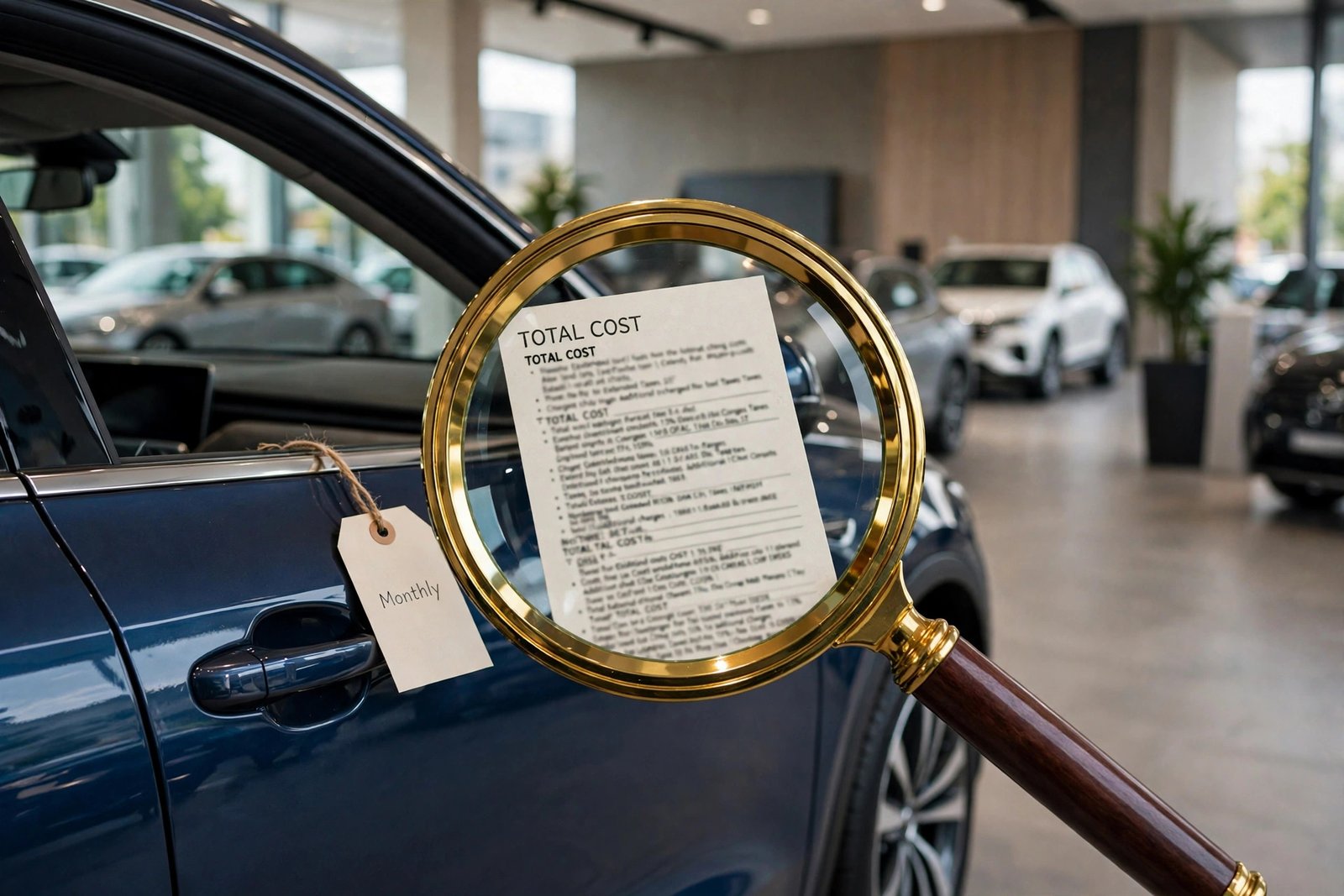
A shiny motor can be made to sound affordable by shrinking attention onto a single monthly figure, while deposits, final payments and handback charges wait quietly elsewhere in the paperwork.
However the car will be used, whether for the daily commute or for adventures such as driving in France for first timers, the financing arrangement decides what the years of driving actually cost. The mistakes below repeat in showrooms everywhere, not because buyers are careless, but because the selling process is arranged around them. Each mistake is paired with the steadier way of handling the same moment, so the whole set can be read as a checklist before signing anything.
Judging deals by monthly figures alone
The commonest mistake is negotiating the monthly payment as though it were the price. A monthly figure can be shrunk in several ways that leave the buyer worse off: stretching the term, enlarging the final payment, trimming the agreed mileage, or quietly reducing what is allowed for a part exchange. Two deals wearing identical monthly figures can differ enormously in total cost and in what the buyer owns at the end, which is precisely why the monthly figure is the salesperson’s favourite ground.
The correct habit is to demand the total payable for every offer and compare totals across the same keeping period. Total payable means the deposit, every instalment, any final payment needed to own the car, and the fees written into the agreement, all added together without apology. Ask also what the arrangement leaves you holding at the end: a car you own, a car you may hand back, or nothing but receipts. A deal that still looks good under those lights is worth considering. A deal that wilts was never good.
Slow the conversation down whenever it speeds towards the monthly figure. Ask for the interest rate, the term, the final payment and the total in writing, and take them away overnight if the sums are large. Reputable sellers expect scrutiny. Any urgency that depends on you not doing the arithmetic is itself information about the deal, and walking away from a pressured signing costs nothing compared with unwinding a signed agreement.
Ignoring the final balloon payment
Personal contract arrangements work by deferring a large slice of the car’s price into a final payment, which keeps instalments low because most of the borrowing is not being repaid along the way. The mistake is treating that final sum as somebody else’s problem, belonging to a distant future self who will somehow find it easily. When the term ends, the choices are stark: pay the sum and keep the car, return the car and leave with nothing, or roll into another arrangement and begin the cycle again.
Contrast that with the older route described in hire purchase agreements and ownership explained, under which goods are paid for in instalments while they are used, with ownership passing once payments are complete. There is no cliff edge at the end because the payments have been buying the car throughout. Neither structure is automatically better, but they suit different intentions. A buyer who means to keep the car should be deeply suspicious of a structure whose affordability depends on not keeping it.
The correct way to handle a final payment is to plan its fate on the day the agreement is signed. If keeping the car is the aim, save towards the sum from the start or choose a structure without one. If handing back is the aim, say so honestly and judge the deal as a form of rental, comparing it against leasing on that basis. What cannot be done sensibly is to drift towards the date hoping the question will answer itself. It answers itself, expensively, in the direction of another signed agreement.
Part exchange values belong in the same total, examined with the same suspicion. A generous sounding allowance for the old car can be funded by a worse price on the new one, and a poor allowance can hide inside an apparently keen deal. Price the two halves separately whenever possible: what the new car costs, and what the old car fetches, each tested against the wider market before the combined figure is allowed to impress anyone.
Accepting add ons without separate scrutiny
Once the main deal feels settled, a procession of extras appears: protective coatings, gap cover, extended warranties, service plans, tyre insurance and more, each presented as a small monthly addition. The mistake is letting them ride through on the mood of the main purchase. Folded into the financing, each extra is also borrowed, attracting interest across the whole term, so its true cost is noticeably higher than the figure attached to it in the showroom conversation.
The correct approach is to unbundle everything. Consider each extra on its own merits, at its own total price, as though buying it separately with cash, because that is effectively what is happening with interest added. Some extras genuinely suit some drivers; a service plan can make sense for high mileage use, and certain covers calm real anxieties. Others duplicate protection the buyer already holds, or cover events so narrowly defined that claiming would be a battle. Time pressure is the enemy here as well, since most extras can be bought later, elsewhere, or not at all.
Ask one question of every addition: what exactly happens, in which circumstances, and what is paid out, and by whom? Vague answers at the point of sale become firm exclusions at the point of claim. Keep a written list of what was included and what was declined, because months later nobody remembers the verbal promises. The extras conversation should end with the buyer able to name each item being paid for and why it earned its place.
Skipping an independent loan comparison
Dealer finance is convenient, and convenience is its own sales pitch. The mistake is assuming the arrangement offered beside the car is the natural or cheapest way to borrow the money. A personal loan arranged independently can fund a purchase outright, giving the buyer immediate ownership, freedom to sell the car whenever they choose, and no mileage or condition conditions attached to their own property. For keepers especially, that freedom has real value that showroom comparisons rarely price in.
The leasing route sits at the other pole, and leasing arrangements and what they involve explains the shape of it: an asset used in return for regular payments without ownership necessarily passing at the end. Leasing can suit drivers who value a new car, predictable motoring and walking away at term’s end, provided they stay within the conditions. The point of comparison is not that one route wins universally, but that the routes differ in ownership, flexibility and total cost in ways the buyer should choose deliberately rather than inherit from the seller’s default.
The correct routine is to arrive with an independent loan quote already in hand, even if dealer finance is eventually chosen. A competing figure transforms the negotiation, because the dealer’s arrangement must now beat something real instead of competing against nothing. Check eligibility in ways that do not damage your credit record where soft checks are offered, and compare the independent total against the dealer total across the same period, including what each leaves you owning at the finish.
Forgetting mileage and condition charges
Agreements that end with a handback carry conditions, and the conditions carry prices. Exceed the agreed mileage and each extra stretch of road is charged for. Return the car with damage beyond accepted wear and the rectification bill follows. The mistake is signing an optimistic mileage figure to lower the payments, then living a different life for the length of the term: a new job further away, a changed commute, family circumstances that put far more road under the wheels than the estimate allowed.
Estimate mileage from evidence rather than hope. Look at the distance covered in previous years, account for the journeys the new car will actually make, and add headroom for the unexpected. A slightly higher payment for a realistic allowance is cheaper than the excess charges waiting at handback, and far cheaper than the misery of rationing journeys in the final year to protect the figures. Photograph and record the car’s condition at collection and through the term, so wear arguments at return can be met with evidence.
Condition deserves the same realism. Cars used by families, dogs and muddy hobbies gather marks that fastidious handback standards may price harshly. Drivers whose lives are hard on interiors should weigh ownership routes more heavily, since an owned car’s scuffs are the owner’s business alone. The correct question is not whether charges are fair in theory, but whether your actual pattern of use will trigger them in practice, priced honestly into the comparison from the start.
Overlooking cheaper used cars bought outright
The final mistake is failing to price the simplest option of all: a modest used car bought outright, or with a small loan, and kept for years. Reference material on depreciation describes how an asset’s value falls with age and use, and cars fall fastest when newest. The buyer of a carefully chosen used car lets a previous owner pay for that steepest fall, then enjoys years of motoring in which the main costs are fuel, maintenance and insurance rather than a permanent monthly commitment to a finance house.
There is also a rhythm problem with repeated new car arrangements. Rolling from one short agreement into the next means perpetually paying for the most expensive years of a car’s life and never reaching the cheap years of outright ownership that follow the final payment. Each individual deal can look reasonable while the sequence quietly becomes the most expensive way of staying mobile ever devised. Judging car costs across a decade rather than a term exposes that pattern instantly.
None of this forbids new cars or tidy arrangements for drivers who want them and can carry the totals comfortably. It asks only that the choice be made with open eyes and complete figures: totals compared, final payments planned, extras unbundled, independent quotes in hand, mileage honest and the humble used alternative priced in the same table. A buyer who has done that work can sign in peace, whichever route wins, because the paperwork holds no surprises left to spring.