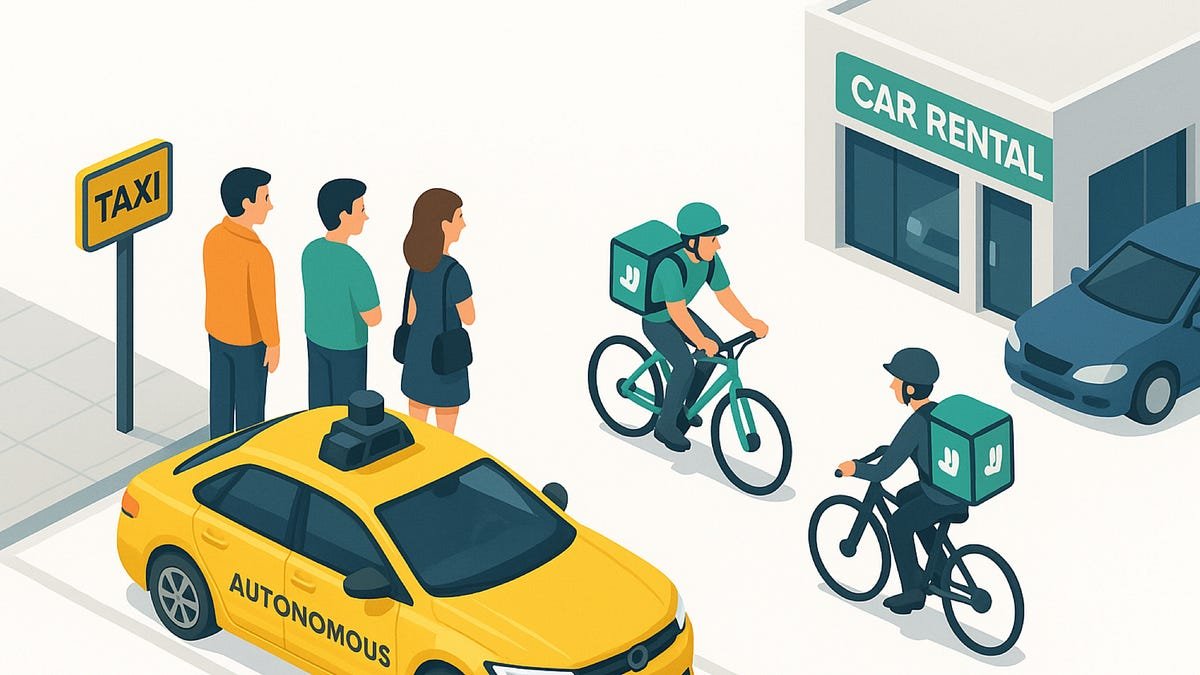
Asking will ai replace taxi and delivery drivers feels very concrete if you drive for a living — it’s not an abstract debate about “the future of work” when it’s your mortgage on the line. I know drivers in London, Manchester, and Birmingham watching this closely, and the honest picture is more nuanced than either the techno-optimists (“robotaxis next year!”) or the sceptics (“never happening”) admit. The timeline matters enormously, and it varies wildly by what kind of driving you do.
Let’s separate the hype from what’s actually on British roads.
Will AI replace taxi and delivery drivers?
Where things actually stand in 2026
Fully autonomous vehicles exist and operate commercially — but in tightly geofenced areas of US and Chinese cities, in good weather, with remote human oversight. The UK is running trials (with safety drivers), and the Automated Vehicles Act 2024 created the legal framework for eventual deployment. But there’s a chasm between “works in sunny Phoenix with a support team watching” and “handles a rainy Friday night in Glasgow with roadworks, a drunk passenger, and a flat tyre”. That chasm is measured in years, not months.
The realistic timeline most experts converge on: limited autonomous taxi services in a few UK cities in the late 2020s, expanding gradually through the 2030s. Full replacement of human drivers across the country? That’s a 2040s question, if then. The technology challenge isn’t the motorway — it’s the last 5% of edge cases, and edge cases are where driving lives.
Different driving jobs, different exposure
- Motorway/long-haul logistics: most exposed first. Hub-to-hub autonomous trucking on motorways is the easiest technical problem and the biggest economic prize. Expect pressure here earliest.
- Urban taxi/PHV (Uber, Bolt, black cabs): medium-term pressure. City driving is hard for AI, but the economics of robotaxis are so compelling that investment will keep coming. The Knowledge — London cabbies’ legendary street memory — is exactly the kind of thing AI navigation does effortlessly, which is a sobering thought.
- Multi-drop delivery (parcels, food): surprisingly resilient. The driving is only half the job — the other half is finding flat 47B, buzzing the intercom, carrying the parcel up three flights, handling the “it’s a gift, can you hide it?” requests. Robots that do stairs and human interaction are much further off than robots that steer.
- Specialist driving: school transport, patient transport, executive chauffeurs — jobs where trust, care, and human presence are the product. Very resilient.
What’s already changing (and what to do about it)
Here’s what drivers often miss: AI is already reshaping the job around the driving. Algorithmic dispatch decides who gets which job; dynamic pricing sets your earnings; route optimisation tells you where to go. The platform is the boss, and it’s already artificial. Understanding this is the first step to adapting.
The adaptation playbook for drivers:
- Move toward the human parts: executive work, school contracts, assisted transport, courier jobs with complex handling — the segments where a person matters.
- Build direct customer relationships: regular private clients who book you, not the app, are automation-proof. This is a business, not just a job — our guide to turning a side venture into a business applies.
- Diversify income now, not later: the drivers who’ll struggle are those with no plan B. Use the good years to build skills or savings — see our guide to using AI to find a better job.
- Watch the regulation: UK deployment will be gradual and regulated. The government’s self-driving vehicle programme publishes timelines worth following.
The passenger side: what riders should know
Most coverage focuses on drivers, but passengers will feel this transition too — mostly as gradual improvement. Autonomous taxis promise cheaper fares (no driver to pay), consistent availability (no surge-pricing refusals at 2am), and safer journeys (the vast majority of accidents involve human error). The trade-offs: less flexibility (no “can you wait two minutes while I grab my bag?”), no help with luggage, and the unresolved question of what happens when something goes wrong with no human present. Early services will likely keep remote human support — someone watching who can intervene — which is reassuring but not the same as a driver.
There’s also the accessibility question. For many elderly and disabled passengers, taxi drivers provide essential assistance — helping with wheelchairs, guiding to the door, waiting while someone gets settled. An autonomous vehicle that can’t do these things isn’t a replacement for those journeys; it’s a different service for different needs. Regulators are aware of this, and the UK’s approach to autonomous vehicle licensing is expected to include accessibility requirements — but the details will determine whether the technology serves everyone or just the able-bodied.
My prediction for the passenger experience: a decade of hybrid reality. Human-driven Ubers and black cabs alongside autonomous options in city centres, with passengers choosing based on price, convenience, and need. The Knowledge will still matter in London for years — not because AI can’t navigate, but because passengers value the human who knows the shortcuts, the stories, and which entrance to use at King’s Cross at rush hour. Some things aren’t about the driving.
One more consideration for drivers: the data question. Platform drivers generate enormous amounts of valuable data — routes, demand patterns, earnings — that the platforms monetise and drivers can’t access. As the industry evolves, driver cooperatives and data unions are emerging to rebalance this: drivers pooling their data to negotiate better terms or build alternative platforms. It’s early days, but the principle matters: in an AI-mediated industry, data is leverage, and workers who organise their data collectively have more power than those who surrender it individually. Worth watching, and worth joining, as these movements grow.
Your practical takeaway
If you drive for a living in the UK, you’re not facing redundancy next year — but you are in an industry with a visible 10–15 year transition ahead. The winning move isn’t panic or denial; it’s a deliberate shift toward the human-valued segments of the work (relationships, care, complexity) while building options for the longer term. The drivers who thrive will be the ones who saw it coming and adapted early — which, if you’re reading this, already includes you.