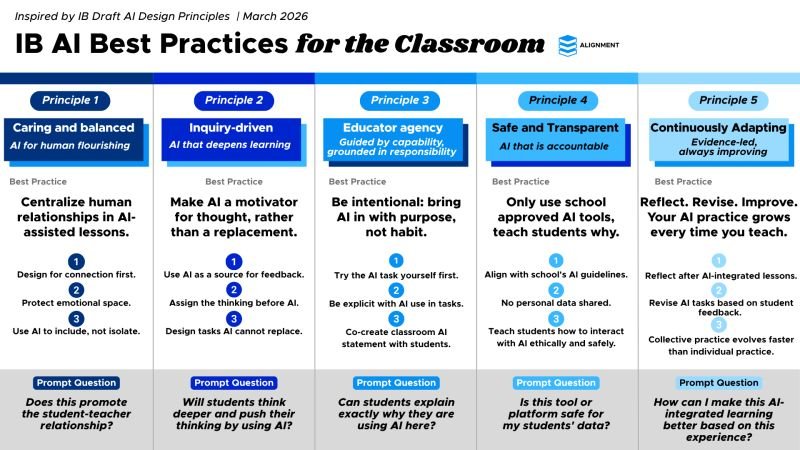
Working out how can teachers use ai in the classroom responsibly is one of the most pressing questions in UK education right now. Walk into any staffroom and you’ll hear the full spectrum: the enthusiast who’s rebuilt their lesson planning around AI, the sceptic who sees it as industrial-scale cheating, and the exhausted majority who just want practical guidance. I’ve spoken with teachers across this spectrum, and the ones getting it right share a common insight: AI in education isn’t about the technology — it’s about what you want students to learn, and being honest about where AI helps or hinders that.
The stakes are real. Used well, AI can cut teacher workload dramatically and personalise learning in ways that were previously impossible. Used badly, it hollows out the thinking that education is supposed to develop. The Department for Education’s guidance encourages schools to embrace AI while managing the risks — let’s get specific about what that looks like in practice.
How can teachers use AI in the classroom responsibly?
1. Slash the workload (the uncontroversial win)
Teacher workload is the crisis AI is best placed to solve. Legitimate, low-risk uses:
- Lesson planning and differentiation: “Create a Year 8 lesson on photosynthesis with activities for lower, middle, and higher attainers, including a starter and plenary.” Review and adapt — never use raw.
- Resource creation: worksheets, quizzes, vocabulary lists, reading comprehensions at specific reading ages, model paragraphs demonstrating specific techniques.
- Feedback drafting: generate comment banks and first-draft report comments, then personalise. (Never paste identifiable pupil data into AI tools — more below.)
- Admin: drafting parent emails, summarising meeting notes, creating revision timetables.
The rule: AI drafts, teacher decides. Every AI output gets reviewed by a professional before it reaches a child. This isn’t bureaucracy — AI invents facts, and a confident-sounding error in a worksheet teaches thirty children the wrong thing.
2. Teach with AI, not just about it
The most powerful classroom uses make AI’s limitations the lesson:
- Critique the output: have students fact-check an AI essay, find its errors, and improve it. This teaches critical thinking and AI literacy simultaneously.
- Socratic tutoring: AI as a patient questioner — “don’t give me the answer, ask me questions until I work it out” — gives every student something like one-to-one tuition.
- Creative collaboration: students draft, AI suggests variations, students choose and justify. The judgement stays human.
- Accessibility: text-to-speech, simplified explanations, and translation support for EAL pupils — genuinely transformative for some learners. See our guide on AI and dyslexia support.
3. Set clear, enforceable boundaries on student use
This is where schools struggle most. Vague “use AI responsibly” policies fail; specific ones work:
- Be explicit per task: “AI allowed for research, not for drafting” / “No AI for this assessment” / “AI permitted — declare how you used it.” Students follow clear rules; they exploit vague ones.
- Design AI-resistant assessment: in-class essays, vivas, process portfolios, and tasks requiring personal reflection or very recent events are harder to fake than take-home essays.
- Teach declaration: normalise stating how AI was used, like citing sources. This builds the academic-integrity habit they’ll need at university — where the rules are strict (see is it cheating to use AI for university assignments).
- Focus on process over product: when you assess drafts, notes, and thinking — not just the final essay — AI shortcuts become visible and less useful.
The safeguarding and data non-negotiables
- Never input identifiable pupil data into public AI tools — names, photos, SEN details, safeguarding concerns. This is a GDPR and safeguarding red line. Use anonymised examples or school-approved platforms with proper data agreements.
- Age restrictions are real: most AI chatbots require users to be 13+. Check your school’s policy and the tool’s terms.
- Bias awareness: AI models reflect biases in their training data. Teach students to notice this — it’s a media-literacy lesson in itself.
The Department for Education’s guidance on generative AI in education is the authoritative UK reference — every school leader should have read it.
Getting colleagues on board (and handling the sceptics)
The biggest barrier to AI in schools isn’t the technology — it’s staffroom culture. You’ll have enthusiasts, sceptics, and the quietly terrified, often in the same department. The approach that works: start with workload wins, not classroom revolution. Show a sceptical colleague how AI drafts differentiated worksheets in two minutes, and you’ve converted them more effectively than any amount of evangelising about “transforming pedagogy”. People adopt tools that solve their immediate pain; philosophy comes later.
Run short, practical sharing sessions — 15 minutes in a department meeting where one teacher demos one AI use that’s actually working. Keep it concrete: the exact prompt, the output, what they changed. Build a shared bank of vetted prompts and resources so nobody starts from scratch. And acknowledge the legitimate concerns openly: workload displacement fears, the cheating question, data worries. Dismissing sceptics as luddites hardens opposition; engaging with their concerns (many of which are valid) builds the coalition you need.
Leadership matters enormously here. Schools thriving with AI invariably have senior leaders who’ve set clear direction: an explicit AI policy, permission to experiment, time allocated for learning, and — critically — modelling the behaviour themselves. A headteacher who openly uses AI for drafting parent communications gives staff more confidence than any training session. The Department for Education’s guidance sets the national direction, but the culture that determines success or failure is built corridor by corridor, one converted sceptic at a time.
One more dimension: AI and teacher wellbeing. The workload crisis driving teachers out of the profession won’t be solved by AI alone — but reclaiming even 3–5 hours a week from planning and admin is meaningful. That’s an evening back with your family, or the difference between marking until midnight and finishing at nine. Frame AI adoption partly as a retention strategy: the teachers who stay are the ones whose workload is sustainable. School leaders serious about keeping staff should treat AI workload tools as wellbeing infrastructure, not just efficiency gains.
Your practical takeaway
Start with workload: pick your most time-consuming planning or marking task and AI-assist it this week, with human review as standard. In the classroom, run one “critique the AI” lesson — it’s the fastest way to build student AI literacy. And push for a clear, task-specific school AI policy rather than a blanket ban or vague encouragement. The schools thriving with AI aren’t the ones with the best tools; they’re the ones with the clearest thinking about what education is for.