
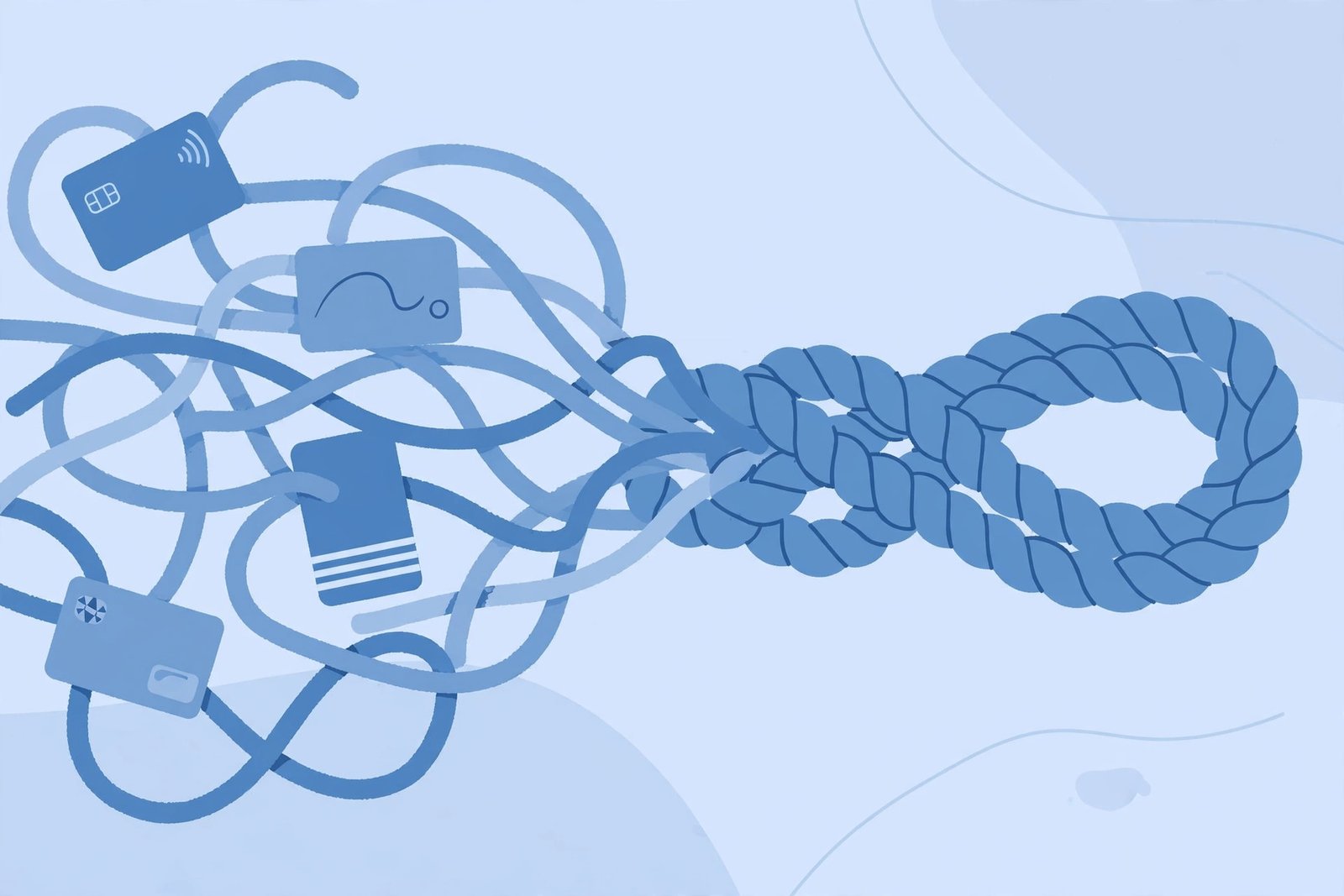
Juggling four credit cards, an overdraft, and a catalogue debt is exhausting — and the idea of rolling them all into one loan with one payment is deeply appealing. Debt consolidation promises simplicity and often a lower rate, but the question of what it “really costs” in a place like Carlisle has more layers than the advert suggests: arrangement fees, longer terms that inflate total interest, and the behavioural trap that sinks most consolidators. This guide prices consolidation honestly, shows when it works and when it backfires, and gives you the decision framework.
You will learn how consolidation loans work, the true cost calculation with examples, when consolidation helps versus harms, the alternatives worth considering first, and the rules that make it stick.
How consolidation actually works
A consolidation loan is simply a personal loan used to pay off multiple existing debts: you borrow one lump sum (say £12,000), clear the cards and overdraft, and are left with a single fixed monthly payment over a fixed term (typically 3–7 years) at a fixed interest rate. The appeal is threefold: one payment instead of five, often a lower interest rate than credit cards (personal loan rates of 8–15% versus cards at 25%+), and a defined end date — unlike revolving credit, which can persist forever.
The mechanics matter: the best approach is often a loan paid directly to creditors, removing the temptation to spend the lump sum. Some lenders offer this; otherwise, iron discipline is required — the loan hitting your current account alongside cleared cards is the danger moment. And check the loan’s terms carefully: arrangement fees (sometimes £100–£300 added to the balance), early repayment charges, and whether the rate is fixed or variable. The headline APR is the starting point of the cost analysis, not the end of it.
The true cost: what the advert does not say
Here is the maths that matters. £12,000 of card debt at 24% APR, paying £350 a month, clears in about 4 years costing roughly £4,800 in interest. A £12,000 consolidation loan at 12% APR over 5 years costs £333 a month and roughly £4,000 in interest — cheaper monthly and cheaper overall. That is the win case, and it is real.
But stretch that loan to 7 years to get payments down to £210 a month, and total interest rises to about £5,600 — more than the original debt cost, despite the lower rate. Longer terms are the hidden price of consolidation: affordable monthly payments bought with greater total interest. Add a £250 arrangement fee and the gap widens. The honest calculation: total interest over the full term, plus fees, versus the true cost of your current debts if attacked aggressively. Consolidation at a lower rate over a similar or shorter term saves money; consolidation that mainly extends the term buys comfort at a premium. Run both scenarios on MoneyHelper’s free calculators before signing anything.
When consolidation helps — and when it backfires
Consolidation helps when: your credit score qualifies you for a genuinely lower rate; the debts are genuinely unaffordable in their current form; and — critically — the spending behaviour that created the debt is addressed. It is a refinancing tool, not a solution; it reorganises debt, it does not reduce what you owe.
It backfires in the classic pattern: the cards are cleared, the loan is in place, and within a year the cards are maxed again — now with the loan on top. Studies and advisers report this as depressingly common, because consolidation treats the symptom (multiple payments) while the disease (spending beyond income) continues. The non-negotiable companion to any consolidation: cut up or freeze the cards, close the paid-off accounts (or keep one for credit-file age with a token limit), and fix the budget gap that created the debt. Without that, consolidation is just a more comfortable route to deeper debt. Building the underlying discipline starts with visibility — a proper budgeting system — and with trimming the lifestyle leaks, from cancelling unused subscriptions upward.
The psychology of the single payment
Consolidation’s underrated benefit is cognitive: five minimum payments across five creditors consume attention and willpower every month, while one fixed payment on one date is administratively trivial. This simplicity dividend is real — fewer decisions, fewer missed-payment risks, one clear payoff date to focus on. Behavioural research consistently shows that visible progress toward a single goal sustains motivation better than diffuse progress across many. The fixed end date is psychologically powerful too: revolving credit feels infinite, but a 4-year loan has a finish line you can count down to. Harness this by tracking the shrinking balance visibly — a chart on the fridge beats a spreadsheet tab nobody opens. The loan does not just reorganise your debt; used well, it reorganises your relationship with it.
Alternatives to consider first
Before consolidating, check the alternatives. A 0% balance-transfer credit card (with a 2–3% transfer fee) can clear card debt interest-free for 12–24 months — far cheaper than any loan if you can clear the balance within the promotional period. The snowball or avalanche methods — attacking debts in sequence with focused overpayments — cost nothing and build powerful momentum. And if debts are truly unmanageable, free debt advice from StepChange, National Debtline, or Citizens Advice can arrange formal solutions (DMPs, IVAs, DROs) that a consolidation loan cannot match.
Also consider: can you increase income temporarily to attack the debt directly? Can you sell assets gathering dust? The cheapest consolidation is the one you do yourself with focused payments. A loan makes sense when the rate saving is substantial and the term disciplined — not as a first resort, but as a calculated tool. The FCA’s consumer guidance sets out your rights when borrowing, worth reading before any application.
Conclusion
Consolidating multiple debts into one in Carlisle — or anywhere — costs the loan’s total interest plus fees, and the honest price depends entirely on rate and term: lower rate over a similar term saves real money; lower payments via a longer term often cost more overall. It works when the rate is genuinely better, the term is disciplined, and the spending behaviour is fixed. Get free debt advice first if you are struggling, run the full-term numbers, freeze the cards, and make consolidation the end of the debt story — not a comfortable middle chapter.
Frequently Asked Questions
Will a consolidation loan hurt my credit score?
The application creates a hard search (minor, temporary dip). Successfully managing the single loan then builds positive history — net effect is usually positive within months if payments are perfect.
Can I consolidate with bad credit?
Options narrow and rates rise — subprime consolidation loans can exceed card rates, defeating the purpose. Free debt advice is usually the better route with poor credit.
Should I close my credit cards after consolidating?
Yes, or at minimum freeze them. Keeping cleared cards open “for emergencies” is how the double-debt trap happens. Keep at most one, with a low limit, for credit-file age.
What is the difference between a DMP and consolidation?
A Debt Management Plan (via free charities) negotiates reduced payments with creditors without new borrowing; consolidation replaces debts with one new loan. DMPs suit unmanageable situations; consolidation suits expensive-but-manageable ones.


