
You want to dress better and buy less — but the high street makes it feel like the only options are hauling fast fashion or spending a fortune. It’s a false choice. Learning how to update your wardrobe without buying fast fashion is mostly about shopping differently, not shopping more expensively. Here’s the full alternative playbook.
First, what we’re avoiding and why: fast fashion means ultra-cheap, trend-chasing clothing made to be worn a handful of times — with well-documented costs in textile waste (the UK bins around 350,000 tonnes of clothing yearly, per WRAP), microplastics and labour conditions. You don’t need a lecture; you need options. Here they are.
How to update your wardrobe without buying fast fashion: the strategies
1. Shop secondhand first
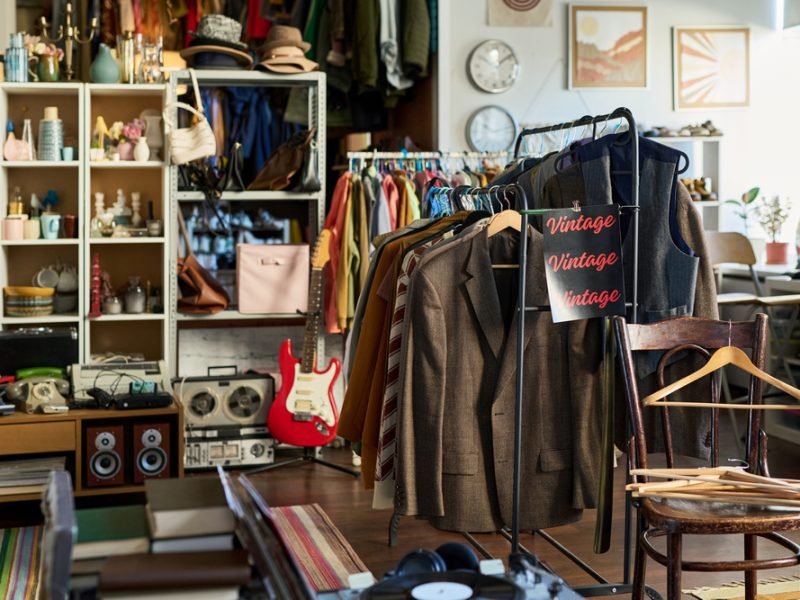
The single highest-impact switch. Charity shops, Vinted, Depop, eBay and vintage stores give you better quality for less money with zero new production. The trick is shopping with a list (see our London charity shop guide) and checking regularly — good secondhand shopping is a habit, not a one-off trip. Our guide to styling secondhand clothes kills the “it’ll look dated” worry.
2. Buy from genuinely sustainable brands
When buying new, choose companies where ethics are structural: our roundup of sustainable clothing brands in the UK covers Thought, Community Clothing, Finisterre and others. Yes, they cost more per item — but cost-per-wear is usually lower.
3. Repair, alter and restyle what you own
The most underrated “new wardrobe” technique: you probably own clothes you’d love if they fit better or felt fresher. A tailor (£8–£25 per alteration), a dye bath for faded blacks, new buttons, hemming, taking in — alterations transform the unworn into the favourite. Learn basic mending (YouTube has it all) for loose buttons and small tears.
4. Clothes swaps and rental
Swaps (free, social, increasingly organised across UK cities) refresh your wardrobe at zero cost and zero waste. Rental (Hurr, By Rotation, Selfridges Rental) covers occasion wear — why buy a £200 dress for one wedding when £40 rents it? For occasion dresses especially, rental is the smart money.
5. Buy less, but better — the cost-per-wear mindset
A £90 coat worn 150 times costs 60p per wear; a £30 coat worn 10 times costs £3 per wear. The “expensive” option is often cheaper. This mindset naturally slows purchasing — you start asking “will I wear this 50 times?” instead of “is it a bargain?”
6. Care for what you have
Washing less, washing cooler (30°C), air-drying, de-pilling knits, reproofing waterproofs — garment care extends life dramatically. WRAP’s research shows extending clothing life by nine months cuts its environmental footprint by around 30%. Their resources on sustainable fashion are the data behind these claims.
The 30-day wardrobe refresh challenge
Want to feel like you have a new wardrobe without buying anything new? Try this: pull out 10 neglected items, get 3 altered, style 5 in new combinations (Pinterest or a friend’s eye helps), repair 2, and donate/sell what you genuinely won’t wear. Most people discover their wardrobe was fine — it just needed editing, not replacing. Our small wardrobe organisation guide helps with the physical side.
The no-buy year: a realistic framework
The most effective way to update your wardrobe without fast fashion is to temporarily stop buying new clothes at all. The “no-buy year” sounds extreme; in practice, most people do a modified version and love it.
The rules (adapt freely): no new clothing purchases for a set period — 3 months to start, a year if you’re committed. Exceptions you define in advance: replacements for worn-out essentials (underwear, tights, white t-shirts that have died), and a small budget (£100–£200/year) for secondhand finds. Everything else waits.
What happens in month one: mild panic, then creativity. You’ll “shop” your wardrobe and find things you’d forgotten. You’ll finally get things altered. You’ll borrow from friends. Most people report wearing 30–40% of their wardrobe in normal life; a no-buy forces the other 60% into rotation, and some of it turns out to be great.
What happens by month three: the urge fades. This is the documented pattern — shopping urges are habitual, not need-based, and habits break in 6–8 weeks. You’ll start noticing how aggressively you’re marketed to, which is its own education. Your style often gets clearer — without constant new inputs, you learn what you actually like wearing.
The money: the average UK woman spends £500–£700 a year on clothes; a no-buy typically saves 60–80% of that. Put the saving somewhere visible — a separate pot, a holiday fund — so the trade-off feels rewarding rather than punishing.
If a full no-buy feels too much
- The one-in-one-out rule: nothing enters unless something leaves. Maintains wardrobe size and forces real desire over impulse.
- The 30-day list: want something? Put it on a list with the date. If you still want it in 30 days, consider it. Roughly 80% of items never make it off the list.
- Secondhand-only: all the fun of shopping, none of the fast-fashion footprint. Vinted, charity shops, kilo sales.
- The seasonal allowance: a fixed budget per season (£75–£150), spent deliberately. Scarcity breeds better decisions.
None of these require moral purity — they’re practical systems for people who like clothes but not the churn. Pick the least intimidating one and start there.
Skipping fast fashion: quick answers
Isn’t secondhand just as bad (it’s still consumption)? No — the production footprint already happened. Buying secondhand extends a garment’s life, which is the single biggest lever on clothing’s environmental impact. It’s not perfect, but it’s an order of magnitude better than new fast fashion.
What about work uniforms and kids’ clothes? Practicality wins — kids outgrow things in months, and workwear has requirements. Buy the best quality you can within the constraints, buy secondhand where possible (kids’ resale is enormous), and save the principles for your discretionary wardrobe.
How do I handle the social pressure? Nobody tracks your outfits as closely as you fear — and “I’m doing a no-buy year” is now a respected position, not a weird one. The friends who judge aren’t thinking about your clothes; they’re thinking about theirs.
When should I just buy the thing? When it’s a genuine gap (you have no winter coat), when it’s secondhand, or when the 30-day list says you still want it. The system isn’t anti-buying — it’s anti-regret. A considered purchase you wear for years is the goal.
Your takeaway: different, not more
To update your wardrobe without buying fast fashion: shop secondhand first, buy sustainable new when needed, repair and alter what you own, try swaps and rental for variety, and think in cost-per-wear. You’ll spend less, waste less, and — counterintuitively — end up with a wardrobe you like more.


