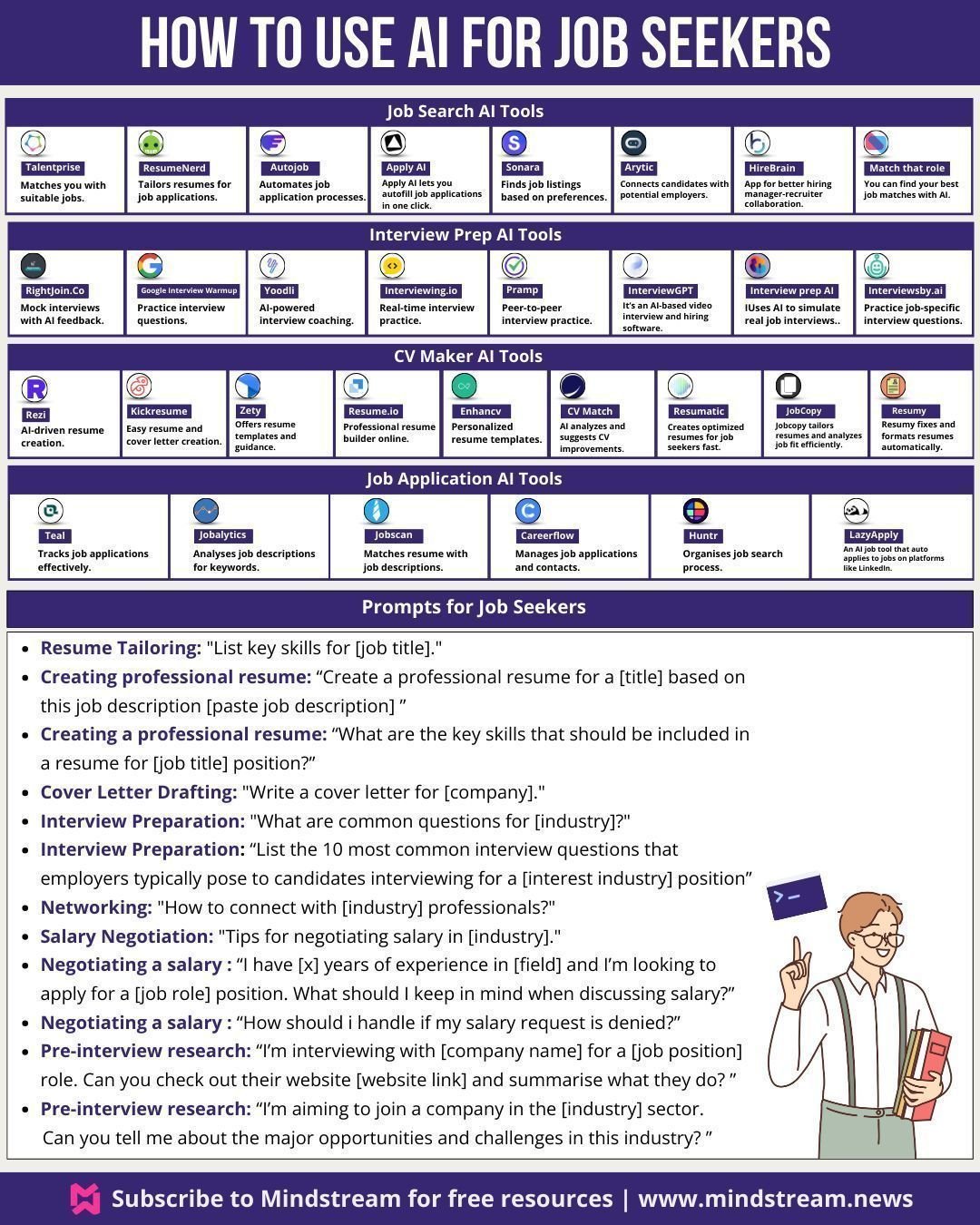
Learning how can ai help me find a better job is one of the most practical AI skills right now, because job hunting is a process — research, positioning, applications, interview prep, negotiation — and AI assists at every stage. I coached a friend through a career change last year using AI throughout: it identified transferable skills she’d undervalued, rewrote her CV for a new industry, generated 50 practice interview questions, and helped her negotiate a £6k uplift. She’d have managed it alone eventually; AI made it faster and, frankly, better.
The key mindset: AI is your job-hunting team — researcher, writer, coach, and strategist — not a magic button. Here’s how to deploy it.
How can AI help me find a better job?
1. Discover what you’re actually qualified for
Most people undervalue their transferable skills. Paste your CV and ask: “Based on my experience, what job titles and industries should I target that I might not have considered? Rank by fit and salary potential in the UK.” Then: “What are the gaps between my profile and these roles, and what’s the fastest way to close each gap?” This reframes your career from “what I’ve done” to “what I could do” — often revelatory.
2. Target the right roles efficiently
- Market research: “What does a [role] pay in [city] for someone with my experience? Which companies are hiring? What’s the demand trend?” — AI synthesises this faster than hours of browsing.
- Company deep-dives: “Summarise what [company] does, their recent news, culture signals from employee reviews, and likely interview focus.” Walk into interviews informed.
- Job-description decoding: paste adverts and ask what the employer actually wants versus what’s boilerplate — then prioritise applications accordingly.
3. Applications that get shortlisted
Our detailed guide to writing a better CV with AI covers this fully, but the highlights: AI gap-analysis against each job description, achievement-focused bullet rewriting with your real numbers, and tailored cover letters you then humanise. Quality over quantity — five tailored applications outperform fifty generic ones.
4. Interview preparation
- Mock interviews: “Interview me for [role] at [company type]. Ask one question at a time, critique my answers, then ask follow-ups.” This is brutally effective preparation.
- STAR story bank: “Help me turn these experiences into STAR-format answers for competency questions.” Prepare 6–8 stories covering leadership, conflict, failure, and achievement.
- Questions to ask them: “Give me 5 insightful questions to ask the interviewer that show I’ve done my homework.” The questions you ask matter as much as the answers you give.
- Salary negotiation: “What’s the market rate for this role? Draft a negotiation script for asking for £X.” Negotiation is a skill; AI is a rehearsal partner. Our prompt guide helps you get sharper outputs here.
5. The hidden job market
AI helps with the parts people neglect: drafting networking messages that don’t sound desperate, researching people to contact, and preparing for informational interviews. In the UK, a huge proportion of roles are filled through networks — AI makes systematic networking less awkward and more effective.
Watch-outs
- Privacy: your CV contains personal data — disable AI training on your inputs or anonymise. See our AI safety guide.
- AI screening: many employers now use AI to screen CVs — keep formatting simple and mirror the job description’s keywords (our CV guide covers ATS optimisation).
- Don’t outsource judgement: AI suggests; you decide. Taking a job is a life decision — use AI for information and preparation, not for the decision itself.
After the offer: starting well (the forgotten phase)
Most job-hunting advice stops at “you got the job!” — but the first 90 days determine your trajectory more than the interview did. AI can help here too: 30-60-90 day plans (“draft a 30-60-90 day plan for a marketing manager joining a 50-person SaaS company”) impress new employers and give you structure. Research your new company’s recent news, key people, and challenges before day one — walking in informed accelerates everything.
The human side matters more than the plan, though. Listen first: spend the first month understanding how things actually work (versus how the interview described them) before suggesting changes. Build the network early: coffee with everyone in your first two weeks — the relationships you build now pay dividends for years. Find quick wins: one visible improvement in the first month builds credibility that sustains you through the longer projects. And manage up: agree expectations explicitly with your manager in week one — what does success look like at 30, 60, 90 days? Misaligned expectations are the top reason new hires fail, and they’re entirely preventable.
Also, don’t neglect the admin: pension enrolment (check the employer’s contribution — it’s part of your compensation), probation terms, notice periods, and any restrictive covenants in your contract. And keep your CV and LinkedIn updated as you go — not because you’re leaving, but because documenting achievements in real time beats reconstructing them in three years. The National Careers Service offers free, impartial careers advice including CV reviews and skills assessments — a useful second opinion at any career stage, not just when you’re job hunting.
One more long-term play: building in public. Sharing your career journey — the learning, the projects, the insights — on LinkedIn or a professional blog compounds over time into something valuable: visibility, credibility, and inbound opportunities. You don’t need to be an influencer; one thoughtful post a month about something genuinely interesting in your field is enough. AI helps with the drafting (you provide the insight, it helps with the structure), but the voice must be yours. Over a year or two, this quiet consistency builds a professional brand that makes your next job hunt dramatically easier — because the opportunities start coming to you.
Your practical takeaway
This week: run the transferable-skills analysis on your CV, research market rates for your target roles, and set up one mock interview session. Then apply the CV and cover-letter techniques to your top three target roles. Job hunting with AI isn’t about gaming the system — it’s about presenting your genuine value more effectively and preparing more thoroughly than candidates who don’t. In a competitive market, that’s often the entire difference.