
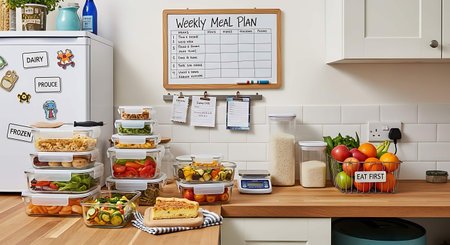
Discovering how can ai help me plan my weekly meals was one of those small revelations that genuinely improved my life. I’d spent years doing the same sad dance: staring into the fridge on Sunday evening, ordering a takeaway out of decision fatigue, then throwing away wilted spinach on Thursday. Then I asked an AI assistant to plan my week around what was already in my fridge, my £60 budget, and the fact that my kids won’t eat anything green unless it’s hidden. It produced a better plan in 30 seconds than I’d managed in years of trying.
Meal planning is one of those tasks AI is almost unfairly good at: it involves juggling constraints (budget, time, dietary needs, what’s in season, what you already own) across dozens of variables — exactly the kind of combinatorial puzzle humans find exhausting and computers find trivial.
How can AI help me plan my weekly meals?
1. The full weekly plan from a single prompt
Give an AI assistant (ChatGPT, Claude, Gemini — all have free tiers) a prompt like: “Plan 5 weeknight dinners for 2 adults and 2 kids. Budget £60 total from Tesco. 30 minutes max cooking time. One vegetarian night. No mushrooms — my daughter is morally opposed. Include a shopping list grouped by supermarket aisle.” What comes back is usually impressive: varied meals, a consolidated shopping list, and often rough cost estimates. The specificity of your prompt is everything — which is why learning how to write good prompts pays off here more than almost anywhere.
2. Cooking from what you already have
This is the killer feature for reducing food waste. List what’s in your fridge — or photograph it, since most AI assistants now accept images — and ask for meals using those ingredients. “I have chicken thighs, half a cabbage, rice, soy sauce, and eggs — what can I make for four?” The answers are consistently creative and practical. UK households throw away around £1,000 of food a year; this one habit puts a real dent in that.
3. Adapting to dietary needs
Gluten-free, halal, low-FODMAP, diabetic-friendly, fussy toddlers — AI handles dietary constraints well because it’s just another variable in the puzzle. Ask it to convert a favourite recipe: “make this lasagne recipe dairy-free and under 600 calories per portion.” It’ll swap ingredients and adjust quantities sensibly. Important caveat: for medical diets (diabetes, kidney disease, severe allergies), treat AI suggestions as ideas to verify, not medical advice — our article on the risks of using AI for medical advice explains why.
4. Batch cooking and prep schedules
Ask for a Sunday prep plan: “Give me a 2-hour Sunday batch-cook session that covers lunches for the week.” You’ll get a timed schedule — what goes in the oven first, what chops while things simmer — that turns meal prep from chaos into a production line. Pair this with a proper shopping list and you’ve reclaimed your weeknights.
Making it a weekly habit
The system that works: Sunday, 15 minutes. Check what’s in the fridge, tell the AI your constraints for the week (busy Tuesday, kids’ swimming Thursday, in-laws Saturday), get the plan and shopping list, do one shop. During the week, just cook what’s on the plan — no decisions required. Decision fatigue is the real enemy of home cooking, and a plan eliminates it.
A few tips from experience: save prompts that work well and reuse them weekly with tweaks; ask for the shopping list in aisle order for your usual supermarket; and tell the AI your family’s actual dislikes honestly — “healthy” meals nobody eats are just expensive compost. If you want to eat better generally, our guide to winter immune-boosting foods pairs well with the planning habit.
Eating well on the plan: nutrition without the effort
The hidden benefit of AI meal planning is nutritional: when you plan deliberately, you eat better almost by accident. Impulse cooking tends toward the beige — pasta, toast, takeaway. Planned cooking includes the vegetables, because they’re on the list. If you want to be more deliberate about it, tell the AI your nutritional goals: “high protein, 5+ portions of veg daily, under 2,000 calories” or “Mediterranean-style, oily fish twice a week”. It’ll build the plan around the targets, and you’ll hit them without thinking about it day to day.
A practical framework that works well with AI planning is the NHS Eatwell Guide — roughly a third of each meal from starchy carbs, a third from fruit and veg, with protein, dairy (or alternatives), and small amounts of healthy fats making up the rest. Ask the AI to plan to this template and add your constraints on top: “Eatwell-style plan, vegetarian, £50/week for two, 30-minute meals”. The structure keeps you honest; the AI does the work.
Two more nutrition wins from planning. First, variety: ask the AI to avoid repeating any dinner within a fortnight, and you’ll eat a wider range of nutrients than the “same five meals on rotation” most households default to. Second, seasonality: ask for a plan based on what’s in season in the UK this month — seasonal produce is cheaper, fresher, and more nutritious than the flown-in alternatives. In winter, that means root vegetables, brassicas, and citrus; in summer, berries, salads, and stone fruit. Your wallet and your body both benefit.
A final tip for making the habit stick: review and refine monthly. After three or four weeks of AI-planned meals, look back: which meals were hits? Which took longer than promised? What did you waste? Feed this back into your prompts — “we loved the lentil dishes but the fish night never happened; adjust” — and the plans get better over time, converging on your family’s actual preferences rather than generic good ideas. The AI doesn’t just plan your meals; with feedback, it learns your household. That’s when it stops feeling like a tool and starts feeling like a very organised friend.
Your practical takeaway
Tonight, photograph your fridge contents and ask a free AI assistant for three meals using what’s there. This Sunday, do the full 15-minute planning session: constraints in, plan and shopping list out, one shop. Within a month you’ll spend less, waste less, and eat better — and you’ll wonder why you ever tried to hold a week’s worth of meal variables in your head when a computer does it in seconds.


