A single theme park ride grew into a pirate saga that has kept audiences hooked across five big-screen adventures. Knowing how the chapters fit together makes a marathon far more satisfying.
Five Released Features Form the Complete Main Series
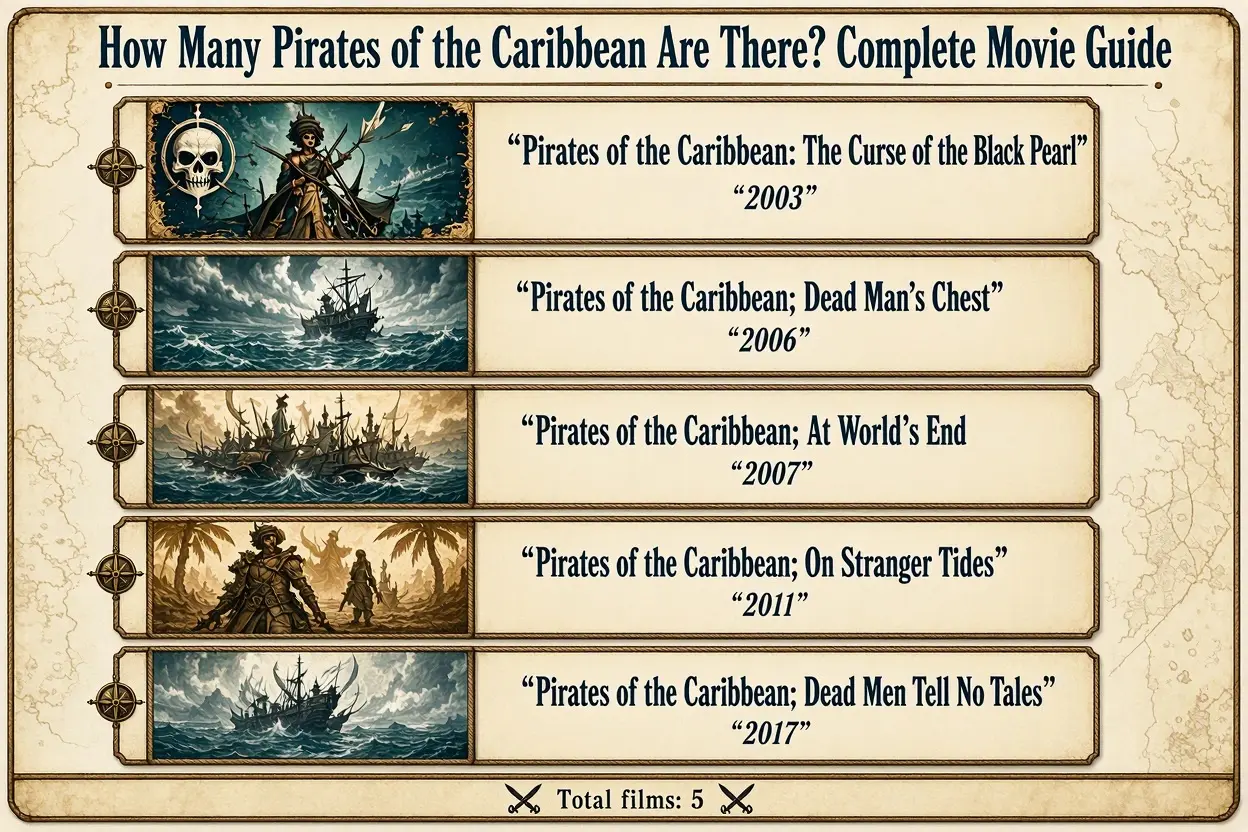
The direct answer is reassuringly simple. Five feature films have been released, and no hidden chapter sits between them waiting to confuse a newcomer. The series began in two thousand and three and its most recent feature arrived in two thousand and seventeen, so the whole run spans fourteen years of filmmaking while telling a story that stays easy to follow in the order the films reached cinemas.
Johnny Depp plays Captain Jack Sparrow throughout, and that continuity helps a great deal. Faces around him change, ships change, and the prizes being chased change, yet Sparrow remains the unpredictable thread running from the first voyage to the latest one. A viewer who starts at the beginning meets him as the audience originally did, which matters because later films assume affection for a character whose charm and chaos were established early on.
Anyone planning the perfect movie night at home around the series can treat the five features as a complete set. There is no need to hunt down television specials or extra episodes to fill a gap, because none exist as part of the main run. What sits outside the count is short and is dealt with near the end, and it does not interrupt the story told by the features themselves.
A Cursed Crew Launches the Adventure in the Opening Chapter
The story opens with Curse of the Black Pearl, which reached cinemas in two thousand and three, and in text that shorter form captures how most viewers casually refer to the film that started everything. A pirate ship with a terrifying reputation arrives at a colonial port, a young woman named Elizabeth Swann is taken, and a blacksmith named Will Turner finds himself drawn into a rescue that forces him to work alongside the very pirate he would rather see arrested.
The heart of the adventure is a curse. Treasure stolen years earlier has left Captain Barbossa and his crew caught between life and death, solid in appearance yet revealed under moonlight as skeletons, unable to enjoy food, drink or any ordinary pleasure. To lift the curse they need to return the stolen gold and settle an old debt tied to blood, which is why Elizabeth, carrying a medallion from that hoard, becomes so valuable to them.
Sparrow enters as a captain without a ship, chasing the Black Pearl that was once his. His shifting bargains drive much of the pleasure, because nobody on screen, and nobody watching, can be entirely sure which side he will serve in the next scene. The film balances sword fights, escapes and humour with a surprisingly tender thread about Will discovering where he came from and what he is willing to risk.
As an introduction it works beautifully on its own. The curse is resolved, the main characters reach a satisfying resting point, and a newcomer could stop here content. What lingers is the world itself, with its pirate codes, haunted ships and uneasy bargains, all of which invite a return without demanding one.
A Debt to a Legendary Captain Drives the Middle Films
Three years later came a voyage built around an unpaid bargain, when Dead Man’s Chest arrived in two thousand and six. Sparrow owes a debt to Davy Jones, who commands the Flying Dutchman, and Jones intends to collect. Will and Elizabeth, whose wedding is rudely interrupted, are pulled back into Sparrow’s troubles, and the search turns towards a chest whose contents could give whoever holds them power over Jones himself.
The film widens the world considerably. A monstrous kraken hunts by scent and drags ships down whole, island cannibals complicate an escape, and the crew of the Dutchman, part human and part sea creature, show what a lifetime serving Jones does to a person. The tone darkens without losing the swashbuckling energy, and the ending leaves Sparrow’s fate hanging in a way that made the wait for the next chapter feel very long indeed.
The year after that, the story continued with a rescue mission beyond the edge of the known map in At World’s End, released in two thousand and seven. Former enemies must work together, pirate lords gather for a council, and allegiances shift repeatedly as everyone tries to survive a concerted campaign by powerful trading interests to wipe piracy from the seas for good.
Together these two films and the opener form a closely connected trilogy. Debts raised in the first are paid in the second, characters introduced early reach their conclusions late, and watching the three in sequence feels like following a single long story told in three generous parts rather than three separate adventures that happen to share a cast.
A Hunt for a Fabled Fountain Refreshes the Formula
After a longer gap, the series returned in two thousand and eleven with a fresh quest, as On Stranger Tides sent Sparrow after the Fountain of Youth. This time he is swept aboard the ship of Blackbeard, the most feared pirate of the age, where an old flame named Angelica claims a family connection to the captain and keeps her own motives carefully hidden from everyone around her.
The ingredients are gathered like pieces of a ritual. The fountain demands specific chalices, a mermaid’s tear and a grim ceremony, so rival parties race one another across jungles and coastlines. Spanish forces pursue their own purpose at the fountain, missionary and mermaid form an unexpected bond, and Barbossa returns in a new role that shows how thoroughly the events of the earlier trilogy changed his fortunes and his loyalties.
Because the Davy Jones storyline had closed, this chapter stands more independently than its predecessors. A viewer could enjoy it after only a light refresher on who Sparrow and Barbossa are, though the pleasure is richer with the trilogy behind you. The film leans into a single treasure hunt with a clear destination, which gives it the feel of a classic adventure yarn rather than the sprawling, interlocking tale that came before it.
A Vengeful Adversary and a New Generation Close the Saga So Far
The fifth and most recent feature reached cinemas in two thousand and seventeen, when Dead Men Tell No Tales placed Sparrow in the sights of Captain Salazar, a ghostly naval officer with a long memory and a personal grievance. Salazar’s crew, trapped between life and death, escape their prison and set out to destroy every pirate on the sea, starting with the man they blame for their condition.
A younger generation carries much of the quest this time. Henry Turner, grown and determined, seeks the Trident of Poseidon, an artefact said to command the seas and break every curse laid upon them, because breaking curses is exactly what his family needs. He is joined by Carina, an astronomer whose scientific knowledge is treated as witchcraft by those around her and whose own past is tied to a diary, a star chart and a father she never knew.
Barbossa returns once more, drawn in by the threat to his hard won wealth and standing, and his part in the story provides some of the most emotional material in the later films. Old threads from the trilogy are gathered up rather than merely referenced, so the film works as a closing chapter for the saga as it stands, even though its own adventure is largely self contained.
It is worth stating plainly, because miscounting is common, that this is the fifth film and not the sixth. The confusion seems to arise because the short prequel discussed below sometimes gets folded into lists, and because talk of another instalment makes the series sound longer than it is. Count the features on your fingers and you will stop at five.
Release Order Doubles as the Simplest Viewing Order
Newcomers sometimes worry that story order and release order might pull in different directions, as happens with some long running series. Here they coincide exactly. Watching the features in the order they were released takes you through the events in the order the characters live them, with no flashback instalment tucked awkwardly into the middle of the sequence.
That simplicity shapes how a marathon can be planned. The combined running time of the five features is roughly twelve hours, which is far too much for a single comfortable sitting for most people, however devoted. Splitting the viewing works naturally along the lines the films themselves draw, because the opening trilogy belongs together and rewards being watched across consecutive evenings while its threads are still fresh in mind.
For readers who want the underlying record set out plainly, the film series overview on Wikipedia lays out the releases in sequence, while anyone curious about how the opening chapter was received can turn to the dedicated page for the first film for its background and reception. Both are handy reference points, though neither is needed before simply pressing play on the first feature and settling in.
A Short Prequel and Talk of Another Voyage Sit Outside the Count
One extra item regularly causes confusion. Tales of the Code: Wedlocked is a short prequel piece, made to sit alongside the features rather than among them. It offers a brief comic glimpse of events connected to Sparrow’s world before the main story, but it is a short, not a feature film, and leaving it out of a marathon costs the viewer nothing in understanding or enjoyment.
As for the future, a further instalment has been discussed in entertainment reporting, including talk during two thousand and twenty six about producer Jerry Bruckheimer and Depp and the possibility of another voyage. Discussion, however, is not a release, and it is not a confirmed production with a settled cast either. Until a new feature is actually made and released, it sits outside the count just as firmly as the short does.
So the complete picture is a tidy one. Five released features tell the story in release order, the first three forming a connected trilogy and the last two standing more alone, with a short prequel as an optional extra and any sixth chapter still only a matter of conversation. Pour a drink, dim the lights, and start where audiences started, with a cursed ship sailing out of the mist.