
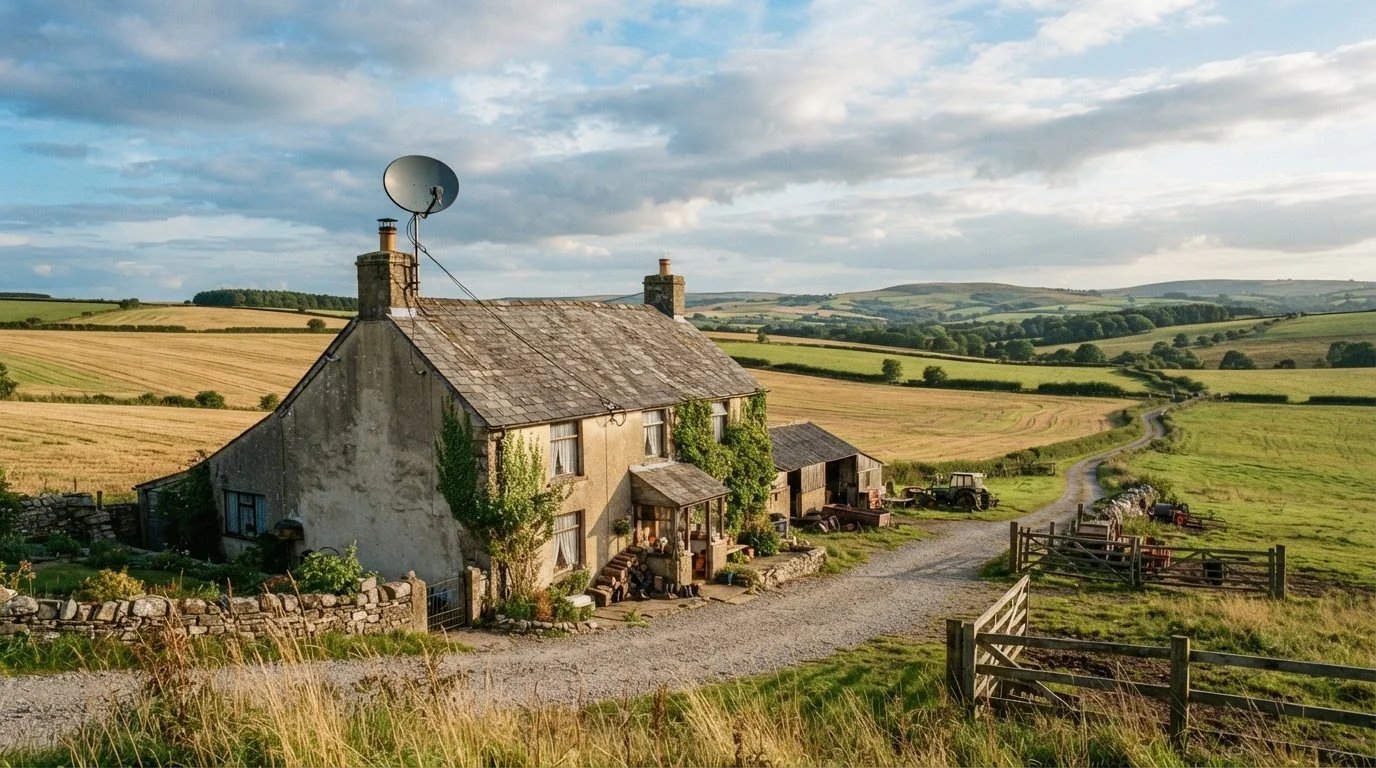
My cousin moved to a cottage in the Yorkshire Dales last year, and her first video call with us was a slideshow of frozen faces and robotic voices. “The estate agent said the broadband was fine,” she sighed, as her pixelated face froze mid-sentence for the third time. Choosing a broadband provider in rural UK areas is a completely different game from picking one in a city — the advertised speeds mean little, the technology matters enormously, and the “best” provider is often whoever has actually bothered to build infrastructure near you. Here’s how to cut through the noise.
The uncomfortable truth first: in rural areas, availability beats brand. A provider with glowing reviews is useless if their network doesn’t reach your postcode. So the process is backwards from what you’d expect — you don’t pick a provider and check coverage; you check what’s physically available at your address, then pick the best of that (usually short) list.
Broadband provider rural UK: your real options in 2026
Rural connectivity now comes in several flavours, and knowing which is which saves you from comparing apples with tractors:
- Full fibre (FTTP) — the gold standard. Speeds of 100Mbps to 1Gbps+, rock-solid reliability, no slowdown at peak times. Openreach, CityFibre, and a growing army of small “altnet” providers (like B4RN in Lancashire and Gigaclear across rural England) are rolling this out fast. If full fibre reaches your property, take it — nothing else comes close.
- Fibre to the cabinet (FTTC) — the old standard: fibre to the street cabinet, copper for the last stretch to your house. Speeds depend brutally on how far you are from that cabinet. Fine at 200 metres; miserable at 2 kilometres. This is what most rural homes still have.
- 4G/5G home broadband — a router with a SIM card instead of a phone line. Often the dark horse winner in rural areas: speeds of 30–150Mbps, no engineer visit, and setup in minutes. Three and EE generally have the strongest rural 4G coverage; check all four networks at your exact postcode.
- Starlink (satellite) — Elon Musk’s satellite service, now well established in the UK. Around 100–200Mbps virtually anywhere with a clear view of the sky, but the hardware costs ~£300+ and it’s ~£75 a month. Expensive, but transformative if you’re truly in the sticks with nothing else.
- Fixed wireless — small local providers beaming broadband from a nearby mast. Common in parts of Wales, Scotland, and Northern England. Speeds vary, but local firms often provide genuinely excellent customer service.
How to check what’s actually available
Don’t trust a provider’s own checker alone — they have a habit of being optimistic. Cross-reference:
- Ofcom’s broadband checker — the regulator’s independent view of what’s available at your address, including predicted speeds. Ofcom’s website also publishes regular reports on rural connectivity that are worth a skim.
- The provider checkers — run your postcode through BT, Sky, Plusnet, and any altnet operating in your region.
- Ask the neighbours. Genuinely the most reliable source. Knock on a door or ask in the village Facebook group what people actually get, especially at 8pm when everyone’s streaming.
- Check the mobile networks — use each network’s coverage checker at your postcode, and if possible test with a pay-as-you-go SIM before committing to a 4G/5G router contract.
Also check whether you’re eligible for the government’s gigabit broadband voucher scheme, which can cover installation costs for rural properties getting full fibre — your chosen provider usually handles the paperwork. And if you’re working from home on a rural connection, our guide to setting up a home office WiFi network that actually works covers squeezing the most from whatever speed you’ve got.
Which providers have the best rural reputation?
With the caveat that local availability rules everything, a few names come up repeatedly in rural discussions:
- BT/EE — the biggest Openreach-based footprint, so they’re available almost everywhere FTTC or FTTP exists. Not the cheapest, but the rural support experience tends to be better than the budget brands.
- Plusnet — BT’s budget sibling, consistently well-rated for customer service, and often meaningfully cheaper for the same Openreach line.
- B4RN — a community-owned full-fibre network in the rural North West and expanding. The stuff of legend locally: gigabit speeds in places the big firms ignored, built partly by volunteers.
- Gigaclear — focused specifically on rural full fibre across England, with a strong reputation where they operate.
- Three (4G/5G broadband) — unlimited data home broadband from around £20 a month, and often the pragmatic choice where fixed lines are slow.
Reliability specifically — fewest dropouts, most consistent speeds — tends to favour full-fibre providers of any brand over FTTC from anyone. A 40Mbps full-fibre line that never wavers beats a “superfast” FTTC line that collapses every evening.
Making a slow line liveable
Sometimes you’re stuck with what you’ve got for now. A few things genuinely help: position the router centrally and high up, use a wired connection for the work computer, and consider a mesh WiFi system if the signal dies in the far bedroom — see how to improve slow WiFi in an upstairs bedroom for the full playbook. For video calls, turning off HD video and closing bandwidth-hungry tabs makes a bigger difference than you’d expect.
Which? runs detailed broadband provider reviews including customer satisfaction scores, which are useful once you’ve narrowed it to two or three available options.
What speed do you actually need?
Providers love selling you 500Mbps you don’t need, so here’s a grounded guide for a typical rural household. 10–15Mbps handles one person working from home with video calls, provided nobody else is streaming in 4K at the same time. 30–50Mbps comfortably covers a family of four with mixed streaming, gaming, and home working. Above 100Mbps is genuinely nice to have — big downloads fly, and there’s headroom for everything at once — but few households can tell the difference between 100 and 500Mbps in daily use.
The number that matters more than headline speed is reliability: a steady 35Mbps that never drops beats a flaky 150Mbps that vanishes every evening. When comparing options, ask neighbours about dropouts rather than speed tests, check the provider’s minimum guaranteed speed (which Ofcom rules require them to state), and remember you can leave penalty-free if they consistently fail to deliver it. A slower line that works is worth more than a faster one that doesn’t.
The practical takeaway
Forget brand loyalty: check Ofcom’s checker, ask your neighbours, and test mobile coverage at your exact postcode. If full fibre (from anyone) is available, take it — it’s the most reliable option by a mile. If not, 4G/5G home broadband is the best-value rural workhorse in 2026, with Starlink as the premium fallback for truly remote spots. And whatever you choose, remember the line is only half the equation — decent router placement and a mesh system for blackspots will do more for your day-to-day experience than an extra 20Mbps on paper.


