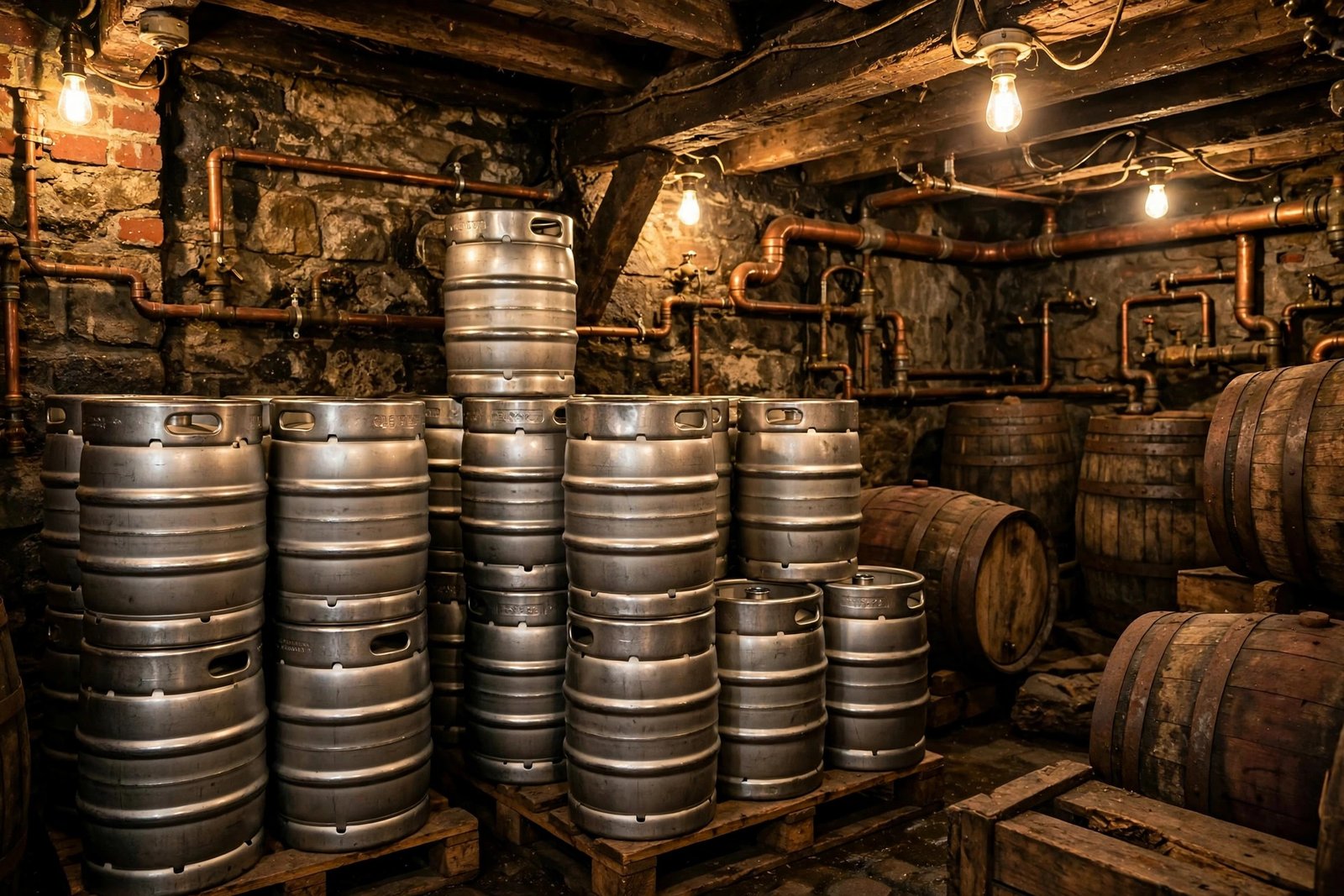
Ask how much beer a keg holds and the internet answers in American gallons, which quietly shrinks every British pint it counts. Volume is the honest place to start: litres in the keg, millilitres in the glass, and one simple division between them.
How much beer does a standard British keg actually hold?
Britain’s standard keg carries fifty litres of beer. That figure is not an arbitrary metric invention: it is the metric form of eleven imperial gallons, the older measure from which the modern keg descends. Multiply eleven by the imperial gallon in litres, four point five four six, and the result lands almost exactly on fifty litres. Anyone working through that sixth keg, measured in litres and pints or any other size is really working through the same relationship between gallons, litres and pints, whatever the container happens to be called.
Turn that volume into British pints and the arithmetic stays simple. An imperial pint is nought point five six eight of a litre, so fifty litres shared out in pints comes to eighty eight, with almost nothing left over. A standard British keg therefore contains about eighty eight proper pints by volume. That is the headline figure worth remembering, and every other size in British use can be measured against it, larger containers as multiples and smaller ones as fractions of the same honest total.
How do smaller British keg sizes compare in volume?
Below the standard size sit two smaller metric kegs that appear regularly in smaller venues and at private events. The thirty litre keg is the middle option. Thirty litres at the same measure gives fifty two point eight, so the volume works out at about fifty three British pints before any allowance is made for what never reaches a glass. Quoted slightly lower in some places, it is the same keg and the same beer; the difference is rounding and wastage, a point returned to later in full.
The twenty litre keg is the smallest of the three common sizes. Twenty litres at the same measure gives thirty five point two, so the container holds about thirty five British pints by volume. Set the three sizes side by side and the pattern is easy to hold in the mind: twenty litres gives roughly thirty five pints, thirty litres gives roughly fifty three pints, and fifty litres gives roughly eighty eight pints. Each step is proportionate, because the pint measure underneath never changes. Volume scales in a straight line, and once the standard keg is understood, the others follow automatically.
Why does an imperial gallon hold more than an American one?
The confusion begins with the gallon, a word that names two different quantities on opposite sides of the Atlantic. An imperial gallon holds eight imperial pints, which makes it four point five four six litres. An American gallon holds only three point seven eight five litres. Put the two together and the American gallon is roughly seventeen percent smaller, a little under a sixth less. That gap is not a rounding choice; the two systems genuinely measure different amounts while using identical words, which is why transatlantic keg figures mislead so reliably.
The pint carries the same trap in miniature. The imperial pint is nought point five six eight of a litre, while the American pint is nought point four seven three of a litre. An American count of pints therefore always sounds generous beside a British one, even when the container holds exactly the same beer. Reading about the keg as a container on Wikipedia helps separate the vessel itself from the measures used to describe it, because the steel is the same everywhere while the arithmetic wrapped around it changes with the country doing the counting.
How many British pints does an American keg really contain?
The big American keg is the half barrel, holding fifteen and a half American gallons. Converted honestly, fifteen and a half multiplied by three point seven eight five litres gives fifty eight point seven litres, noticeably more beer than the British standard keg. At the British pint measure, that volume comes to about one hundred and three British pints. In American pints the same keg produces a far larger sounding count, which is exactly why British readers should convert the volume first and count the pints second.
The smaller American size worth knowing is the sixth barrel, holding about nineteen and a half litres. At the same measure that gives thirty four point three, so roughly thirty four to thirty five British pints. That lands it close to the British twenty litre keg in real volume, despite the barrel language making it sound like a different creature altogether. The lesson repeats across every American size: strip the gallons away, restate the litres, and only then talk about pints. The detailed history of the pint measure on Wikipedia shows how these rival definitions developed side by side.
What about the traditional firkin and its gallon measure?
The firkin belongs to the cask tradition rather than the keg world, but its arithmetic is the cleanest of all. A firkin holds nine imperial gallons. Since an imperial gallon contains eight pints, nine multiplied by eight gives seventy two pints exactly, with no remainder, no rounding and no argument. In litres the same container holds nine multiplied by four point five four six, which is forty point nine litres. It sits, in volume terms, between the thirty litre and fifty litre kegs, while delivering the most satisfying piece of mental arithmetic in the whole subject.
That exactness explains why the firkin survived so long as a working measure. Brewers, landlords and draymen could reckon in gallons and pints without touching a decimal, because the units were designed to divide into each other neatly. Modern metric kegs trade that neatness for international consistency, and the trade is mostly a fair one, but something was lost when the counting stopped coming out even. Remembering the firkin also guards against a common mix up: it is a cask for traditionally conditioned ale, not a pressurised keg, even though its volume can be compared with keg volumes perfectly fairly.
There is a historical reason the British standard settled where it did, and it explains why the figures feel half metric and half traditional. Breweries once worked entirely in gallons and barrels, and the eleven gallon keg fitted the established handling, storage and delivery habits of the trade. When metric measures became the working language, the industry rounded its familiar container to the nearest clean figure rather than redesigning everything around an unfamiliar size. Fifty litres is that rounding made permanent. The container barely changed; only the language on its side did. Much of the confusion in modern charts is simply the residue of that translation, with older gallon based descriptions and newer litre based ones describing the same steel in different words.
A similar translation issue explains why cask and keg figures are so often placed side by side as though the containers were interchangeable. Their volumes can be compared honestly, pint for pint, but the products inside behave differently once opened, and volume alone says nothing about condition or keeping. Keeping the comparison strictly to volume, as careful sources do, avoids smuggling in claims about freshness or serving that the numbers cannot support. A firkin and a keg of similar volume hold a similar amount of beer; that is the beginning and the end of what the arithmetic entitles anyone to say.
How can you convert any keg volume for yourself?
Two methods cover every keg you will ever meet. The precise method starts from millilitres: take the volume in litres, multiply by one thousand to reach millilitres, then share the total out in imperial pints of nought point five six eight litres each. The answer is the pint count by volume. The quick method skips a step: one litre equals one point seven six imperial pints, so multiplying any litre figure by one point seven six gives the pint total directly. Fifty multiplied by one point seven six is eighty eight, which checks the standard keg without any long division at all.
- Precise method: litres to millilitres, then share the total out in imperial pints
- Quick method: multiply the litres by one point seven six
- American figures: convert gallons to litres before counting pints
- Gallon check: multiply imperial gallons by eight for exact pints
Keep those two routes in mind and no supplier’s chart, American blog or pub argument can mislead you for long. Every claim reduces to a volume and a division. If a quoted pint count cannot be reproduced by one of these methods, the fault lies in the quote, usually in an American pint hiding inside a British conversation. Checking takes seconds, and it is the only reliable way to compare containers described in different units by different countries.
Why do published pint counts differ slightly between sources?
Given the arithmetic is so tidy, why do published counts disagree by a pint or two? The first reason is simple rounding. Fifty two point eight pints cannot be poured as a fraction in a summary table, so one source rounds up to fifty three while another rounds down, and both are describing the identical thirty litre keg. Decimal remainders vanish in presentation, and readers comparing two rounded figures can easily believe they are looking at two different containers when nothing but the rounding rule has changed between them.
The second reason is wastage. A small amount of every keg never reaches a glass, lost to foam and to what remains unusable in the container, so some sources quote the theoretical volume while others shave a little off and quote what pouring realistically delivers. A thirty litre keg described as holding about fifty two pints with a wastage allowance and the same keg described as about fifty three pints by pure volume are not contradicting each other; they are answering slightly different questions. Judge any count by whether it states its basis, and treat small disagreements as bookkeeping rather than mystery.