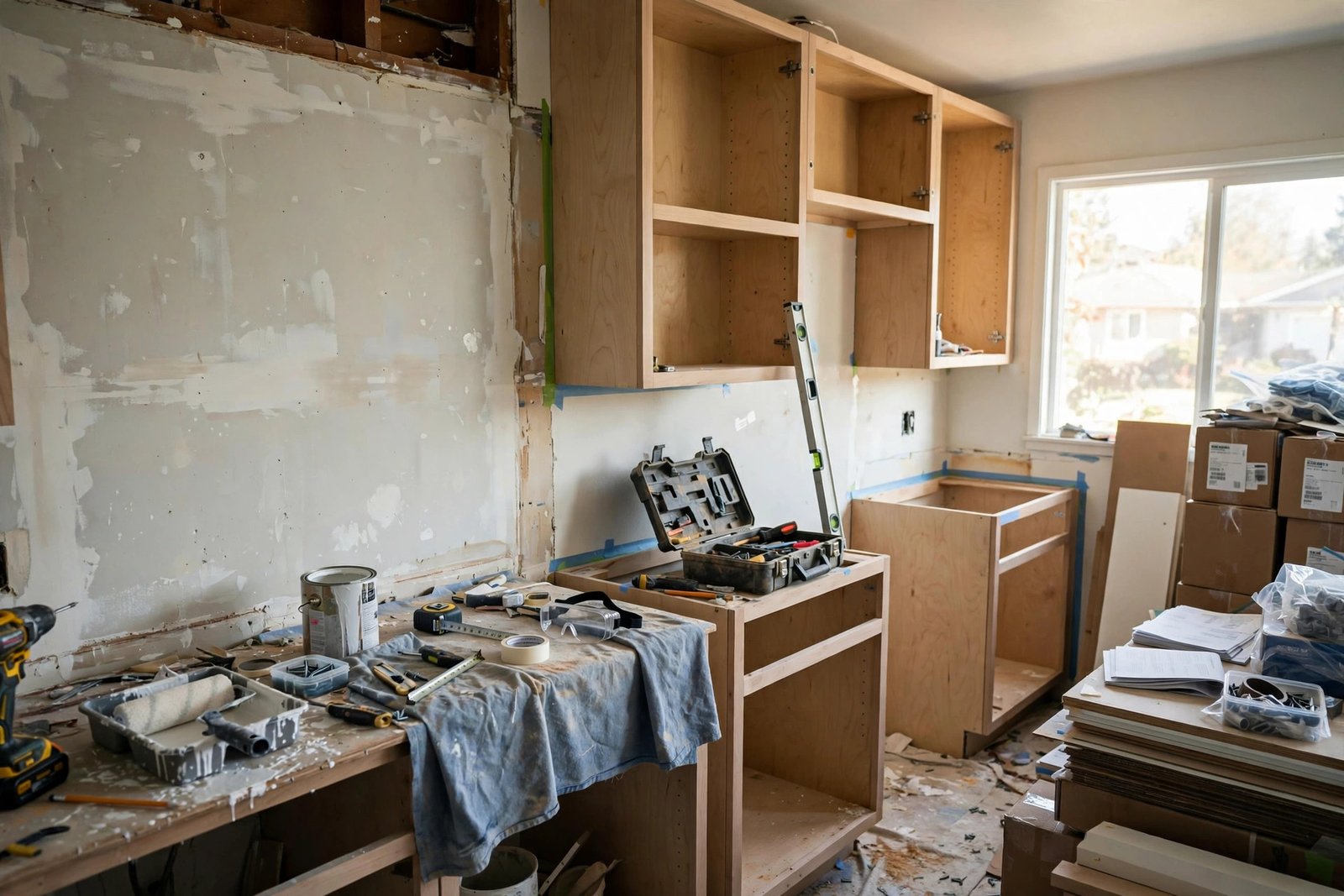
Kitchen budgets die by inches, rarely by one grand mistake.
A kitchen renovation rarely collapses because of one reckless purchase. It collapses gradually, through a budget written in hope, a layout moved on a whim, trades chosen on the lowest quote, flat-pack savings that dissolve at fitting time, appliances bought before measurements existed, and a scope that grows a little every week until the money runs out before the room does. Together the risks compound, because a kitchen is the most serviced room in the house: water, waste, gas, electricity and heavy daily use all meet in a few square metres, and changing anything tends to disturb everything. Keeping a renovation affordable is therefore less about hunting bargains and more about refusing the known traps in the right order.
Budgets Built on Hope Collapse by the Second Week
The first risk is the budget itself, written backwards from the sum available rather than forwards from the work required. A hopeful budget lists the visible items, units, worktops, flooring and a lick of paint, and treats everything beneath the surface as somebody else’s problem. Then the old kitchen comes out and the real room introduces itself: pipework past its best, wiring that predates modern standards, a floor that slopes, a wall that turns out to be doing more structural work than anyone assumed. None of these discoveries is unusual in an older British house; what is unusual is a budget with room in it to absorb them. A budget built on hope has none, so the first surprise is paid for by raiding the fund meant for the second, and by the second week the project is financing itself by quiet borrowing from its own later stages.
An honest budget starts by separating the certain from the speculative. The certain items are quoted, measured and chosen. The speculative items, everything hidden behind units and under floors, are given room rather than precision, and a contingency is held back as a deliberate line in the plan, not as whatever happens to remain at the end. Households also forget to budget for living through the work: weeks of makeshift cooking, perhaps with one dependable pan kept in good order, the sort of workhorse maintained by seasoning a cast iron skillet properly, plus takeaways and the small daily costs of a house mid-upheaval. Counting the disruption as a real cost protects the main budget from small leaks that never appear on any quote.
Moving Pipes and Wires Eats the Contingency
Few decisions burn money faster than moving the services. A sink under the window is a convention because the plumbing already lives there; relocating it across the room means new supply runs, new waste runs, floors lifted and walls opened, all before a single attractive thing has been bought. Moving a cooker point, especially a gas supply, carries the same lesson with added regulation, and shifting sockets and lighting circuits multiplies electrician time in ways a sketch on paper never shows. Sometimes the move is genuinely worth it, because a badly placed sink or hob poisons every day the kitchen is used. Often, though, the layout is being moved for novelty rather than need, and the same improvement in feel could be had from better storage, lighting and worktop space within the existing arrangement.
The classic defence is blunt: keep the layout unless the layout is the problem. Work through the wider logic of home improvement projects and planning and the principle repeats itself across every trade, that the cheapest service run is the one already buried in the wall, tested and working. Where a move is unavoidable, price it as its own itemised job before committing, including the making good afterwards, because opening a wall is quick while reinstating it neatly is neither. Photograph every opened wall before it is closed again, too; a record of where pipes and cables run is worth real money the first time anyone drills or repairs.
Trades Chosen on Price Alone Cost Twice
The third risk wears a friendly face: the cheapest quote. A kitchen touches several trades, and the builder, plumber, electrician or fitter who bids far below the others is rarely offering the same job more efficiently. Something is missing, usually the unglamorous parts: proper preparation, adequate time, decent fixings, waste removal, or the return visit when something settles and needs adjustment. The saving then reappears as a cost, paid to the same tradesperson in extras, or to a second one hired to put the first one’s work right, which is the most expensive sequence in all renovating. Chosen on price alone, trades also tend to be chosen in a hurry, without references followed up, without written terms, and without any agreement about what happens when the schedule slips, as kitchen schedules do.
Vetting properly is unglamorous and highly effective. Ask for recent, local work you can see or customers you can speak to, and be suspicious of anyone offended by the question. Get the scope in writing, itemised enough that both sides know what is included: who supplies what, who disposes of the old kitchen, who makes good the plaster. Agree payment stages tied to completed stages of work rather than to dates, and keep the final payment until the room is finished and snagged, because money already handed over is leverage already handed over. For gas work, use an engineer on the Gas Safe register, and for electrical work expect certification under the building regulations; these are not bureaucratic niceties but the difference between work that is insured and safe, and work that becomes a problem the day the house is sold.
Flat-Pack Savings and the Fitting Bill Behind Them
Flat-pack kitchens promise the most visible saving in the whole project, and the promise is partly real: self-assembly units can be well made and far cheaper to buy than their rigid counterparts. The trap is that the purchase price is only the opening chapter. Assembly takes time, skilled time if the room is old and its corners are not square, and a fitter who quoted happily for rigid units may charge very differently for a mountain of panels, or decline the fiddly work of scribing units into uneven walls altogether. Handles, end panels, plinths, cornices and the filler pieces that make a run of boxes look built-in all sit outside the headline price, quietly queuing at the till. Add delivery in stages, missing parts discovered mid-fit, and the cost of your own weekends if assembly is a do-it-yourself plan that collides with real life.
None of this rules flat-pack out; it rules out comparing it dishonestly. Compare the finished, fitted, working kitchen, not the boxed one: units plus assembly plus fitting plus every trim item, against the same total for the alternatives. In a square, modern room with a willing fitter, flat-pack often wins that honest comparison. In a crooked period terrace where every unit needs persuading, the saving shrinks and can invert entirely. The same honesty applies to worktops bought as bargain blanks, which still need cutting, sealing and fitting around sinks and hobs, the skilled hours where the real cost of any surface lives.
Appliances Bought First Distort Every Later Choice
Buying appliances first feels like progress and behaves like a trap. A range cooker bought in a sale dictates the width of the gap, the position of the supply and sometimes the whole run of units, before the room has been measured by anyone who will fit it. An American-style fridge freezer, chosen for its looks, can commit the design to a deep recess, a wider door swing and a route into the house it may not physically fit through. Integrated appliances are stricter still, sized to specific housings and door fronts, so one early purchase quietly forbids a whole family of later, cheaper choices. The discounts that tempt people into buying early are real but small; the distortion they cause runs through every subsequent decision, and returning a large appliance bought months earlier, once the design has moved on, is rarely as simple as the receipt suggested.
Sequence is the whole remedy. Measure the room properly, settle the layout, design the units, and only then choose appliances to fit the spaces the design provides, keeping a written note of every aperture and service position they require. Think of the room throughout as the kitchen as a working room rather than a showroom, where the hob, sink and fridge form the daily triangle of movement and everything else is storage arranged around them. Where an old appliance still works, keeping it through the renovation and replacing it later, when the budget has recovered, is an honourable strategy that showrooms will never suggest. A kitchen does not fail because its oven is last year’s model; it fails because its money ran out before its floor went down.
Scope Creep, Regulations and the Resale Test
The final risk is the project that refuses to stay the same size. It begins innocently: while the floor is up, why not move that radiator; while the walls are open, why not add a utility corner; the new units make the old ceiling look tired, so the ceiling joins the list. Each addition is small, defensible and unbudgeted, and together they are scope creep, the most reliable budget-killer of all because it arrives disguised as efficiency. The discipline is to keep a written scope and treat every addition as a swap rather than an extra: if the ceiling joins, something of equal weight leaves, or the addition waits for a later phase with its own budget. Phasing is no defeat. A kitchen finished completely at a modest scope beats a grander one abandoned half-tiled, every time, both to live in and to sell.
Regulations and resale close the argument. Work on gas and electrics carries legal requirements, some building work needs approval or certification, and a house sold without the paperwork hands buyers a reason to chip the price or walk away. Keep every certificate, invoice and photograph in one folder from the first day. Then apply the resale test to the plan as a whole: money spent on layout sanity, sound services, durable worktops and storage that fits how people actually cook tends to show in a valuation; money spent on fashionable extremes tends to date in the photographs of the next sale. Renovate for the household that lives there now, but let the test of the stranger viewing it in years to come veto anything merely whimsical.