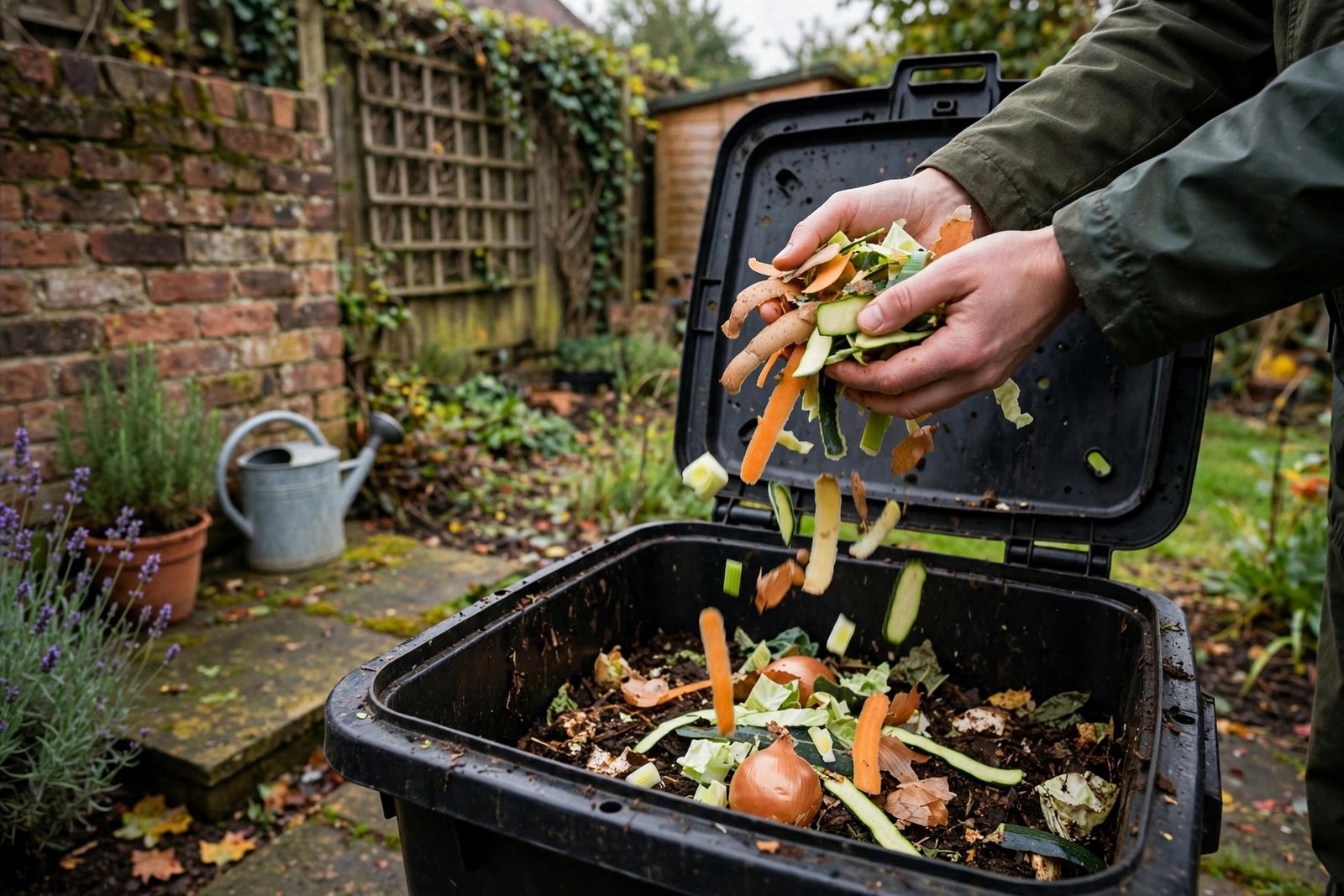
Every year, the average UK household bins around 70kg of food waste per person that could have been eaten — and a huge share of the inedible remainder (peelings, cores, coffee grounds, eggshells) goes in the same bin, off to landfill, where it rots into methane. Composting at home short-circuits the whole sorry chain: your potato peelings become next year’s tomato feed, your bin gets lighter and less smelly, and your garden gets free soil improver that garden centres charge £6 a bag for. In Durham, where the council’s garden waste collections are subscription-based and food waste collections vary, home composting on a tight budget is not just eco-worthy — it is the financially rational move. This guide covers the how, the what, and the honest costs.
Why Compost? The Three Payoffs
Money: a cubic metre of finished compost replaces £40–£60 of bought soil improver. A productive home compost setup yields 200–400 litres a year — £30–£60 of value annually, every year, from stuff you were paying (in council tax and bin space) to throw away. Garden: compost is the single best soil improver for Durham’s often-heavy clay soils — it opens structure, feeds worms, holds moisture in summer and releases nutrients slowly. Nothing bought in a bag does all four. Climate: food waste in landfill generates methane (~80x CO2’s warming power over 20 years); composted aerobically, the same waste generates mostly CO2 and stable humus. Home composting is among the highest-impact per-pound climate actions available.
The Budget Setup: Under £30 All-In
Forget the £150 tumblers (nice, unnecessary). The budget composter’s kit:
- The bin: Durham County Council has historically offered subsidised compost bins (~£15–£25 via getcomposting.com schemes — check current availability); or build a pallet bin free (three pallets wired in a U-shape, the classic allotment build); or simply a heap in a discreet corner (free, slightly slower, totally functional). A 220-litre “dalek” bin is the sweet spot for beginners.
- The caddy: a kitchen caddy with compostable liners (£8–£12 for the caddy, liners ~£5 for a year’s supply) — the thing that makes the habit stick, because the distance from chopping board to bin determines compliance.
- A fork: for turning (optional monthly; a garden fork you own is fine).
- Browns stockpile: cardboard, newspaper, dry leaves — free, and the ingredient beginners always under-supply (see below).
Total: £0–£30. Payback: first year, in compost value alone — before counting the lighter bin and the better soil.
What Goes In: The Greens and Browns System
Composting has one rule that matters: balance nitrogen-rich “greens” with carbon-rich “browns,” roughly 50/50 by volume (beginners should lean brown-heavy — excess browns just slow things; excess greens create the smelly anaerobic sludge that puts people off).
Greens (nitrogen, the activators): fruit and veg peelings, cores and trimmings; tea bags (check they are plastic-free — many still contain polypropylene; snip and compost the leaves, bin the bag if unsure); coffee grounds and filters; grass cuttings (in thin layers — a thick mat of grass goes slimy); annual weeds before they seed; eggshells (crushed).
Browns (carbon, the structure): cardboard (torn up, tape removed), newspaper and egg boxes, dry autumn leaves (the gold standard — stockpile bags of them), straw, wood chips, toilet roll tubes, natural-fibre dusters at end of life.
Never compost: meat, fish, dairy and cooked food in an open bin (rats — the one thing that turns neighbours against composting); glossy magazines; coal ash; cat/dog faeces (pathogens — though dedicated pet-waste composters exist for ornamentals only); perennial weed roots (docks, bindweed, couch grass — they survive home composting temperatures); diseased plants.
The Method: Lazy Composting That Works
1. Site it right: level ground, partial shade (full sun dries it out; full shade slows it), direct soil contact underneath (lets worms in — the unpaid workforce), and convenient to the kitchen (compliance decays with distance). 2. Start with browns: a 15cm layer of coarse browns (twiggy prunings, torn cardboard) for drainage and airflow. 3. Layer as you go: each addition of kitchen greens gets a handful of browns on top — this single habit prevents 90% of smell and fly problems. 4. Keep it damp as a wrung sponge: in Durham’s climate, rain usually suffices; in dry spells, a watering can’s worth. 5. Turn occasionally: monthly turning with a fork speeds things dramatically; never turning still works, just slower (12–18 months vs 6–9). 6. Harvest from the bottom: finished compost is dark, crumbly and earthy-smelling — fork it out from the base hatch, sieve out the chunky bits back into the top.
Troubleshooting: The Four Classic Problems
Smells bad (rotten eggs): too many greens, too wet, no air — add browns, turn it, stop adding grass in thick layers. Flies: exposed food — always cover fresh additions with browns; a sheet of cardboard on top works wonders. Not heating up: usually too small (a dalek needs to be fairly full to heat), too dry, or too brown-heavy — add greens, water, and wait; small cool heaps still compost, just slowly. Rats: almost always meat/dairy/bread in the bin — remove the attractant, ensure a tight lid, and consider a wire mesh base. A correctly-run greens/browns bin does not attract rats.
For the waste-reduction context, reducing household food waste tackles the edible fraction upstream, and growing vegetables in a small garden gives the finished compost its highest-value job.
Wormeries and Bokashi: The Upgrades
Two systems worth knowing: wormeries (£60–£100) — tiger worms convert kitchen waste to superb vermicompost and liquid feed in a compact stackable unit, ideal for small yards and patios, odourless when run right. Bokashi (£35–£50 for the two-bucket kit plus bran): a fermentation pre-treatment that handles all food waste including meat and dairy — the fermented output then goes into the compost bin or is buried. Bokashi is the answer for households whose main waste is cooked food. Neither is necessary for beginners; both are excellent second-year upgrades.
Conclusion
Composting food waste at home on a tight budget in Durham costs £0–£30 to start, takes five minutes a week, and returns £30–£60 of soil improver a year while shrinking your bin, de-smelling your kitchen waste, and cutting your household’s methane footprint. The method is one rule (balance greens with browns), one habit (cover every addition), and one patience (nature does the rest). Get the subsidised bin or build the pallet bay this month, put the caddy by the chopping board, and by next spring you will be forking dark, sweet-smelling compost onto the garden — made from nothing, worth everything.
Frequently Asked Questions
Can I compost in a small yard with no garden?
Yes — a wormery or bokashi system fits on a patio or balcony and handles a household’s veg waste odourlessly. Even a 220-litre dalek bin tucks into a 1m² corner. The only genuinely unsuitable setup is no outdoor space at all — in which case, check Durham’s food waste collection options or a community composting scheme. The Recycle Now site maps local composting schemes and subsidised bins by postcode.
How long does compost take to make?
A well-managed hot-ish bin: 6–9 months. A lazy unturned heap: 12–18 months. A wormery: 3–6 months for the first harvest, then continuous. Start now and the “wait” is just the first cycle — after that, with a two-bin or continuous system, finished compost is always coming available.
Does composting attract rats?
A correctly managed bin (no meat, fish, dairy or cooked food; lid on; browns covering additions) does not. Rats are attracted to food, not to composting — an open kitchen bin bag attracts more rats than a closed compost bin. If rats are already present, a mesh base and the bokashi pre-treatment route eliminate the issue.
What is the difference between compost and mulch?
Finished compost is fully decomposed humus — dark, crumbly, sweet-smelling — dug into soil or used in potting mixes. Unfinished or coarse material spread on the surface is mulch. Both are valuable; compost feeds the soil biology, mulch suppresses weeds and retains moisture. Your bin produces both at different stages.
Where can I get a cheap compost bin in Durham?
Check Durham County Council’s website for current subsidised-bin schemes (historically via getcomposting.com at significant discounts), Freecycle/Freegle and Facebook Marketplace for free secondhand daleks, and allotment associations for pallet-bin building advice. The charity Garden Organic offers free composting guides for every system type.