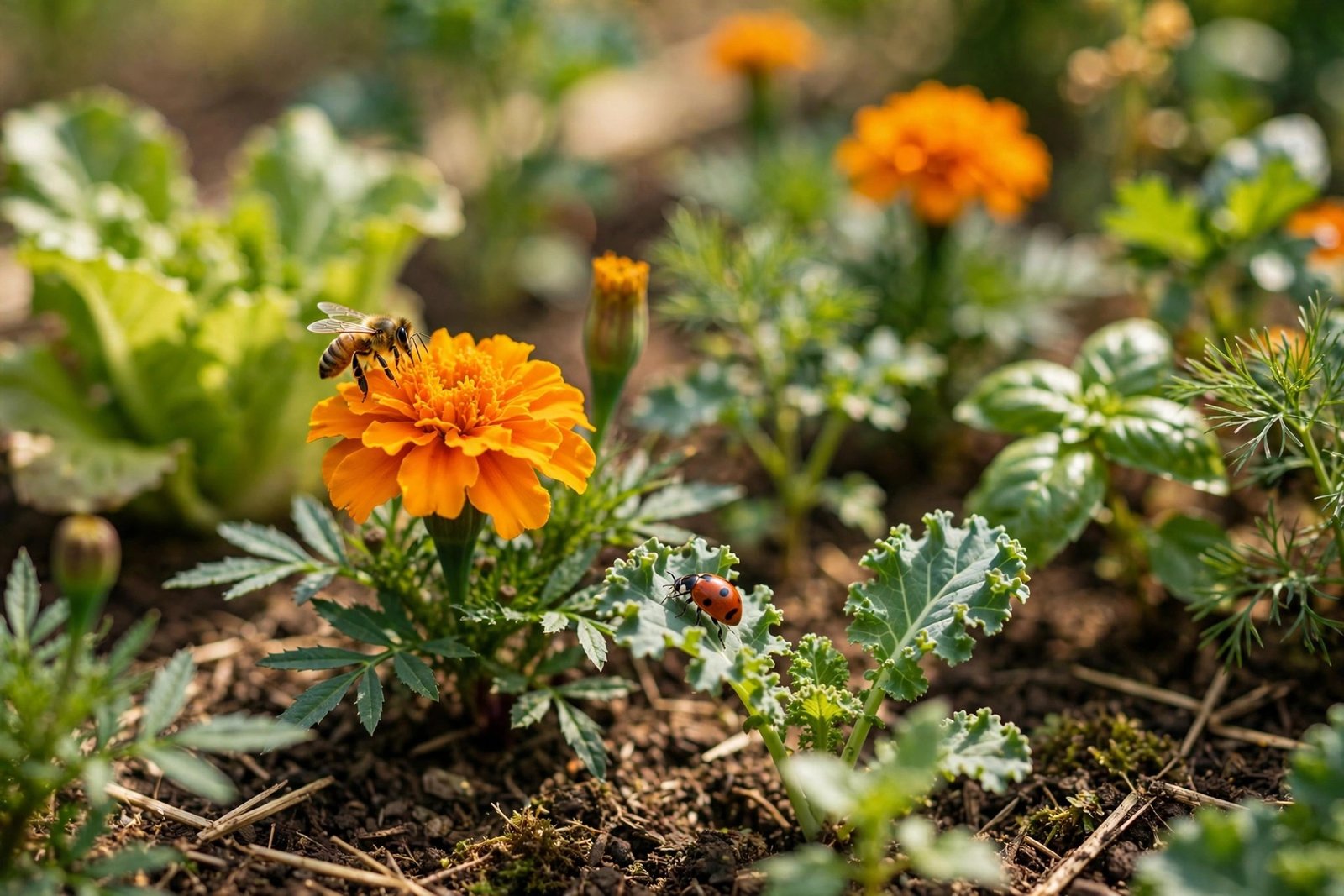
Plant basil next to tomatoes and both thrive. Marigolds among the vegetables and the aphids stay away. Onions near carrots and the carrot fly gets confused. Companion planting — growing specific plants together for mutual benefit — is one of gardening’s most appealing ideas: natural, chemical-free, almost folk-magical. But how much of it actually works, and how long does it take to understand it well enough to see real results?
The honest answer: the core concepts take an afternoon; seeing results takes one full growing season; and separating the science from the folklore takes a discerning eye. Here is the complete beginner’s guide.
What Companion Planting Claims (and What Is True)
The claims cluster into four mechanisms. Pest confusion: strongly scented plants (onions, garlic, marigolds) mask the scent of target crops from pests — plausible and partially evidenced; intercropping onions with carrots measurably reduces carrot fly. Trap cropping: sacrificial plants lure pests away from crops — genuinely effective; nasturtiums draw aphids away from vegetables reliably. Beneficial insect attraction: flowers (alyssum, marigolds, umbellifers like dill) attract hoverflies, lacewings, and parasitic wasps that eat pests — well evidenced; this is companion planting’s strongest scientific leg. Nutrient sharing: legumes fix nitrogen benefiting neighbours — true but slow; the benefit accrues over seasons as roots and residues break down, not instantly.
And the folklore: the famous “Three Sisters” (maize, beans, squash) is genuine indigenous agricultural science — the beans fix nitrogen, the maize provides support, the squash shades weeds. But many companion charts circulating online are untested tradition — pairings repeated for decades without trials. The discerning beginner’s rule: mechanisms with ecological logic + some evidence = worth trying; mystical pairings with no mechanism = skip.
Learning It: An Afternoon’s Work
The conceptual understanding is quick because the principles are few. Afternoon 1 (2–3 hours): learn the four mechanisms above, the dozen most reliable pairings (below), and the ecological reasoning — diversity confuses pests, flowers feed predators, legumes feed soil. The RHS companion planting guidance gives the evidence-based version, free; Garden Organic’s resources add the organic-growing perspective.
The reliable dozen — pairings worth planting in year one: nasturtiums near brassicas and beans (aphid trap crop); marigolds (French, the strongly scented type) throughout vegetables (whitefly and aphid deterrence, hoverfly attraction); onions/garlic with carrots (carrot fly confusion); basil with tomatoes (whitefly deterrence, and they taste good together); dill and fennel flowers near vegetables (beneficial wasp attraction); clover or vetch as living mulch under crops (nitrogen, weed suppression); sunflowers at bed ends (aphid trap, beneficial habitat); sweet alyssum edging beds (hoverfly magnet — the single best beneficial-insect plant for small gardens).
Seeing Results: One Full Season
Here is the timeline nobody advertises: companion planting is ecological, not chemical — it works by building relationships (predator populations, soil biology, plant communities) that take a season to establish. Weeks 1–4: plant the companions; nothing visible happens — this is normal. Months 2–3: flowers bloom, beneficial insects arrive, trap crops start intercepting pests — the first observable effects. Months 4–6: the system matures — noticeably fewer pest outbreaks than unplanted beds, healthier plants, the “it works” moment. Year 2+: compounding — overwintering beneficial habitat, improved soil, established rhythms.
The measurement problem: companion planting’s effects are comparative — fewer aphids than last year, less damage than the unplanted bed. Beginners who plant companions everywhere cannot tell what worked. The learning hack: leave one bed uncompanion-planted as a control. The comparison teaches more in one season than any book. And realistic expectations matter — companions reduce pest pressure; they do not eliminate it. A bad aphid year still needs intervention (more on which below).
What Companion Planting Cannot Do
Honesty requires the limits. It will not save a bad site: companions cannot fix deep shade, waterlogging, or starved soil — get the fundamentals right first. It will not stop determined pests: cabbage white butterflies find brassicas regardless of marigolds; physical barriers (fleece, netting) remain essential for some crops. Some pairings compete: vigorous companions can outcompete the crops they are meant to help — allelopathic effects (fennel suppressing neighbours is documented) and simple resource competition are real. The evidence is thin for many claims: enjoy the folklore, but do not bet the harvest on untested pairings.
Think of companion planting as one layer of integrated pest management, alongside healthy soil, appropriate varieties, physical barriers, and manual intervention. The gardeners who succeed with it are the ones who treat it as ecological support, not magic. For the inevitable aphid invasions that companions only blunt, know your direct controls too — small-space vegetable growing always involves some pest management, and choosing the right plants for tough spots follows the same right-plant-right-place logic.
The Science Debate: What Researchers Actually Say
Companion planting sits in an interesting scientific position: widely practised, thinly researched. Agricultural science has validated specific mechanisms thoroughly — intercropping for pest confusion is well documented in field trials, floral resources boosting beneficial insects is robustly evidenced, and trap cropping has decades of research behind it. These are not folk tales; they are applied ecology.
But the specific pairings in popular companion-planting charts are mostly untested. Few trials have examined whether basil genuinely improves tomato flavour (a beloved claim) or whether the classic “enemies” pairings actually harm. The gap exists because research funding follows commercial agriculture, not home gardening — the trials simply have not been run. The honest scientific position: the principles are sound, the specifics are often tradition.
What this means for beginners: trust the mechanisms, test the pairings. Your garden is a laboratory — the control-bed method described above is genuine citizen science. The companion planters who contribute most to knowledge are the observant ones who record what actually happened, not the ones who follow charts blindly. In a field this under-researched, the careful beginner’s observations are genuinely valuable.
The Bottom Line
Understanding companion planting takes an afternoon (four mechanisms, a dozen reliable pairings, ecological reasoning); seeing real results takes one full growing season (the ecology needs time to establish); and mastery takes years of observation. Start with the evidence-based pairings — nasturtium traps, marigold borders, alyssum edging, onion-carrot intercropping — keep one control bed for comparison, and treat it as support, not magic. The garden becomes a community, not a collection of individuals — and that shift in thinking is the deepest result of all.
Frequently Asked Questions
Does companion planting really work?
The evidence-based pairings do: trap crops (nasturtiums for aphids), beneficial-insect flowers (alyssum, marigolds), and scent-confusion intercropping (onions with carrots) all have real effects. Many traditional pairings lack rigorous testing.
How long before companion planting shows results?
One full growing season — the ecological relationships (predator populations, soil biology) take months to establish. First observable effects typically appear 2–3 months after planting, with the full “it works” moment arriving in months 4–6 as the planted community matures.
What are the best companion plants for beginners?
French marigolds, nasturtiums, sweet alyssum, basil, dill, and onions/garlic — all easy, all with genuine effects, all useful in their own right.
Can companion planting replace pesticides entirely?
Not entirely — it reduces pest pressure as part of integrated management, alongside healthy soil, resistant varieties, and physical barriers. It is support, not magic.