The cheaper house is the one that costs less across ten winters.
At the Offer: the Price Each Asks Today
The comparison begins, as buyers naturally begin, with the asking prices on the screen. In Inverness, as in most places, the older home usually asks less. Its rooms may be larger, its street settled, its garden grown, yet the figure sits below the new build of similar size because the market prices in everything the older house will need. The new build asks more and defends the premium with newness itself: untouched systems, modern standards and a warranty standing behind the structure. On the day of the offer, the older home wins the price argument easily, and that is exactly why the argument must not be allowed to end there.
What each price is really buying deserves a slower look. The new build’s premium purchases a beginning with no backlog: no previous owner’s deferred repairs, no wiring of uncertain vintage, no roof quietly ageing toward its expensive years. The older home’s discount is not a gift either. It is the market’s rough estimate of the work and risk being handed over with the keys, and it can be generous or tight-fisted depending on how thoroughly the buyer inspects. Heating belongs near the top of that inspection, because a tired heating system shapes both comfort and cost from the first week, which is why careful buyers read up on choosing the right boiler for a family house before they need one, rather than in a cold kitchen afterwards.
Incentives blur the day one picture further. Developers sometimes sweeten new builds with contributions, upgrades or help with moving costs, each of which narrows the visible gap without changing the underlying prices. Older homes negotiate differently, through the offer itself and through whatever the survey brings to light. The disciplined buyer strips both sides back to a comparable total: price, immediate essential work and the costs of the purchase itself. Only then does the timeline that follows rest on honest foundations.
The First Winter: Heating Bills Tell the Truth
The first Highland winter is the audit no viewing can simulate. Wind finds the gaps that summer hid, daylight shrinks to a brief appointment and the heating runs for long hours in any home that is lived in properly. Here the new build’s construction tells in its favour. Modern insulation, modern glazing and a heating system designed for the building’s size hold warmth in a way that older construction, however charming, rarely matches without significant work. The bills that arrive through that first season are not a surprise so much as a revelation of what the walls have been saying all along.
The older home’s winter story depends heavily on what its previous owners did or neglected. Some older houses have been insulated, reglazed and reheated with care, and they perform far better than their age threatens. Others carry single glazing, uninsulated lofts and a boiler kept alive by habit, and their first winter teaches an expensive lesson in draughts. This is why the certificate and the survey matter before purchase rather than after: background reading on energy performance certificates and ratings explains what the ratings are estimating, and winter has a way of agreeing with them.
Comfort belongs in this phase beside cost. A home that is cheap to heat but cold in the corners has not won anything worth having, and a warm older home whose bills are higher may still be the better place to live for a family that values its rooms. The budget question is narrower and should be kept narrow: which home leaves the household less exposed when the coldest months do their worst. On a tight budget, exposure matters more than averages, because the bad month is the one that has to be paid.
Years Two to Five: Repairs Wake Up in Older Homes
After the first winter, the timelines diverge along a predictable line. The new build enters a quiet period where the structure and systems are young, defects are the builder’s problem under warranty and the owner’s maintenance list is mostly cosmetic. Snagging issues appear, certainly, and should be pursued with the developer while the warranty is fresh, but the years are comparatively peaceful. The house costs its mortgage, its bills and very little else that was not planned.
The older home, in the same years, begins presenting the deferred items in something like order of age. Roof repairs, guttering, rendering, window seals, ageing electrics, plumbing that has outlasted its design life: each arrives as a separate decision, rarely at a convenient moment, and their combined weight across a few years is the true second price of the cheaper purchase. A full building survey before buying earns its keep precisely here, because it converts these future ambushes into a known list that can be priced, sequenced and sometimes negotiated into the offer.
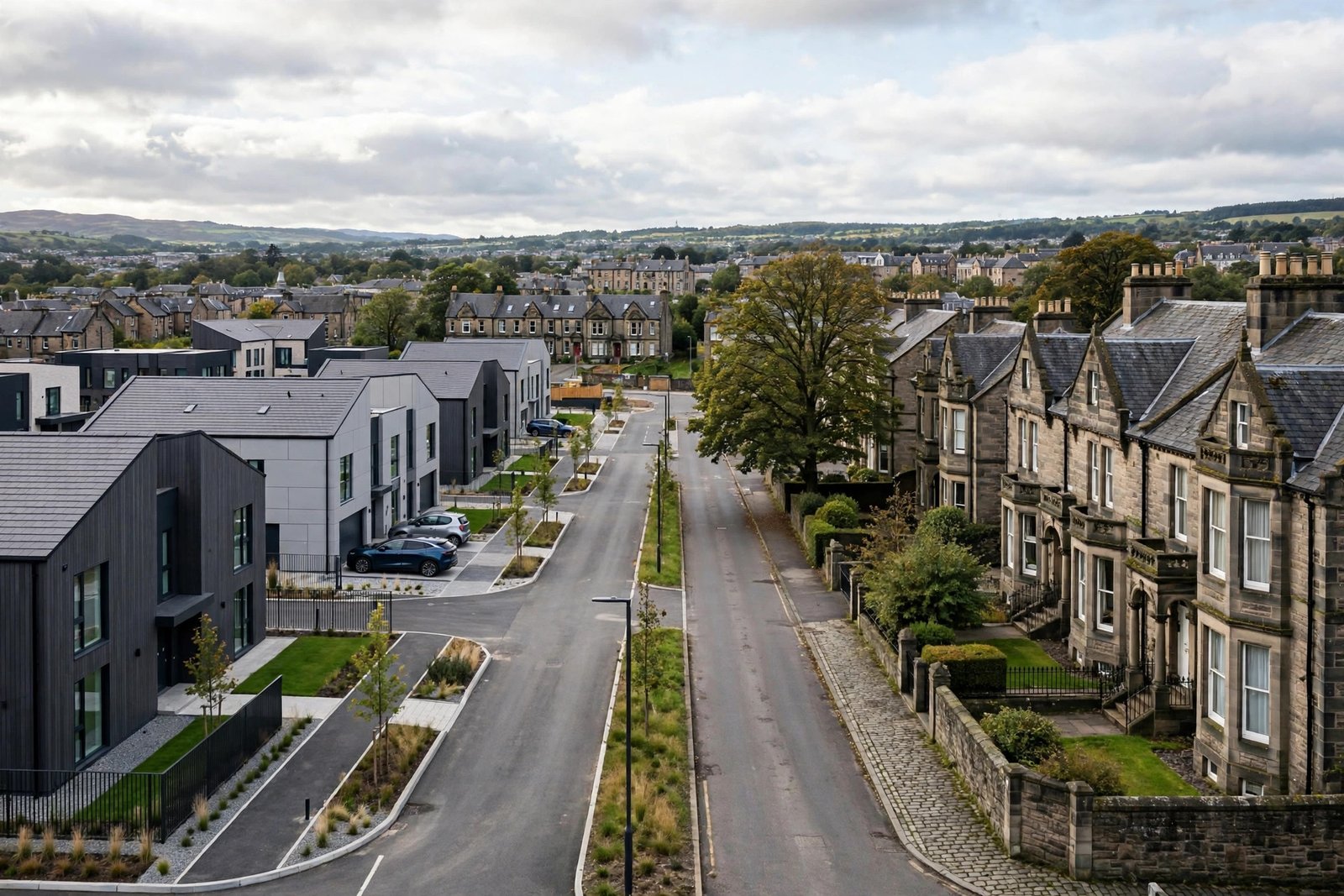
Character is the older home’s counterweight in these years, and it should not be priced at nothing. Inverness and its surroundings hold streets of stone built homes whose proportions, fireplaces and solid construction carry a quality new developments rarely attempt, and a grounding in Victorian architecture and the older housing stock helps a buyer see which features are assets to preserve rather than problems to solve. Owners who love their older homes tend to experience repairs as stewardship. Owners who merely bought them cheaply experience the same repairs as betrayal. The difference was set at the viewing, in what each buyer honestly expected.
Along the Way: Charges Hiding in New Estates
Running alongside the repair story is a quieter charge that belongs mostly to the new side of the comparison. Many new developments include roads, verges, play areas and drainage that the local council has not adopted, and the cost of maintaining those shared spaces falls on the homeowners through estate charges collected by a management company. The amounts are not usually dramatic in any single year. Their significance lies in their permanence and their growth: they continue for as long as you own the home, they can rise, and they arrive in addition to the ordinary council tax rather than instead of it.
Buyers miss these charges because they are rarely part of the sales conversation and because a new estate, freshly landscaped, does not look like a place with obligations attached. The questions belong at the reservation stage: what is charged, for what, by whom, with what record of increases and what say residents hold over the company collecting it. Answers exist in the purchase paperwork, and a solicitor can surface them, but only a buyer who asks early weighs them while walking away is still a live option rather than a regret.
Older streets have their own shared obligations from time to time, particularly where private roads or shared drainage exist, yet the pattern is less systematic than on a new estate where unadopted infrastructure is part of the design. The fair comparison therefore adds the estate charge to the new build’s running costs across the whole timeline, just as it adds expected repairs to the older home’s. Symmetry is the entire method: no side may leave its recurring costs out of the photograph while insisting the other side poses in full.
At Resale: What the Next Buyer Will Pay For
Years along, both homes meet the market again, and the resale chapter reframes everything before it. The new build, by then simply a modern home among others, has usually shed the premium that newness commanded, because the next buyer compares it with homes of its age rather than with the show home it once was. Its lasting resale strengths are the ones that were real all along: energy performance that future buyers increasingly prize, a layout suited to modern life and systems with years left in them.
The older home resells on a different mixture. Its value rests on location, character, the condition its owners maintained and the work they can prove was done, which is why keeping records and guarantees from the repair years matters financially and not merely administratively. An older home bought below its street’s ceiling and improved steadily can repay its owner handsomely in standing and in price. One bought cheaply and then starved of the very maintenance its discount anticipated will carry that neglect into its valuation, written plainly for the next surveyor to find.
Neither timeline guarantees a winner, and anyone who promises one is selling something. Local demand in Inverness, the supply of similar homes at the moment of sale and the wider market’s weather will all take their turns. What an owner controls is narrower: buy at a price that respects the costs coming, keep the home sound and keep the evidence. Resale rewards exactly those habits in both kinds of house, and punishes their absence without much interest in the owner’s original reasons.
Reading the Whole Timeline on a Tight Budget
For a buyer whose budget is genuinely tight, the whole timeline should be read as one document rather than as a first page followed by surprises. Add the older home’s likely repairs and higher heating costs to its lower price. Add the new build’s estate charges and premium to its lower running costs. Lay the two totals across the years you realistically expect to stay, because a short stay weights the purchase price heavily while a long stay lets the running costs speak louder. The cheaper house is the one whose total, not whose ticket, is smaller at the end of your own timeline.
Risk deserves a vote beside arithmetic. A tight budget has little room for the older home’s worst year arriving early, and the new build’s warranty and predictable costs buy protection against exactly that fragility, at a premium. Equally, a tight budget stretched to reach the new build’s price leaves nothing in reserve for anything, and a smaller, older home bought with money kept back can be the more resilient choice. The question is never only which house costs less. It is which house’s bad month you can survive without borrowing.
Read that way, the choice between new and old in Inverness stops being a contest of slogans and becomes a piece of household planning, as personal as the family that will live with it. Choose the timeline whose costs arrive in a pattern your budget can carry, whose risks you have seen in writing before committing, and whose home you will still be glad to return to on a dark winter evening when the comparison charts are long forgotten. That gladness, sustained across ten winters, is the only saving that never appears in anyone’s figures.