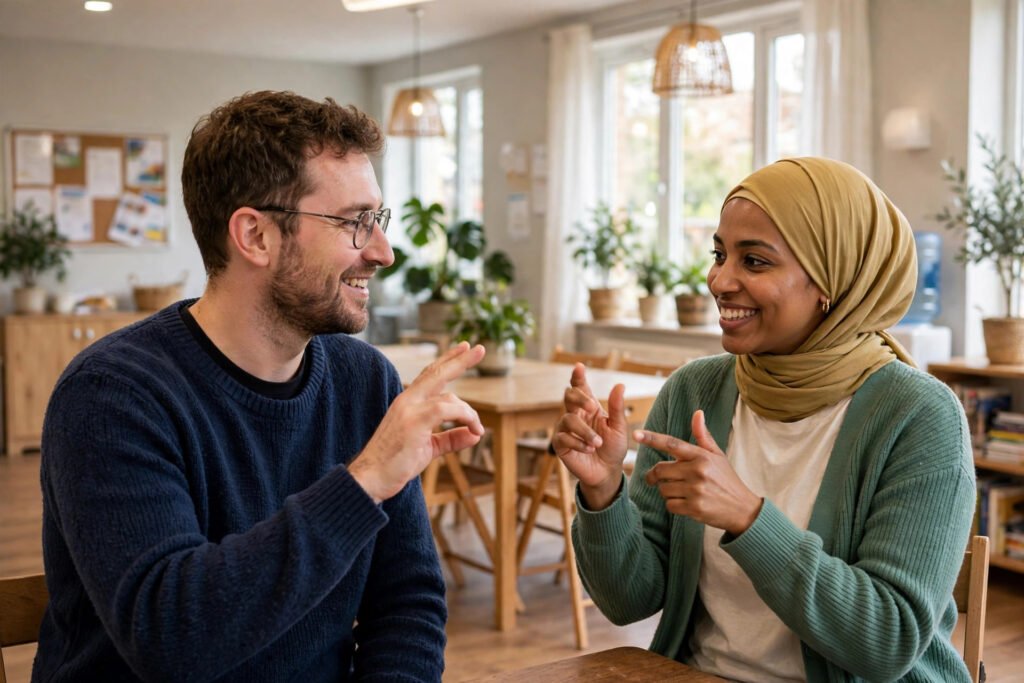
Learning a new language as an adult feels like a superpower everyone else was given at birth: children absorb languages effortlessly (or so the myth goes), while you wrestle with verb conjugations and an accent that amuses native speakers. The reality is more encouraging — and more interesting — than the myth. Adults learn languages differently from children, not worse: you have analytical tools, learning strategies, and motivation that children lack, and the science of adult language acquisition is genuinely optimistic. This guide explains how adult language learning actually works, the methods the evidence supports, and how to reach conversational fluency without moving abroad.
You will learn the truth about the “critical period,” how adult brains learn languages, the method that actually works (input + interaction), realistic timelines, and the system for reaching fluency on 30 minutes a day.
The critical period myth (and what is actually true)
The popular belief — that language learning ability collapses after childhood — is a distortion. What the research actually shows: children excel at native-like pronunciation (the accent window narrows with age), but adults learn faster initially — better at grammar analysis, vocabulary memorisation, and strategic learning. Adults routinely outpace children in the first months of study; children win only over years of immersion, mainly on accent.
The real adult advantages are substantial: metalinguistic awareness (you understand what a verb tense is), transfer from your first language (cognates, shared structures — enormous for related languages), self-direction (you choose when, what, and how to study), and motivation (you are learning for reasons that matter to you, the strongest predictor of success). The adult disadvantages are real but manageable: less free time, more self-consciousness, and entrenched first-language habits. The net verdict from researchers: adults can reach high proficiency — including near-native levels — with the right methods and sufficient input. The barrier was never age; it is method and consistency. This mirrors how adults master any complex skill — adult skill acquisition follows the same principles of deliberate, consistent practice.
How it actually works: input, interaction, and time
Language acquisition runs on comprehensible input — language you mostly understand, stretching slightly beyond your level. Your brain acquires grammar and vocabulary statistically, from massive exposure, not from memorising rules (rules help organise, but exposure builds the intuition). This is why the method that works is embarrassingly simple: enormous amounts of listening and reading at your level, plus regular interactive speaking.
The practical stack: input first — graded readers, podcasts for learners, subtitled shows (target-language subtitles, not English — English subtitles train reading English, not listening). Then interaction — conversation practice from early on, even badly; speaking is a separate skill from understanding and only improves by doing. Then targeted study — 10–15 minutes daily on vocabulary (spaced-repetition apps work brilliantly here) and grammar patterns as they arise in your input. The ratio: roughly 70% input, 20% interaction, 10% study. Most failing learners invert this — 70% app exercises, minimal real input — and wonder why they cannot understand actual speech. Apps are supplements, not programmes; the language itself is the programme. AI tools can accelerate specific parts — AI assistance for language learning is genuinely useful for conversation practice and explanations, used wisely. The British Council and BBC Bitesize both offer free structured language resources.
Realistic timelines
The US Foreign Service Institute’s data gives honest benchmarks: for a native English speaker, reaching professional working proficiency takes roughly 600–750 class hours for “easy” languages (French, Spanish, Italian, Portuguese, Dutch — close relatives with vast cognate overlap), 900 hours for medium languages (German, Hindi, Russian, Greek), and 2,200+ for hard ones (Mandarin, Japanese, Korean, Arabic — different writing systems and distant structures).
Translate to real life: 30 minutes daily is ~180 hours yearly — conversational fluency (comfortable everyday conversation, travel independence) in a Category 1 language in 1.5–2 years; an hour daily halves that. These are medians, not guarantees — consistency and method quality shift them enormously. The milestones to expect: 0–3 months — survival phrases, basic present tense, thrilling first real conversations; 3–8 months — past and future tenses, 1,000+ words, handling daily situations; 8–18 months — conversational fluency, following media with effort, thinking partially in the language; 18+ months — deepening toward advanced proficiency. Plateaus are normal (especially the intermediate plateau around month 8–12) — push through with harder input, not more apps.
The 30-minute daily system
Design for the life you have, not the immersion fantasy. A sustainable daily 30 minutes: 10 minutes spaced-repetition vocabulary (non-negotiable — the highest-ROI minutes); 10 minutes listening (podcast during commute, graded audio); 10 minutes reading or grammar (graded reader, one grammar point applied, not just read). Weekly additions: one 30–60 minute conversation session (tutors online cost £8–£20/hour — the best money in language learning; language exchanges are free) and one enjoyable immersion session (a show you actually like, a film, music).
Rules that make it stick: never miss twice (the universal habit rule); make it identity-based (“I am someone who studies Spanish daily” beats “I want to learn Spanish”); front-load the day (morning sessions survive; evening sessions compete with exhaustion); and track streaks visibly — the chain becomes its own motivation. Monthly: reassess and adjust — more listening if comprehension lags, more speaking if production lags. Yearly: a trip, an exam (DELE, DELF, Goethe — external goals focus effort wonderfully), or a project (read a novel, watch a series unsubtitled). The system works because it is small enough to survive bad weeks and structured enough to compound — 30 honest minutes daily beats 4 heroic hours monthly, every time.
Mistakes that stall adult learners
Perfectionism: waiting to speak “until ready” — readiness comes from speaking, not before it. Embrace the beautiful mess of early conversation; native speakers are almost universally encouraging. Grammar-first study: memorising conjugation tables without input produces knowledge about the language, not ability in it — rules without exposure do not transfer to speech. App-only learning: gamified apps teach app skills; graduates of 500-day streaks who cannot hold conversations are a cliché for a reason.
Others: translating everything mentally (slow, exhausting — train direct comprehension through massive input instead); fear of the accent (adults can achieve clear, pleasant pronunciation even without native-like accent — intelligibility is the goal); comparing with others (your 30 minutes against someone’s immersion year is not a fair fight — compare with your past self); and quitting at the intermediate plateau (the flat months where progress feels invisible but consolidation is happening — push through with harder, more interesting input). The through-line: input massively, speak bravely, study lightly, persist patiently.
Conclusion
Learning a new language as an adult works through comprehensible input, regular interaction, and consistent daily effort — not through youth, talent, or perfect methods. Adults learn faster than children initially and can reach high proficiency; the realistic path is 30 focused minutes daily, 70% input, weekly conversation, and 1–2 years to conversational fluency in a related language. Start today: the best time was years ago, the second-best time is the next 30 minutes.
Frequently Asked Questions
Am I too old to learn a language?
No. Adults learn languages successfully at every age — the research is clear that age is not the barrier. Method, input volume, and consistency determine outcomes, not birthdays.
Which language should I learn?
The one you will actually study — motivation predicts success more than difficulty rankings. That said, related languages (French, Spanish, Italian for English speakers) give the fastest wins.
Are language apps enough?
No — they are useful supplements for vocabulary and habit, but fluency requires massive real input (listening, reading) and interactive speaking. Apps alone produce app-shaped skills.
How do I practise speaking without living abroad?
Online tutors (£8–£20/hour), language exchange apps (free), local conversation groups, and even talking to yourself (narrating your day) all build production skills. Weekly conversation is the minimum effective dose.