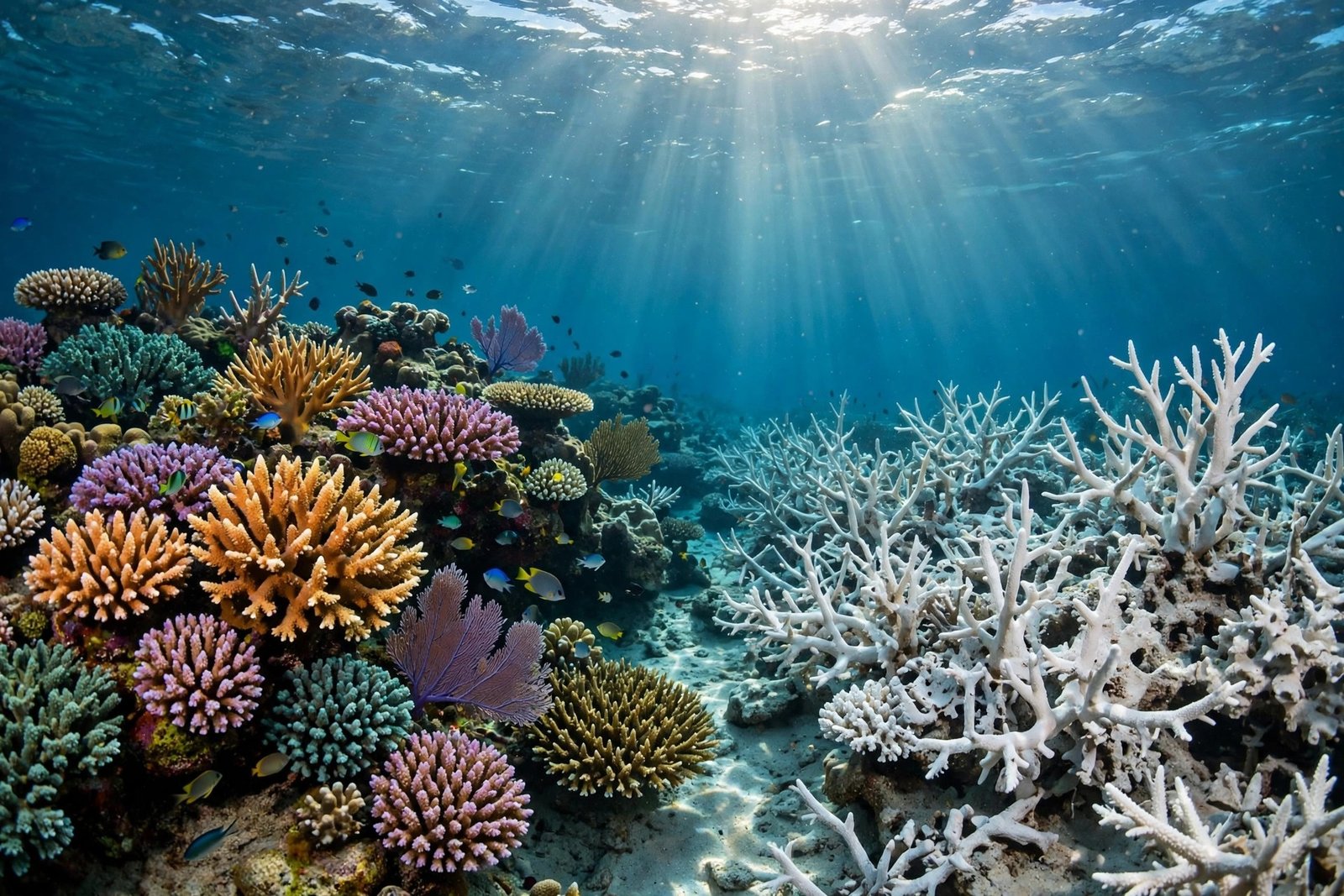
Coral bleaching is one of those phrases everyone has heard and almost nobody truly understands. The images are unforgettable — vast stretches of reef turned ghostly white — but what is actually happening? Is the coral dead? Can it recover? And, if you live in Aberdeen, about as far from a coral reef as you can get in the UK, can you genuinely understand it on a tight budget?
Yes — completely. Understanding coral bleaching requires no travel, no expensive equipment, and no science degree. It requires curiosity and a few well-chosen free resources. This guide explains what bleaching really is, why it matters far beyond the tropics, and exactly how to learn it properly without spending more than the price of a library card (which is free).
What Coral Bleaching Actually Is
Here is the surprise at the heart of the story: corals are animals, and their colour comes from someone else. Living inside coral tissue are millions of microscopic algae called zooxanthellae. The relationship is a beautiful partnership — the algae photosynthesise and share food with the coral; the coral gives the algae shelter and nutrients. Those algae are what make reefs riotously colourful.
Bleaching happens when corals get stressed — overwhelmingly, these days, by water that is too warm — and expel the algae from their tissues. Without the algae, the coral’s white limestone skeleton shows through: the “bleached” look. Crucially, bleached does not mean dead. A bleached coral is a starving coral. If temperatures drop back within weeks, the algae can return and the coral recovers. If the heat persists, the coral starves and dies — and dead reefs do not come back.
The Natural History Museum’s ocean and reef resources explain this symbiosis with superb visuals, and are the single best free starting point for a beginner.
Why It Matters From Aberdeen
It is tempting to file coral bleaching under “sad but distant.” That would be a mistake, for three reasons. First, reefs support roughly a quarter of all marine life while covering less than 1% of the ocean floor — they are the rainforests of the sea, and their collapse would be a mass extinction event in slow motion. Second, around 500 million people depend on reefs for food, coastal protection, and income; reef loss is a human crisis, not just a wildlife one. Third, bleaching is the clearest visible signal of ocean warming on the planet — understanding it means understanding climate change through its most photogenic evidence.
The science is also directly connected to Scottish waters. The same warming trends bleaching tropical reefs are shifting marine life around Britain’s coasts — species moving north, cold-water corals under stress. Scotland’s own deep-water coral reefs, like those in the Darwin Mounds off the west coast, face parallel threats. Learning about bleaching is learning about your own coastline’s future, whether you walk Britain’s family-friendly beaches or explore seaside towns for a weekend break.
The Free Learning Route (Aberdeen Edition)
Aberdeen is better placed for this than you might think. The University of Aberdeen has a respected marine science tradition, and its public lectures and open events periodically cover ocean and climate topics — all free. The university library and the city Central Library stock the key popular-science books on reefs and oceans; borrow rather than buy.
Online, the free resources are outstanding. The US National Oceanic and Atmospheric Administration runs NOAA’s coral reef programme, including the Coral Reef Watch system that tracks bleaching-level heat stress across the world’s oceans in near-real time — you can literally watch bleaching conditions develop on a map. Documentaries do the emotional heavy lifting: Chasing Coral (available on streaming platforms) compresses years of reef decline into a devastating 90 minutes and is the single most effective bleaching education tool ever made.
Total cost of this route: £0. Time: one weekend of focused watching and reading.
The Tight-Budget Upgrades (Under £30)
If you want to go beyond free, the best-value spends are small. A second-hand copy of a reef or ocean book (£5–£10 from charity shops or online) gives you depth the documentaries skip. A visit to a public aquarium with a tropical reef tank — the nearest major ones require travel, so check for special exhibitions closer to home — typically costs £10–£20 and makes the symbiosis viscerally real in a way screens cannot.
Citizen science is the hidden gem of the budget tier: projects like reef monitoring programmes welcome volunteers, and while tropical fieldwork is out of budget, UK-based marine conservation volunteering — beach cleans, seagrass surveys — teaches the same ecological thinking for nothing. Understanding bleaching is, at its core, understanding how ecosystems respond to stress; you can practise that thinking on the Aberdeenshire coast.
What Most People Get Wrong
Three misconceptions dominate. First, that bleaching is caused by pollution alone — pollution harms reefs, but mass bleaching events are driven by marine heatwaves, which are driven by climate change. Second, that dead reefs recover quickly — recovery takes decades at minimum, and repeated bleaching events now strike faster than reefs can bounce back; parts of the Great Barrier Reef have bleached in four of the last ten years. Third, that nothing can be done — marine protected areas, pollution reduction, and above all emissions cuts all measurably help. Despair is as inaccurate as denial.
How Scientists Actually Monitor Bleaching
One of the most remarkable parts of the bleaching story is how closely it is watched. Scientists do not wait for divers to report white reefs — they see the heat coming from space. Satellites measure sea surface temperatures daily, and when temperatures exceed the local bleaching threshold, alert systems flag the risk weeks before visible bleaching begins. This early-warning capability, run by agencies including NOAA, has transformed reef management: marine park authorities can now prepare, reduce local stresses like boat traffic and pollution during heatwaves, and give reefs their best possible chance of surviving.
On the ground — or rather, in the water — monitoring combines old and new methods. Divers survey fixed transects year after year, photographing the same coral heads to track recovery or decline. Autonomous underwater vehicles and even citizen-science photographs uploaded by snorkellers now feed into the datasets. It is a genuinely global scientific effort, and much of its data is public — which means a curious learner in Aberdeen can explore the same bleaching alert maps the researchers use.
The Bottom Line
Can you understand coral bleaching on a tight budget in Aberdeen? Absolutely — £0 gets you documentaries, NOAA’s live bleaching maps, museum resources, and library books that together provide a better education than most paid courses. Under £30 adds books and an aquarium visit. The reefs cannot wait for you to have money; fortunately, understanding them does not require any.
Frequently Asked Questions
Is bleached coral dead?
Not necessarily. Bleaching means the coral has expelled its symbiotic algae and is starving, but it can recover if water temperatures return to normal within weeks. Prolonged heat kills it — and dead coral cannot recover.
What causes coral bleaching?
Overwhelmingly, unusually warm water — marine heatwaves driven by climate change. Pollution, extreme low tides, and changes in salinity can also trigger localised bleaching, but mass global events are heat-driven.
Can coral reefs recover from bleaching?
Yes, given time — typically 10 to 15 years for badly damaged reefs. The problem is that severe bleaching events are now recurring faster than that, so many reefs are being hit again before they recover.
Does Scotland have coral reefs?
Yes — Scotland has cold-water coral reefs, including the Darwin Mounds off the west coast. They lack the colourful algae of tropical reefs but are rich ecosystems, and they face threats from warming, acidification, and deep-sea trawling.