
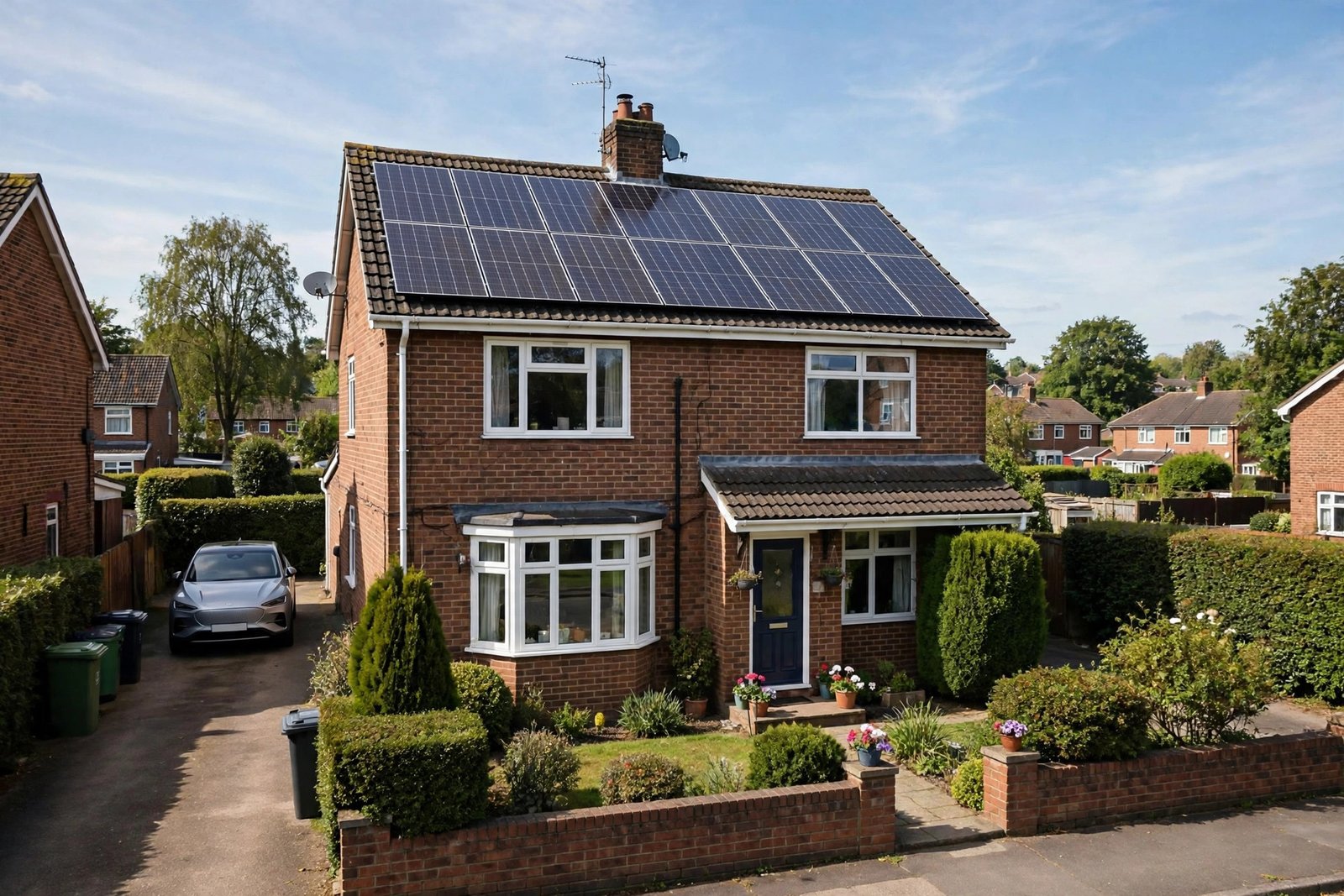
Solar panels have gone from eco-statement to mainstream investment in barely a decade — and with UK energy prices where they are, the question is no longer just environmental but financial. But most buyers sign up understanding only the headline (“free electricity from the sun”) without grasping how the panels actually work, which determines everything about system choice, placement, and realistic savings. This guide explains the physics clearly, covers how the electricity gets from roof to kettle, what affects performance in British conditions, and the honest economics.
You will learn the photovoltaic effect step by step, the components of a home system, what affects output in the UK climate, battery storage explained, and the real costs and payback.
The photovoltaic effect: how light becomes electricity
A solar panel is a sandwich of silicon layers engineered to exploit a quantum phenomenon. The top layer is silicon doped with phosphorus (n-type: extra electrons), the bottom is silicon doped with boron (p-type: electron “holes” — absences that behave like positive charges). Where they meet, an electric field forms — the p-n junction. When a photon of sunlight strikes the silicon with enough energy, it knocks an electron loose from its atom. The junction’s electric field then sweeps the freed electron in one direction and the hole in the other — and this organised flow of charge is electric current. Every second, trillions of photons liberate trillions of electrons, and the panel’s metal contacts collect them into a usable flow.
Two things worth noting. First, panels respond to light, not heat — they work in cold, bright conditions (and actually perform slightly better when cool; heat reduces efficiency). Second, only photons above a threshold energy contribute — which is why panel efficiency has a theoretical ceiling (~33% for single-junction silicon; commercial panels achieve 20–23%). The physics was understood by Einstein (his 1921 Nobel Prize was for the photoelectric effect, the same phenomenon); the engineering challenge was making it cheap, which took another century. The Energy Saving Trust’s solar guidance explains the technology for UK homeowners.
From panel to plug: the system components
Panels: generate direct current (DC) electricity. A typical UK home installation is 10–14 panels (3.5–5 kW capacity), covering 20–28 square metres of roof. Inverter: converts DC to the alternating current (AC) your home uses — the system’s workhorse, typically lasting 10–15 years (shorter than the panels) and costing £800–£1,500 to replace. String inverters (one for the whole array) are standard; microinverters (one per panel) cost more but handle partial shading far better. Mounting: rails fixing panels to the roof at the optimal angle. Generation meter/monitoring: tracks production — modern systems include app-based monitoring showing real-time generation and consumption. Battery (optional): stores surplus daytime electricity for evening use — see below. Export arrangement: the Smart Export Guarantee (SEG) requires large energy suppliers to pay you for surplus electricity exported to the grid — rates vary by supplier (typically 3–15p per kWh), so shopping around matters.
Performance in British conditions (the honest version)
The UK’s reputation for gloom undersells solar reality: panels generate from daylight, not direct sun, and produce meaningful output on overcast days (roughly 10–25% of peak). A south-facing roof at 30–40° tilt is ideal, but east/west splits work well (generation spread across the day, matching usage patterns better), and even north-facing can contribute modestly. Shading is the real enemy — a single shaded panel can disproportionately drag down a string-inverter system, which is why shade analysis before installation matters more than orientation perfection. A 4kW system in southern England generates roughly 3,800–4,200 kWh/year; in Scotland, roughly 3,000–3,400 kWh. Seasonal variation is extreme: a system might generate 400+ kWh in June and under 100 kWh in December — battery sizing and expectations must account for this. Panels degrade slowly (~0.5% per year) and carry 25-year performance warranties; they do not suddenly die. Keeping generation in perspective helps with the bills too — reducing heating bills and energy-saving home upgrades multiply the benefit of any solar investment.
Battery storage: worth it?
Without a battery, you use solar electricity as it generates (daytime) and export the surplus cheaply via SEG while buying evening electricity at full price — the fundamental mismatch batteries solve. A typical home battery (5–10 kWh usable) stores daytime surplus for evening use, roughly doubling self-consumption from ~30% to ~60%. Costs: £4,000–£8,000 installed. The economics: batteries extend payback periods rather than shortening them at current prices — they make sense if you value energy independence, have high evening usage (EV charging, heat pumps), or face frequent outages, but as pure investments they are marginal. Battery prices are falling steadily; many installers advise panels now, battery later. One caution: batteries have finite lifespans (10–15 years, ~6,000 cycles) and their own efficiency losses (~10% round-trip) — factor both into any payback calculation.
Costs and payback: the real numbers
Typical UK installation (2026): £5,000–£8,000 for a 4kW system without battery; £9,000–£14,000 with battery. Prices have fallen ~70% in a decade but stabilised recently. Annual savings: £400–£800/year on electricity bills for a typical household (higher for high daytime users, EV owners, or those also on heat pumps), plus SEG export income of £50–£150/year. Payback: roughly 8–12 years without battery at current energy prices — shorter if prices rise, longer if they fall. What improves the case: high daytime electricity use, working from home, EV charging, electric heating, and SEG rates at the top end. What weakens it: heavy shading, north-facing roofs, low daytime occupancy, and planning to move within the payback period (buyers value solar, but rarely at full installed cost). Get three MCS-certified installer quotes minimum — prices and quality vary enormously, and MCS certification is required for SEG eligibility. The GOV.UK guidance on the Smart Export Guarantee sets out your export rights.
Conclusion
Solar panels work through the photovoltaic effect — photons knocking electrons loose in doped silicon, swept into current by the p-n junction’s electric field — converted to household AC by the inverter, with optional batteries bridging the day-evening gap. In Britain they generate meaningfully even on overcast days, perform best unshaded and south-facing, and pay back in roughly 8–12 years at current prices. The technology is mature, the physics is 19th-century elegant, and the economics now work for many households — provided you get MCS-certified quotes, understand the seasonal variation, and size the system to your actual usage. The sun does not send bills; the panels just need a roof.
Frequently Asked Questions
How do solar panels work in simple terms?
Sunlight knocks electrons loose in silicon layers; an electric field inside the panel organises them into flowing current. An inverter converts this DC electricity to the AC your home uses. Panels respond to light, not heat — they work on cold, bright days.
Do solar panels work in the UK winter?
Yes, but at reduced output — a system might generate 400+ kWh in June and under 100 kWh in December. They produce from daylight even on overcast days (10–25% of peak). Annual generation estimates account for this seasonal variation.
How much do solar panels cost in the UK?
£5,000–£8,000 for a typical 4kW system without battery; £9,000–£14,000 with battery storage. Payback is roughly 8–12 years through bill savings (£400–£800/year) plus Smart Export Guarantee payments for surplus.
Are solar batteries worth it?
They roughly double self-consumption (from ~30% to ~60%) but extend payback at current prices (£4,000–£8,000). They make most sense with high evening usage, EVs, or heat pumps — otherwise, panels now and battery later is often the better strategy.


