Beginners face a choice: scatter plants hopefully and see what happens, or plan the garden layout first. The scatterers call planning overkill; the planners call scattering wasteful. After watching hundreds of beginner gardens succeed and fail, the verdict is clear: a little planning pays for itself many times over — but the kind of planning matters enormously. Here is what is worth planning, what is not, and how much planning a beginner actually needs.
Why Planning Pays (The Evidence)
Unplanned beginner gardens fail in predictable ways. Sunlight mistakes: sun-lovers planted in shade, shade-lovers scorched — the single most common failure, entirely preventable by observing light patterns for a few days before planting. Spacing disasters: the tiny shrub that becomes a 3-metre monster swallowing its neighbours; vegetables crowded into competition. Access problems: beds you cannot reach the middle of without stepping on soil (compacting it) or plants. Watering misery: thirsty plants far from the tap, abandoned in August. Succession gaps: everything ripe in July, nothing in September.
Every one of these is a layout problem, not a gardening-skill problem — and layout is fixed on paper, free, before a single plant goes in. An hour with a pencil saves a season of regret. This is the core case for planning: it moves mistakes from the garden (expensive, slow) to the paper (free, instant).
What Beginners Should Actually Plan
Not everything — planning has diminishing returns, and over-planning is its own trap. The high-value items:
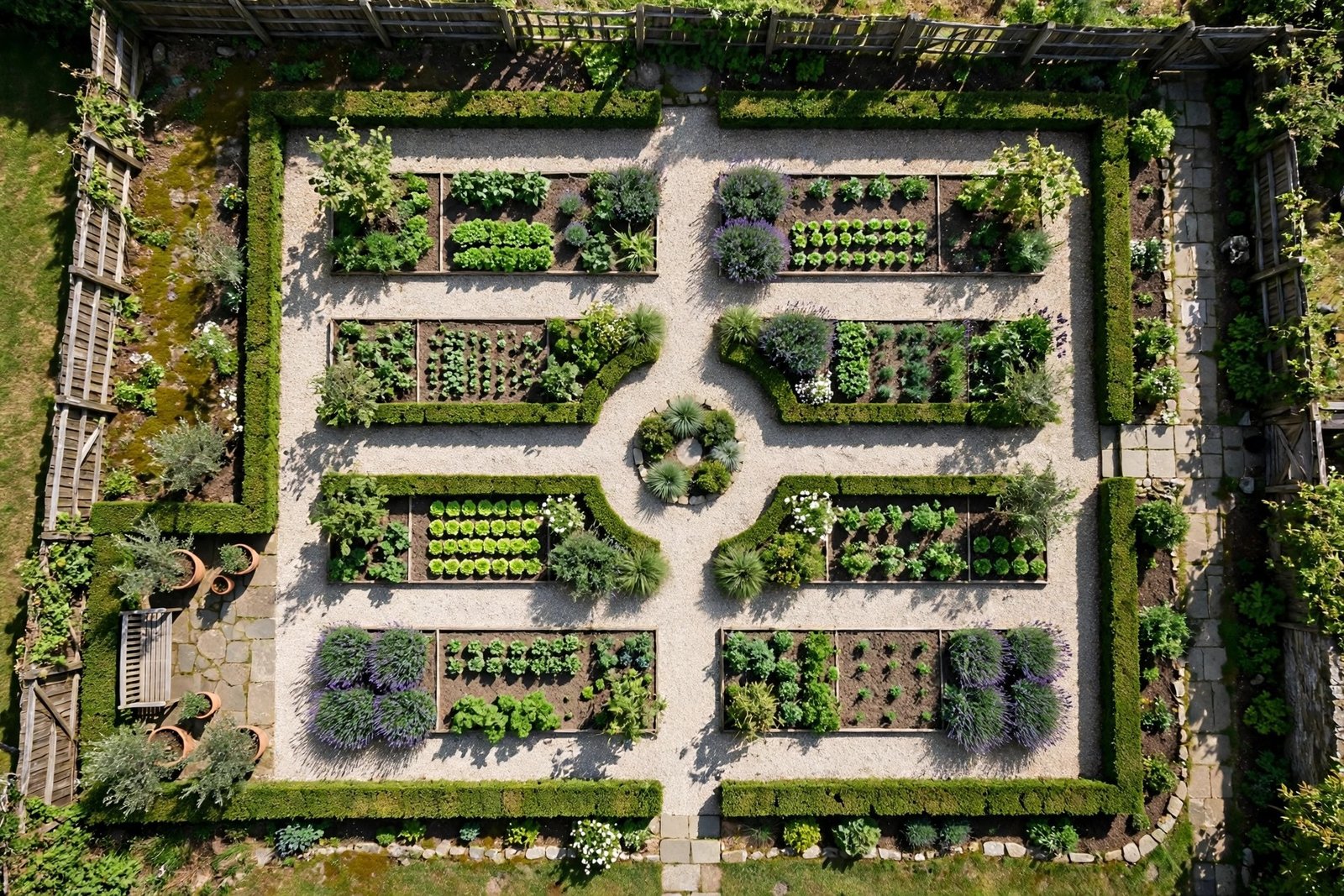
1. Sun mapping (30 minutes). Sketch your plot; mark sunny, partly shaded, and shady areas at morning, noon, and evening. This one exercise prevents more failures than all other planning combined. 2. Bed placement and paths (30 minutes). Beds no wider than 1.2m (reachable from both sides), paths between them, access to water. Draw it; walk it mentally. 3. The plant list (1 hour). Not a design — just what goes where, matched to sun, soil, and mature size. Check mature sizes, not nursery-pot sizes — the most expensive planning omission. 4. Succession basics (30 minutes). Note what gets harvested when, and what follows it — salad after spring crops, for example. 5. The watering plan (15 minutes). Water source to thirstiest plants: the shortest route wins.
Total: under 3 hours. That is the entire planning investment a beginner needs. The RHS garden design resources support this level perfectly — practical, not pretentious.
What Beginners Should NOT Plan (Yet)
Detailed aesthetic design: colour schemes, focal points, “rooms” — the garden-design-magazine stuff. Beautiful, and completely premature for year one. Plant for success first; aesthetics emerge from healthy plants, not from plans. Five-year visions: your garden will teach you what it wants to be; rigid long-term plans fight that learning. Complex rotations: allotment-style four-year crop rotation matters at scale; for a beginner’s few beds, simple “don’t plant the same family in the same spot twice running” suffices. Precision companion planting: the basics (tall plants north of short ones, so they do not shade them) beat intricate charts.
The principle: plan the constraints, improvise the rest. Sun, space, water, and timing are constraints — plan them. Which exact variety, which colour combination, which arrangement — improvise, observe, adjust. Gardens are conversations, not blueprints.
The Tools (Mostly Free)
Graph paper and pencil (£0): still the best planning tool — fast, flexible, and you already own them. Phone camera: photograph the plot through the day for sun mapping; photograph monthly through the season to learn what worked. Free apps: several garden planners offer free tiers — useful for the plant-list stage, unnecessary for the sketch stage. The Gardeners’ World planning guides: free, seasonal, practical.
What not to buy: expensive design software, professional design services (£300–£1,000+ — wonderful for established gardens, absurd for a beginner’s first plot), and glossy design books that inspire but do not instruct. Your £0 pencil sketch, informed by sun observation, outperforms a £500 design based on guesswork.
Planning for Small and Low-Maintenance Gardens
Small gardens benefit most from planning — every centimetre counts, and mistakes have nowhere to hide. The small-plot priorities: vertical thinking (climbers, wall planters, tiered beds multiply space), multi-function plants (edible ornamentals, herbs as edging), and relentless editing (one thriving specimen beats five struggling ones). Low-maintenance garden ideas pair naturally with planning — designing for low effort is planning, and budget garden improvements go further with a sketch guiding the spend.
For the time-poor, planning is the low-maintenance strategy: right plant, right place, first time — the planned garden needs a fraction of the corrective work the scattered garden demands.
Planning for Wildlife (Free Pest Control)
The best-planned beginner gardens include wildlife from the start — not from sentimentality but from self-interest. A garden designed for beneficial creatures needs fewer interventions forever. The planning additions are small: a water source (even a shallow dish — frogs and toads eat slugs prodigiously); undisturbed corners (log piles, dense planting — overwintering habitat for ladybirds, lacewings, and hedgehogs); flowering plants among the productive ones (the companion-planting principle, designed in from the beginning); no pesticides as a planned policy (chemicals kill predators faster than pests, creating worse outbreaks).
The results compound yearly: the first season brings a few ladybirds; by year three, the garden hosts a standing army of predators that handle most pest pressure automatically. Planning for wildlife is planning for a garden that increasingly manages itself — the ultimate low-maintenance strategy, designed on paper before a single plant goes in.
The Year-Two Review: Planning Never Ends
The final planning habit: review every autumn. Walk the garden with your original sketch and notes, and ask what worked. Which plants thrived where? What got too big? Where were the watering headaches? What did you wish you had planted more of? Write the answers down — memory lies, notes do not. Then adjust next year’s plan accordingly. This annual review loop is what turns a beginner into an experienced gardener: not talent, not books, but the disciplined habit of observing, recording, and adjusting. Year one’s plan was a hypothesis; year two’s is informed by evidence. By year three, you will be planning like a gardener with a decade’s experience — because in the most important way, you will be one.
The Bottom Line
Is planning a small garden layout worth it for a beginner? Yes — about three hours’ worth. Sun mapping, bed placement, a plant list matched to conditions, succession basics, and a watering plan: that is the complete high-value set, doable with pencil and paper for free. Skip the aesthetic over-design and five-year visions; plan the constraints and improvise the rest. The planned beginner’s garden does not just look better — it grows better, because every plant started life in the right place.
Frequently Asked Questions
How much planning does a beginner garden need?
About 3 hours total: sun mapping, bed/path layout, a plant list matched to conditions, basic succession, and a watering plan. Pencil and paper suffice.
What is the biggest layout mistake beginners make?
Ignoring sunlight patterns and mature plant sizes — sun-lovers in shade, and tiny nursery plants that become garden-swallowing monsters. Both are fixed free on paper.
Should I hire a garden designer as a beginner?
No — professional design (£300–£1,000+) suits established gardens, not first plots. Learn your garden for a season or two first; design services pay off far more once you know what works.
How do I plan a very small garden?
Think vertically (climbers, wall planters), choose multi-function plants, and edit ruthlessly. Small plots benefit most from planning since every centimetre counts.