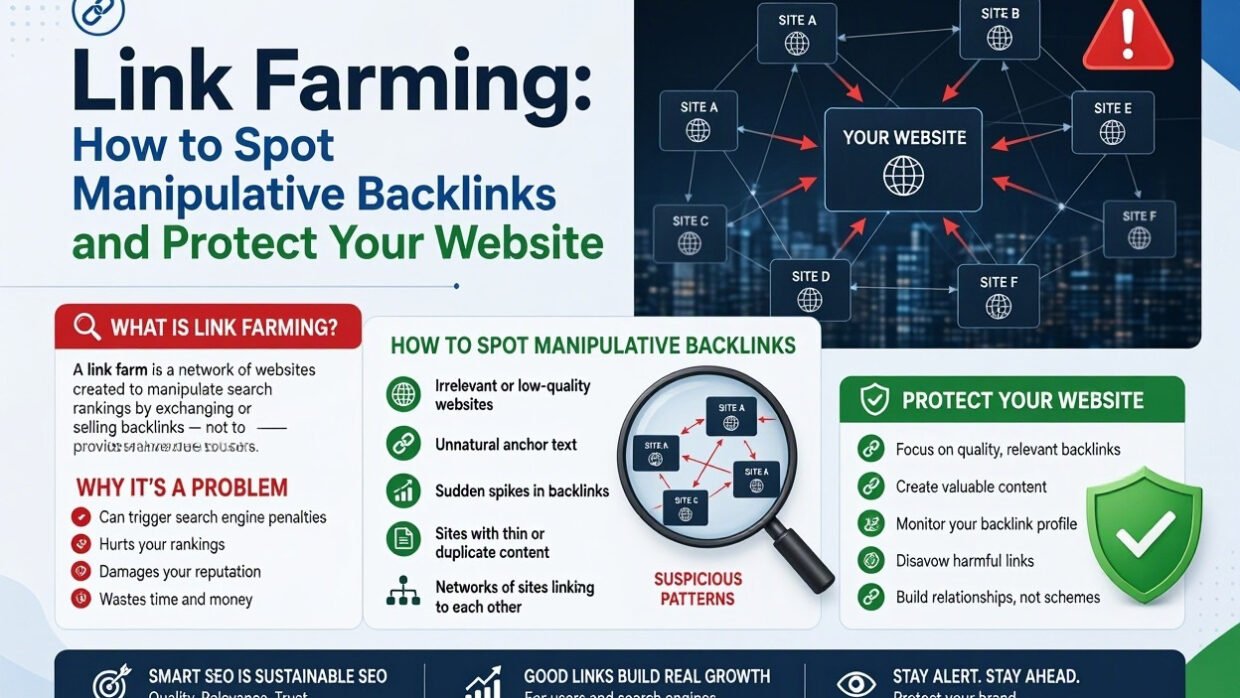
A sudden rise in backlinks can look like welcome recognition for a new website. But when those links come from sites built mainly to pass ranking value, the apparent boost may be a warning sign rather than a breakthrough. Link farming is the practice of creating or using networks of websites to generate links without genuine editorial reasons. For businesses, publishers and anyone commissioning online marketing, knowing how it works can prevent wasted budgets and avoidable damage to a site’s reputation.
The details change as search engines refine their systems, but the basic test remains useful: would this link exist if nobody expected it to influence search rankings? A recent guide to spotting link farms sets out the warning signs; the same principles are worth applying before buying placements, accepting a backlink offer or approving a campaign.
What link farming looks like
A link farm may be a group of websites controlled by one operator, a collection of low-quality blogs exchanging links, or a service that sells large numbers of placements with little regard for relevance. The common feature is that links are the main product. Articles and pages exist to host them, rather than to inform a particular audience.
Not every paid placement or guest article is a link farm. Businesses can sponsor content, experts can contribute to publications, and relevant organisations can cite one another for sound reasons. The distinction lies in editorial judgement and usefulness. A genuine article has a clear subject and audience; a manufactured placement tends to exist chiefly to insert a chosen phrase and point it at a client’s website.
Warning signs to check before accepting a link
One suspicious link does not prove that a site is part of a network. Look for patterns instead. A site may publish articles about unrelated topics in quick succession, each containing several links to commercial pages. The writing may be thin, repetitive or awkwardly built around exact-match phrases such as “best conveyancing solicitor” or “cheap office software”. Author details and contact information may be absent, while the site’s design and old posts appear neglected.
Check the destination of the links as well as the page carrying them. A cluster of unrelated websites linking to the same small set of businesses can suggest coordination. So can repeated wording in anchor text, especially when the phrase seems forced into an article. Search results, the site’s own archive and its visible categories can help show whether it has a consistent subject or simply publishes whatever a buyer wants to promote.
Relevance is more useful than a headline score. A modest specialist publication with real readers may provide a more credible reference than a high-metric site whose recent posts have little connection to one another. Ask who reads the page, what the article offers them, and whether the publisher would still want it without the backlink.
Why quick backlink wins can become costly
Search engines assess link patterns as part of a much wider picture. Links created primarily to manipulate rankings can be ignored, and schemes that breach search spam policies may contribute to a manual action or a loss of visibility. There is no reliable promise that a purchased batch will lift a site; even if rankings move temporarily, the links may later be discounted.
The business cost is not limited to search traffic. A weak placement can make a company look careless to customers who follow it, and money spent on bulk links is money unavailable for useful content, technical improvements or genuine outreach. Recovery can also take time: a site owner may need to review its backlink profile, document efforts to remove or disavow links where appropriate, and address any underlying practices.
That is why backlink reviews should be calm and evidence-led. A website will naturally collect some odd links over time. Do not assume every unfamiliar domain is dangerous or start removing links indiscriminately. Investigate the source, the context and the pattern, and seek experienced SEO advice if a manual action or a substantial change in visibility is involved.
Safer ways to earn useful links
Start with something worth citing: original reporting, a clear data set, a practical tool, a well-explained service or expertise that answers a question better than the existing results. Then identify publications whose readers would genuinely benefit. A relevant guest article should be written for that publication’s audience, not used as a wrapper for a predetermined link.
When exploring guest-posting opportunities, assess each blog and article on its own merits. Read recent posts, check whether the site has an identifiable editorial focus, and agree in advance how any commercial relationship will be disclosed. A list of available placements is a starting point for research, not proof that every opportunity is appropriate.
Businesses planning a digital launch should also set realistic marketing budgets. A company weighing the cost of building an app, for example, can use Osdire’s US app-development pricing breakdown as a point of comparison, while remembering that US figures are not UK quotations. Launch promotion belongs in that same budget conversation, but a credible plan should prioritise useful content and relevant audiences over guaranteed rankings or bulk links.
A practical decision before publishing
Before approving a backlink placement, ask three questions: does the site serve a recognisable audience, does the article stand on its own, and is the link genuinely helpful to the reader? If the answers are unclear, pause and investigate. A good link is a consequence of useful work being recognised in the right place. A link farm reverses that order, producing pages to manufacture the appearance of recognition. For publishers and businesses alike, that difference is worth checking before the next campaign begins.