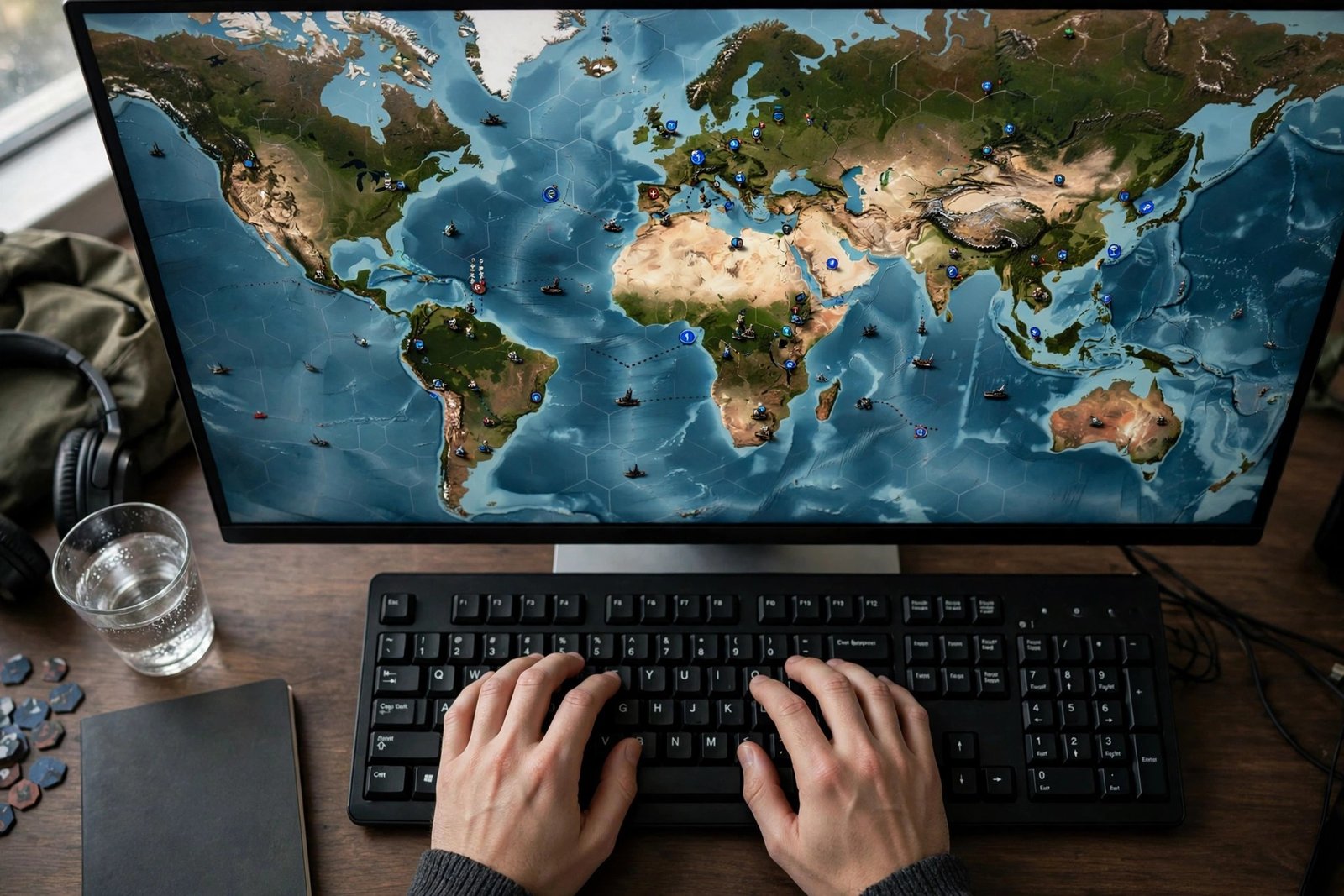
Strategy games have a reputation problem. To outsiders, they look like homework: incomprehensible interfaces, a hundred units moving at once, opponents who seem to think ten moves ahead. Games like StarCraft, Civilization, Age of Empires, and Total War can feel impenetrable — which is a shame, because strategy gaming offers some of the deepest satisfaction in the medium, and the learning curve is far friendlier than it looks.
The secret beginners miss: strategy games are not about fast reflexes or innate genius. They are about learnable systems — and the skill of learning systems transfers between every strategy game you will ever play. This guide gives you the complete beginner’s path: the mindset shift, the foundational skills in order, and the practice routine that takes you from overwhelmed to competent.
The Mindset Shift: Strategy Is a Skill, Not a Talent
Most beginners approach strategy games believing good players are simply smarter. They are not — they are more practised. What looks like genius is pattern recognition built over hundreds of hours: recognising that an opponent’s early expansion means aggression is coming, or that a particular map layout favours a specific approach. Every strong player was once confused by the same interface you are staring at.
The liberating corollary: improvement is predictable. Strategy skill decomposes into learnable sub-skills — economy management, scouting, build orders, tactical positioning — and each improves independently with focused practice. You do not need to “get good at strategy” as a monolith; you need to get slightly better at five specific things, one at a time. Players who understand this improve steadily. Players waiting to feel “naturally talented” quit.
Start With the Right Game (This Matters Enormously)
The single biggest beginner mistake is starting with the wrong title. Jumping straight into competitive StarCraft II ladder as your first strategy game is like learning to drive in a Formula 1 car — technically possible, practically miserable. Choose your entry point deliberately.
Turn-based first: games like Civilization VI, XCOM 2, or Into the Breach let you think at your own pace — no reflexes required, no opponent rushing you while you read tooltips. They teach the core strategic thinking (resource allocation, risk assessment, long-term planning) without time pressure. Then real-time against AI: Age of Empires IV or StarCraft II’s campaign and co-op modes introduce real-time decision-making against forgiving opponents. Then multiplayer: only when the basics are automatic.
This progression is not dumbing down — it is how every strong player actually learned, whether they admit it or not. And the skills genuinely transfer: the economic thinking from Civilization helps in StarCraft; the positioning sense from XCOM helps in Total War. For relaxed starting points, casual-friendly video games include excellent strategy-lite options, and strategy thinking even enriches board games for adults’ game night — the tabletop roots of the genre.
The Five Foundational Skills (In Order)
1. Economy before army. In almost every strategy game, beginners over-invest in military units and under-invest in the economy that produces them. The counter-intuitive truth: the player with the better economy usually wins, because they can afford to replace losses. Spend your first ten hours obsessing over resource income, not combat. Watch a replay of a loss and check: were you outplayed, or just out-produced? It is out-produced nine times out of ten.
2. Scouting and information. Beginners play blind; intermediate players play informed. The habit of regularly checking what your opponent is doing — scouts, map vision, reconnaissance — is the highest-leverage skill in competitive strategy. Perfect mechanics with no information lose to mediocre mechanics with perfect information. Make scouting automatic before anything else.
3. Build orders and openers. Every strategy game has established opening sequences — the first few minutes of optimal play. Learn one solid opener per game and practise it until it is muscle memory. This is not creativity-stifling; it is foundation-building. Jazz musicians learn scales first. Your creativity emerges after the fundamentals are automatic, not instead of them.
4. Decision-making under pressure. Once mechanics are automatic, the game becomes about judgement: when to attack, when to expand, when to defend. This only develops through real games — ideally with a review habit. After each loss, identify one decision that mattered most. Not ten things — one. Fix that one thing next game. This single-decision review method compounds astonishingly fast.
5. Adaptation. The final skill is abandoning the plan. Beginners follow build orders rigidly even as the game demands otherwise; strong players read the game state and pivot. Adaptation cannot be drilled directly — it emerges from the previous four skills plus experience. Give it time; it arrives around the 100-hour mark like clockwork for players who practise deliberately.
The Practice Routine That Actually Works
Forget marathon sessions. The evidence-backed routine: 30–60 minutes of focused play daily beats weekend binges, because strategy skill is pattern recognition and patterns consolidate with sleep between sessions. Structure each session: 10 minutes warming up mechanics (a build-order drill against easy AI), 30–40 minutes of real games, 10 minutes reviewing one loss. That review habit — painful, unglamorous, skipped by everyone — is the entire difference between players who plateau and players who climb.
Use the community’s knowledge shamelessly. Every major strategy game has beginner guides, build-order repositories, and replay analysis from top players, collected on wikis like Liquipedia’s strategy game portals — all free. Watching a strong player explain why they made each decision teaches in an hour what solo trial-and-error teaches in a month. And lose productively: a loss where you learned one thing beats a win where you learned nothing. Track decisions, not rating points.
Common Beginner Traps
Guide paralysis: consuming strategy content instead of playing. Guides inform practice; they do not replace it. Cap guide-watching at a quarter of your gaming time. Blaming balance: “this unit is overpowered” is occasionally true and usually a crutch — strong players beat “overpowered” strategies by adapting. Playing too many games: depth beats breadth for beginners; one strategy game for three months teaches more than six games for two weeks each. Tilt-queuing: playing ranked while frustrated, losing, getting more frustrated. The strategy equivalent of drunk texting — nothing good comes of it.
The Bottom Line
Improving at strategy games as a beginner is a solved problem: start turn-based, learn economy first, drill one opener, review one decision per loss, and practise a little daily. The timeline is encouraging — most players go from confused to competent in 40–60 hours, and from competent to genuinely good in 150–200. Strategy gaming rewards the patient and the curious above all. And remember to check PEGI ratings when choosing titles — many of the best strategy games are family-friendly, making the genre one of gaming’s most welcoming entry points.
Frequently Asked Questions
What is the best strategy game for a complete beginner?
Civilization VI or Into the Breach — both turn-based, so no time pressure, with excellent tutorials. For real-time, Age of Empires IV’s campaign is the friendliest on-ramp.
How long does it take to get good at strategy games?
Competent in 40–60 hours of deliberate practice; genuinely good in 150–200 hours. The early learning curve is steep but very rewarding — the first 20 hours contain the biggest improvements.
Do I need fast reflexes for strategy games?
For turn-based games, no. For real-time games, moderate speed helps but decision-making matters far more — many top players win through superior strategy with average mechanics.
Should I play the campaign or go straight to multiplayer?
Campaign first. It teaches mechanics in a forgiving environment. Jump to multiplayer once basic build orders and controls are automatic — usually after 10–20 hours.
Why do I keep losing even when I have a bigger army?
Almost always positioning, engagement timing, or economy: a smaller force that fights on favourable terms beats a larger force caught out of position. Review replays to find the real cause — it is rarely “not enough units.”