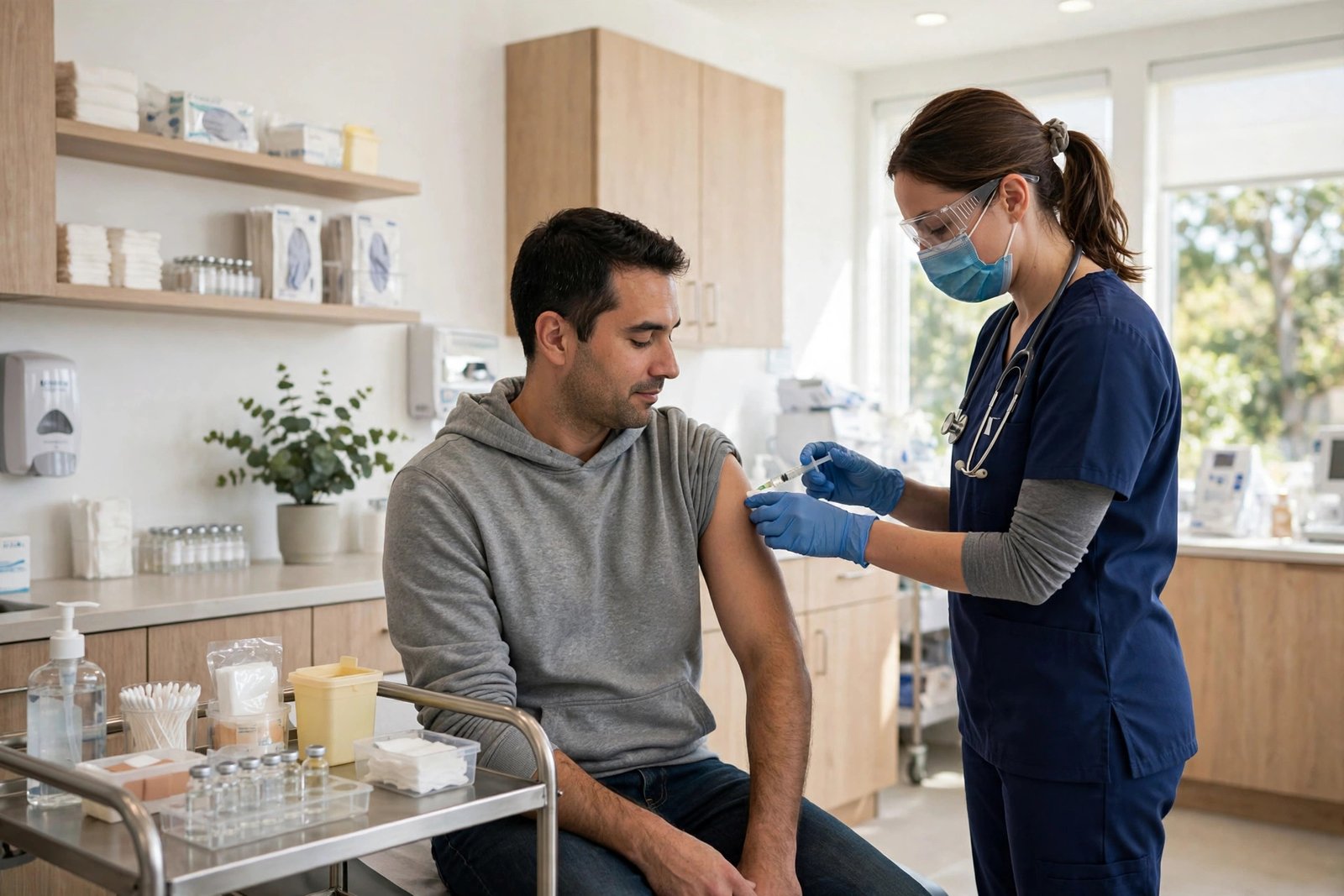
Vaccines are among the most studied medical interventions in history — and among the most misunderstood. How do they actually work, and what does understanding them cost if you are on a tight budget in Derry? The reassuring answer to the second question first: nothing. The NHS provides all routine vaccinations free, and understanding them costs only your time. This guide explains the immunology in plain English — no biology degree required — covers the UK vaccination schedule, addresses the common concerns honestly, and points to Derry-specific resources for getting vaccinated.
You will learn how vaccines train your immune system, the different vaccine types, the UK schedule from childhood to adulthood, what side effects to actually expect, and where to get vaccinated in Derry.
How vaccines work: training your immune system
Your immune system learns by encounter: the first time it meets a pathogen, it takes days to mount a defence — time during which you get ill. The second time, it responds in hours, often before you notice symptoms. This is adaptive immunity, and vaccines exploit it brilliantly: they show your immune system a harmless preview of the pathogen, so the real encounter meets a prepared defence.
The mechanism: the vaccine introduces an antigen (a piece of the pathogen, a weakened version, or instructions for your cells to make a piece of it). Specialised immune cells engulf the antigen and present it to T-cells and B-cells. B-cells that recognise it multiply and produce antibodies — Y-shaped proteins that latch onto the pathogen and mark it for destruction. Crucially, some of these B-cells and T-cells become memory cells, which persist for years or decades. On real exposure, memory cells reactivate within hours, producing a flood of antibodies before the pathogen can establish itself. That is the whole trick: a rehearsal that makes the performance effortless. The NHS guide to how vaccines work explains this with clear diagrams.
The vaccine types (and why there are several)
Live attenuated: weakened pathogens that replicate mildly without causing disease (MMR, nasal flu vaccine for children). Strong, long-lasting immunity — but unsuitable for people with severely weakened immune systems. Inactivated/killed: pathogens killed outright (injectable flu, polio injection). Safe for everyone, but immunity may wane and need boosters. Subunit/toxoid: just a piece of the pathogen or an inactivated toxin (hepatitis B, tetanus, HPV). Very safe, very targeted. mRNA: instructions for your own cells to manufacture a harmless piece of the pathogen temporarily (some COVID-19 vaccines). The mRNA degrades within days; it does not alter DNA — a persistent myth worth killing definitively, since mRNA cannot enter the cell nucleus where DNA lives. Viral vector: a harmless carrier virus delivers the instructions (some COVID-19 and Ebola vaccines).
Different types suit different pathogens and populations — the variety is a feature of sophisticated vaccinology, not inconsistency. All types licensed in the UK have passed the same rigorous MHRA safety evaluation. General immune health supports vaccine response too — strengthening your immune system before flu season covers the lifestyle foundations.
The UK schedule: what you get and when
Childhood (free, via GP): the routine schedule covers diphtheria, tetanus, polio, whooping cough, Hib, MMR (measles, mumps, rubella), meningitis B/ACWY, HPV (now offered to all adolescents), and more — starting at 8 weeks old. Uptake is high and the diseases’ collapse since introduction is among medicine’s greatest achievements: measles cases fell by over 99% after vaccination began. Adults: annual flu vaccine (free for over-65s, pregnant women, and clinical risk groups; available privately for around £15–£20), COVID-19 boosters per current guidance, shingles vaccine at 65–70, pneumococcal at 65+. Travel: some travel vaccines are free on the NHS (hepatitis A, typhoid, cholera); others (yellow fever, rabies, Japanese encephalitis) are private, typically £40–£80 per dose at travel clinics.
Side effects: what to actually expect
Common and harmless: sore arm, mild fever, fatigue, or headache for 24–48 hours — these are signs the immune system is responding, not signs of illness. The vaccine cannot give you the disease (inactivated, subunit, and mRNA vaccines contain no live pathogen; live vaccines use weakened strains that do not cause disease in healthy people). Rare but real: severe allergic reactions (anaphylaxis) occur in roughly 1–2 per million doses — which is why you wait 15 minutes after vaccination where observation is advised. The monitoring systems (the MHRA’s Yellow Card scheme in the UK) track every reported reaction, making vaccines among the most surveilled medical products in existence. The honest risk comparison: the diseases’ risks dwarf the vaccines’ risks by orders of magnitude — measles hospitalises roughly 1 in 5 unvaccinated children who catch it; the MMR vaccine’s serious adverse event rate is measured per million.
Getting vaccinated in Derry on a budget
Routine vaccinations are free on the NHS — register with a GP in Derry if you have not already, and the practice will call you for scheduled vaccinations. Community pharmacies across Derry offer private flu jabs (£15–£20) and some travel vaccinations, often with walk-in availability. For catch-up vaccinations (missed childhood doses, or new to the UK), GPs can arrange these free — it is never too late, and there is no judgement for asking. If cost is the barrier to understanding rather than receiving vaccines, the free resources are excellent: the NHS website, the GOV.UK vaccination guidance, and your pharmacist, who will answer questions free of charge. Health literacy also connects to general wellness — vitamin D deficiency, common in Northern Ireland’s winters, is worth understanding alongside.
Conclusion
Vaccines work by giving your immune system a harmless rehearsal — antigens trigger antibody production and memory cells that respond in hours to the real pathogen, often before you feel ill. The UK schedule covers you from 8 weeks old through adulthood, routine vaccinations are free on the NHS in Derry, side effects are mostly a sore arm for a day, and the diseases’ risks exceed the vaccines’ by orders of magnitude. Understanding them costs nothing; the free NHS and pharmacist resources are excellent. The science is settled, the mechanism is elegant, and the memory cells are waiting. Get the jabs you are due.
Frequently Asked Questions
How do vaccines work in simple terms?
They show your immune system a harmless preview of a pathogen (a piece of it, a weakened version, or instructions to make a piece). Your immune system makes antibodies and memory cells, so when the real pathogen arrives, the defence activates within hours instead of days.
Can vaccines give you the disease they prevent?
No. Inactivated, subunit, and mRNA vaccines contain no live pathogen. Live vaccines use weakened strains that cannot cause disease in people with healthy immune systems. Feeling mildly unwell for a day after vaccination is the immune response working, not infection.
Do mRNA vaccines change your DNA?
No. mRNA cannot enter the cell nucleus where DNA is stored, and it degrades within days after instructing cells to make a harmless piece of the pathogen. This has been confirmed by every regulatory agency worldwide.
Are vaccines free in Derry?
All routine NHS vaccinations are free — register with a GP and you will be called for scheduled doses. Private flu jabs at pharmacies cost around £15–£20; some travel vaccines are private (£40–£80 per dose).