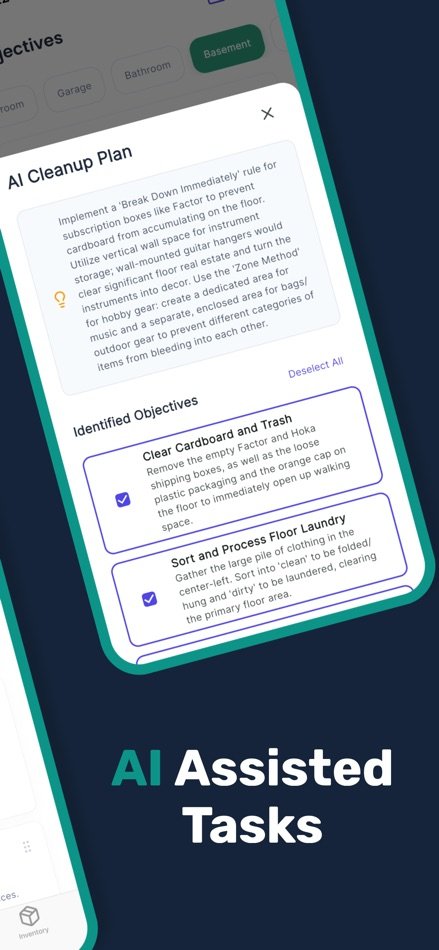
Discovering how can ai help me declutter and organise my home might sound like overkill — can’t you just tidy up? — but anyone who’s stood paralysed in a chaotic spare room knows decluttering is a decision-making problem, not a tidying problem. Every object demands a judgement: keep, donate, bin, relocate? Multiply by hundreds of objects and the cognitive load becomes overwhelming. That’s exactly where AI helps: not by moving your stuff, but by structuring the thousands of micro-decisions so you can actually execute.
I’ve used AI through two house moves and one ruthless pre-renovation clear-out. It’s not magic, but it turns an emotional swamp into a project plan.
How can AI help me declutter and organise my home?
1. The room-by-room battle plan
The biggest decluttering mistake is starting randomly. Instead, ask AI to build your campaign:
“Create a decluttering plan for a 3-bedroom UK house. I have 4 weekends, about 5 hours each. Order rooms by impact, break each into 1-hour tasks, and include what to do with common categories (clothes, books, kitchen gadgets, paperwork, kids’ toys, electronics).”
You’ll get a structured schedule that removes the “where do I even start?” paralysis. The plan also sequences sensibly — paperwork and obvious rubbish first (quick wins build momentum), sentimental items last (when your decision muscles are trained).
2. Decision frameworks for the hard stuff
For categories where you stall, ask AI to be your ruthless consultant:
- Clothes: “Give me a decision framework for decluttering a wardrobe, including the 12-month rule exceptions and what to do with ‘aspirational’ sizes.” (The AI will be kinder about this than your internal monologue, and firmer than your excuses.)
- Paperwork: “What household paperwork must UK residents keep, and for how long? What’s safe to shred?” — genuinely useful, since fear of binning something important paralyses many people. (Short version: keep 6 years of financial/tax records; most else can go.)
- Sentimental items: “How do I declutter sentimental items without guilt?” — AI suggests the photograph-and-release method, the “keep the best, not all” rule, and memory-box limits. Surprisingly emotionally intelligent.
- Kids’ stuff: frameworks for involving children without trauma, and the “one in, one out” maintenance rule.
3. Selling and donating efficiently
- What sells where: “I have [list of items] to sell in the UK — which platform for each (eBay, Facebook Marketplace, Vinted, Gumtree) and what pricing?” AI knows the platform norms and saves you listing a £5 item where fees eat the profit.
- Listing descriptions: photograph items and have AI draft compelling listings — the same techniques as our small-shop marketing guide, applied to your loft clear-out.
- Donation logistics: “Which UK charities collect furniture in [area]? What can I donate vs recycle at my local tip?” — practical, local, actionable.
4. Organising what remains
Decluttering is half the job; systems keep it that way:
- Storage plans: photograph a chaotic cupboard and ask for an organisation scheme — zone by frequency of use, label everything, one home per item.
- Inventory for storage: “Help me catalogue 20 boxes going into storage with a searchable list” — future you will be grateful.
- Maintenance routines: AI-designed 15-minute daily reset routines and seasonal declutter schedules that prevent re-accumulation.
The psychology AI can’t fix (but can support)
Be honest: decluttering stalls are emotional, not informational. The “just in case” items, the gifts from people you love, the things representing who you used to be. AI can’t process your grief about your mum’s china — but it can give you structured methods (photograph it, keep one piece, release the rest) that make the emotional work manageable. And there’s evidence that reducing physical clutter genuinely reduces anxiety — this isn’t just aesthetics, it’s wellbeing.
Digital decluttering: the invisible mess
While you’re sorting the physical house, don’t ignore the digital one — it’s often worse. The average person’s phone holds thousands of unlooked-at photos, hundreds of unread emails, and dozens of unused apps. Digital clutter causes the same low-grade stress as physical clutter: every notification, every full inbox, every chaotic camera roll is a tiny cognitive load. And unlike the spare room, you carry it everywhere.
The AI-assisted digital declutter follows the same principles: photos — use AI search (“show me all receipts”, “find blurry photos”) to mass-delete the junk, then organise the keepers into albums; email — our guide to organising email with AI covers the triage system; files — one cloud folder structure, consistent naming, archive anything untouched for a year; apps and subscriptions — delete what you haven’t opened in three months, cancel what you don’t use (your budgeting app will have flagged these).
The goal isn’t digital minimalism as an aesthetic — it’s friction reduction. Every digital mess you clean is one fewer thing competing for your attention. The NHS Every Mind Matters resources cover how environment and routine affect wellbeing — and that includes your digital environment. Do the big clear-out once, maintain lightly forever — the same philosophy as the physical declutter, applied to the screens where modern life increasingly happens.
One more room that deserves attention: the kitchen — the hardest-working and most clutter-prone room in most homes. The AI-assisted approach: photograph the cupboards and ask for an organisation scheme (everyday items at eye level, occasional items high/low, duplicates identified for donation). Be ruthless with the classic kitchen clutter: the mug collection (keep favourites, donate the rest), the plastic container chaos (if it has no lid, it goes), the gadget graveyard (bread maker unused since 2019? release it). A calm, organised kitchen makes the daily cooking that sustains everything else more pleasant — and pleasant routines are sustainable routines.
Your practical takeaway
This weekend: ask AI for your room-by-room plan, then execute just the first 1-hour task — probably the “obvious rubbish and recycling” sweep, which needs no decisions at all. Momentum is everything; the plan gets you started, and started is 80% of done. Within a month of consistent weekends, you’ll have a transformed home and — more importantly — systems that keep it that way. The AI doesn’t lift a single box. It just makes sure every box you lift is the right one.