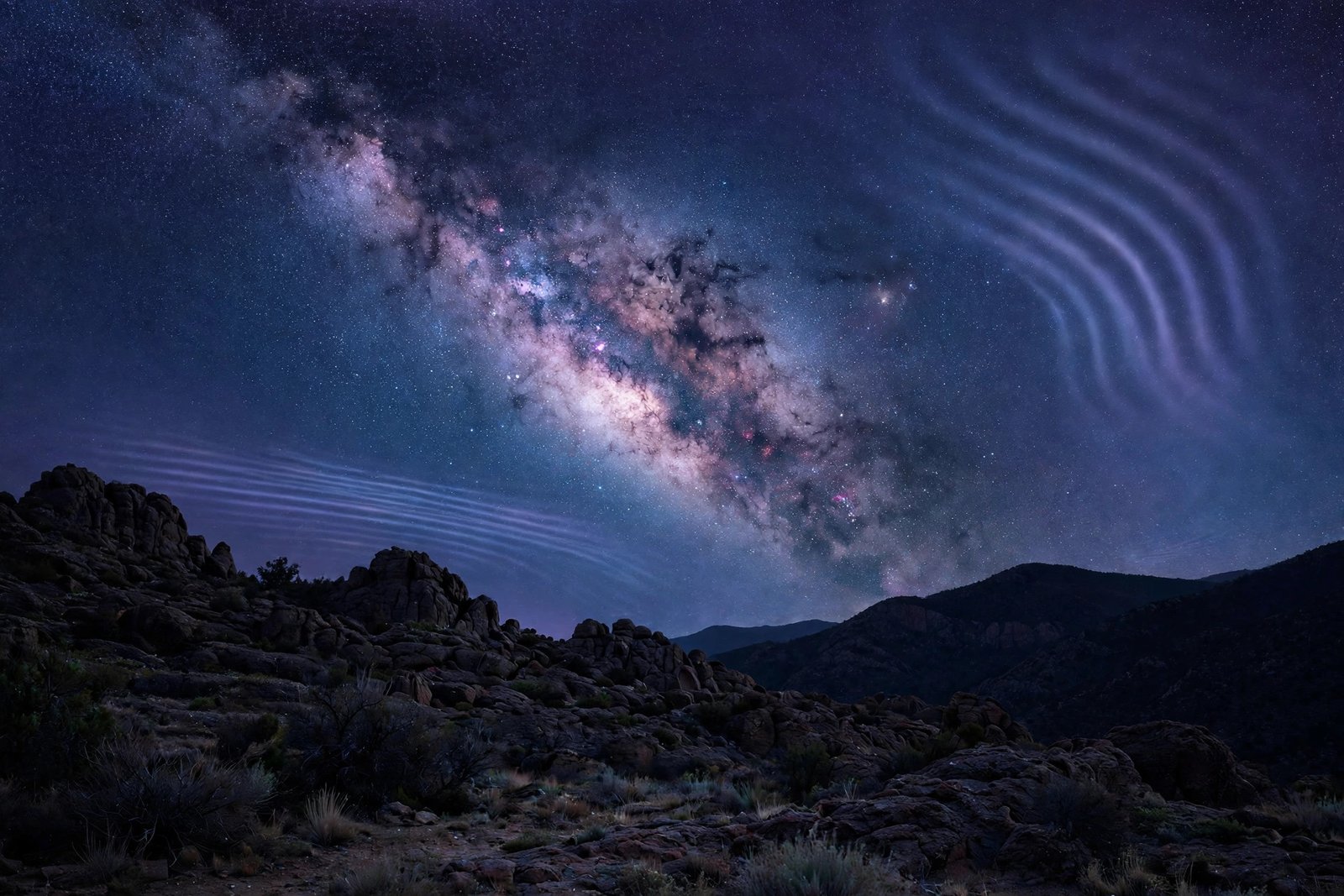
Gravitational waves are ripples in the fabric of spacetime itself, predicted by Einstein in 1916 and detected for the first time in 2015 — a century later, by instruments so sensitive they measure distortions thousands of times smaller than a proton. It is arguably the most extraordinary detection in the history of science. But can you actually understand gravitational waves on a tight budget in Carlisle — without a physics degree, expensive courses, or costly books? Absolutely. The concepts are graspable with the right explanation, and the learning resources are overwhelmingly free. This guide explains what gravitational waves are, how we detect them, what they have revealed, and exactly how to learn more for nothing.
You will learn what spacetime is (intuitively), how massive events create ripples, how LIGO detects the undetectable, the landmark discoveries so far, and the free learning path in Carlisle and online.
Spacetime: the intuitive version
Forget “fabric” as a perfect metaphor, but start there: Einstein’s general relativity says space and time are a single four-dimensional entity — spacetime — and mass tells spacetime how to curve, while curved spacetime tells mass how to move. That is gravity: not a force pulling things, but objects following the curves in spacetime created by mass. The classic image is a bowling ball on a trampoline, curving the surface so marbles roll toward it — imperfect (it needs gravity to work, and spacetime is four-dimensional), but useful for intuition.
Now the key step: when massive objects accelerate — two black holes spiralling into each other, neutron stars colliding — they do not just curve spacetime statically; they send ripples propagating outward through it at the speed of light. These are gravitational waves: travelling distortions where space itself alternately stretches and squeezes as the wave passes. By the time they reach Earth from a billion light-years away, the distortion is almost unimaginably tiny — changing the distance between two points by less than a thousandth of a proton’s width. Everything about gravitational-wave astronomy is the story of detecting the almost-undetectable. The LIGO Scientific Collaboration publishes open explanations of the physics.
How LIGO detects the undetectable
The detection method is interferometry pushed to its absolute limit. LIGO’s detectors (in Louisiana and Washington State, with Virgo in Italy and KAGRA in Japan joining the network) are L-shaped vacuum tubes 4 kilometres long. Laser light bounces back and forth between mirrors at each end; when a gravitational wave passes, it stretches one arm by an infinitesimal amount while squeezing the other, shifting the interference pattern where the beams recombine. The sensitivity required is staggering: measuring length changes of 10^-19 metres — proportionally like measuring the distance to the nearest star to within a hair’s breadth. Achieving this needs: the world’s most stable lasers, mirrors polished to atomic smoothness, seismic isolation that filters out everything from earthquakes to distant traffic (and tumbleweeds — literally, tumbleweeds thumping the buildings were a noise source), and quantum squeezing techniques that push past standard measurement limits. The 2015 detection (GW150914 — two black holes, 36 and 29 solar masses, merging 1.3 billion light-years away) moved the mirrors by that thousandth-of-a-proton amount, and the signal matched Einstein’s century-old prediction exactly. It is hard to overstate what an achievement this is: a hundred years from pencil-and-paper prediction to direct detection of billion-year-old cosmic events.
What the waves have revealed
Since 2015, the detector network has logged around 90 gravitational-wave events, opening an entirely new sense with which to observe the universe — we previously saw the cosmos only through light; now we “hear” it through spacetime ripples. The revelations: black holes are common and heavy — stellar-mass black holes merge regularly, including surprisingly massive ones that challenge formation theories. GW170817 (2017): the landmark event — two neutron stars colliding, detected in gravitational waves and across the electromagnetic spectrum, confirming that such mergers forge heavy elements (gold, platinum — the gold in your ring was made in a neutron-star collision detected as a spacetime ripple). Testing Einstein: every event so far matches general relativity’s predictions precisely — a century-old theory surviving its most extreme tests. The Hubble tension: “standard siren” measurements (gravitational waves give direct distances) offer an independent measure of cosmic expansion, potentially resolving cosmology’s biggest current disagreement. The future: LISA (a space-based detector, 2030s) will hear supermassive black hole mergers across cosmic history; pulsar timing arrays are already detecting the background hum of countless distant mergers. We are in the first decade of a new astronomy. For the budget-conscious learner, saving money on everyday spending frees up exactly the kind of small budget that funds a universe of free learning.
Learning it free in Carlisle (the budget path)
£0 — online: LIGO’s own website and YouTube channel (excellent animations of detections), MIT OpenCourseWare and university lecture series on YouTube, PBS Space Time’s gravitational-wave episodes (rigorous but accessible), and the papers themselves — the GW150914 discovery paper is openly available and its introduction is readable. £0 — library: Carlisle Library (and the Cumbria library network) stocks popular physics books — Kip Thorne’s Black Holes & Time Warps (Thorne won the Nobel for LIGO) is the definitive accessible account; request it free if not on the shelf. £0–£5 — talks: university physics departments (Lancaster, Newcastle) run free public lectures; the Institute of Physics and local astronomical societies host talks — Carlisle’s astronomical society welcomes beginners. £0 — citizen science: Einstein@Home lets your computer analyse real LIGO data for continuous gravitational waves — you participate in the science directly, free. The Institute of Physics also lists free public lectures and resources on gravitational physics. £0 — podcasts: several excellent physics podcasts have gravitational-wave series for commutes and walks. Total cost of deep understanding: £0 and curiosity. The expensive part of physics was never the learning — it is the 4-kilometre vacuum tubes, and kindly, someone else built those. General science literacy compounds too — looking sharp on a budget and thinking sharply on a budget follow the same principle: the best resources are free.
Conclusion
Gravitational waves are ripples in spacetime from accelerating massive objects — black hole mergers, neutron star collisions — detected by kilometre-scale laser interferometers measuring distortions a thousandth of a proton’s width, exactly as Einstein predicted a century earlier. They have revealed a universe rich in merging black holes, confirmed where gold comes from, and opened a new sense for astronomy. And understanding them in Carlisle on a tight budget costs nothing: LIGO’s free resources, library books, public lectures, citizen science, and podcasts provide a complete education for £0. The most extraordinary detection in scientific history, and the explanation is free. That is a rather wonderful thing.
Frequently Asked Questions
What are gravitational waves in simple terms?
Ripples in spacetime caused by accelerating massive objects (like merging black holes), travelling outward at light speed. As they pass, they alternately stretch and squeeze space itself by unimaginably tiny amounts — detected by LIGO’s 4km laser interferometers.
How were gravitational waves first detected?
In September 2015, LIGO detected GW150914 — the merger of two black holes 1.3 billion light-years away. The signal moved the detectors’ mirrors by less than a thousandth of a proton’s width, exactly matching Einstein’s 1916 prediction.
Can I learn about gravitational waves for free?
Yes — LIGO’s website and videos, university lectures on YouTube, library books (Kip Thorne’s Black Holes & Time Warps), free public physics talks, the Einstein@Home citizen science project, and science podcasts. Total cost: £0.
What have gravitational waves discovered?
Around 90 events revealing that black hole mergers are common, that neutron star collisions forge heavy elements like gold (GW170817), precise tests confirming Einstein’s relativity, and independent measurements of cosmic expansion. Space-based detectors in the 2030s will extend this to supermassive black holes.