Cardiff is a fine place to think about diversification. It is also a place where a hundred pounds is a hundred pounds, and the idea of spreading a small crypto budget across a dozen altcoins can feel like slicing a pizza so thin nobody gets a meal. Yet diversification on a tight budget is not only possible — it is arguably more important for small investors, because one bad token choice hurts a £400 portfolio far more than a £40,000 one. This guide shows how to diversify across altcoins safely without your fees eating the portfolio alive, which mistakes to avoid, and a concrete framework built for UK investors starting small.
You will learn what diversification actually means in crypto (it is not just owning more coins), how position sizing protects you, how to keep transaction costs under control on a tight budget, the red flags that mark tokens to avoid, and how to review your mini-portfolio without becoming obsessed. Everything is framed for someone in Cardiff or anywhere in the UK working with modest sums.
What diversification really means in crypto
Owning ten coins is not diversification if nine of them are small-cap tokens that all move together. In crypto, most altcoins are highly correlated with Bitcoin and Ethereum: when the market falls, nearly everything falls. Real diversification means spreading across different risk types, not just different names.
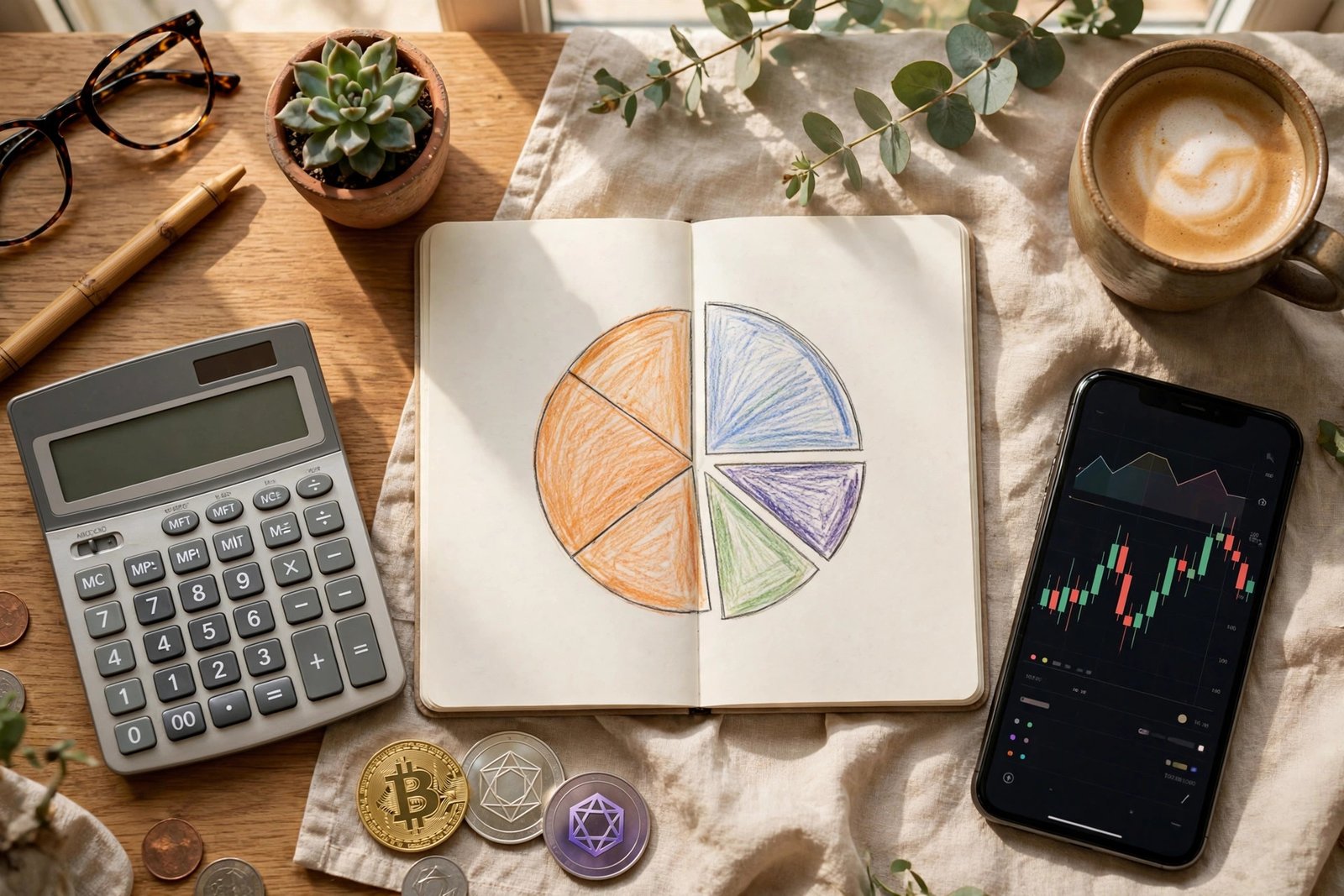
A sensible small-portfolio structure looks like this: a core of established large-cap assets (Bitcoin and Ethereum, the two with the longest track records and deepest liquidity), a smaller allocation to a handful of mid-cap projects with genuine usage and development activity, and — only if you accept the risk — a tiny speculative slice for small caps. The proportions matter more than the names. A common beginner framework is 60–70% in the majors, 20–30% in mid-caps, and 0–10% speculative. On a £500 portfolio, that means £300–350 in the majors, £100–150 across two or three mid-caps, and up to £50 in higher-risk bets. Notice what this does: it guarantees that even a total wipeout of your riskiest picks costs you a bounded, survivable amount.
The tight-budget problem: fees eat small portfolios
Here is the maths that kills small diversified portfolios. If your exchange charges a 1.5% spread plus a fixed fee, buying £25 of a token can cost you 3–5% before the price even moves. Do that across eight tokens with monthly rebalancing and you can lose 15–20% of a small portfolio to friction in a year — worse than most bad trades.
The fixes are practical. First, consolidate your buying: fewer, larger purchases instead of many tiny ones. Buying £150 of one token once costs far less proportionally than buying £25 six times. Second, compare fee structures honestly — the headline “commission-free” app often hides a wide spread, while an exchange with an explicit fee schedule can be cheaper for larger orders. Third, use limit orders on proper exchanges rather than instant-buy buttons, which almost always carry a premium. Fourth, batch your diversification: build the position in one asset this month, the next asset next month, rather than splitting £100 across five coins in one afternoon.
Also watch network fees. Moving small amounts of tokens on-chain can cost more in gas than the tokens are worth. If you are working with modest sums, keeping assets on a reputable exchange while you build up is a defensible trade-off — but only alongside proper security, which is why pairing a proper budgeting habit with your crypto plan matters: know exactly what you can afford to lock away before it leaves your current account.
Position sizing: the rule that saves beginners
The single most important safety rule for small investors is also the simplest: no single speculative position should be large enough to ruin you. Professional traders talk about risking 1–2% of capital per trade; for a small crypto portfolio, a workable beginner rule is that no altcoin outside the majors exceeds 10–15% of your total crypto allocation.
Why does this matter more than picking “the right” tokens? Because token selection is mostly luck at the small-cap end, while position sizing is entirely within your control. Ten well-sized positions where three go to zero still leaves you standing. One oversized position in the wrong token ends the experiment. Write your allocation percentages down before you buy anything. If you cannot state your allocation rule in one sentence, you do not have a strategy — you have a shopping list.
Research before you buy: the cheap investor’s due diligence
You cannot afford to lose money to avoidable mistakes, so your research process needs to be ruthless and free. For every token you consider, answer five questions: What problem does it solve, and do real people use it? Who is building it — are the team public and the development active? How is the token supply structured, and who holds the largest wallets? Is there genuine liquidity, meaning you can actually sell without crashing the price? And what would have to go wrong for this to go to zero?
The answers are all publicly available: block explorers, the project’s documentation and code repositories, and community channels. If you cannot find clear answers, that is itself an answer — walk away. The UK’s financial regulator is blunt on this point: the FCA’s cryptoasset guidance warns consumers to be prepared to lose all their money, which is precisely why small, sized, researched positions beat large hopeful ones.
The Cardiff angle: practical realities for UK small investors
Being in Cardiff changes little about the strategy and a lot about the logistics. Use a UK-friendly exchange or platform that supports Faster Payments for GBP deposits, so you are not paying conversion fees on every top-up. Keep records from day one — every buy, sell, swap, and fee — because HMRC treats crypto disposals as taxable events, and reconstructing a year of small trades from memory is miserable. A simple spreadsheet is free and sufficient at this scale; tracking your expenses methodically is a habit that pays off far beyond crypto.
Set a schedule and stick to it: many small investors do well with a monthly buy of a fixed amount, split by their allocation rule. This is pound-cost averaging, and its virtue is psychological — it removes the decision of “is now a good time” from every purchase. And decide your exit rules in advance: at what point do you take profit, and at what point do you admit a token thesis was wrong? Rules written in calm moments survive panicked ones.
Conclusion
Diversifying across altcoins on a tight budget is not about owning many coins — it is about owning the right mix in the right sizes with fees under control. Anchor most of your money in the majors, keep speculative positions small enough to survive, batch your buys to starve the fee monster, research everything, and keep records for HMRC. Do that from Cardiff or anywhere else, and a small portfolio becomes a durable learning machine instead of an expensive lottery ticket.
Frequently Asked Questions
How many altcoins should a beginner hold?
Quality beats quantity. Three to six positions beyond Bitcoin and Ethereum is plenty for a small portfolio. More coins usually means more fees, more tracking, and more dilution of your best ideas.
Is £100 enough to start diversifying?
Yes, but keep it simple: with £100, one or two positions is diversification enough. Splitting £100 five ways loses too much to fees. Build up over months rather than fragmenting immediately.
Should I keep small amounts on an exchange?
For modest sums, a reputable exchange with strong security is a reasonable place to hold while you build. The Bank of England’s explainer on cryptocurrencies is useful background on what these assets actually are before you commit funds.
Do I owe tax on small crypto gains in the UK?
Capital Gains Tax applies to crypto disposals above the annual exempt amount, regardless of portfolio size. Keep records of every transaction from the start — MoneyHelper has free guidance on how investment tax basics work.