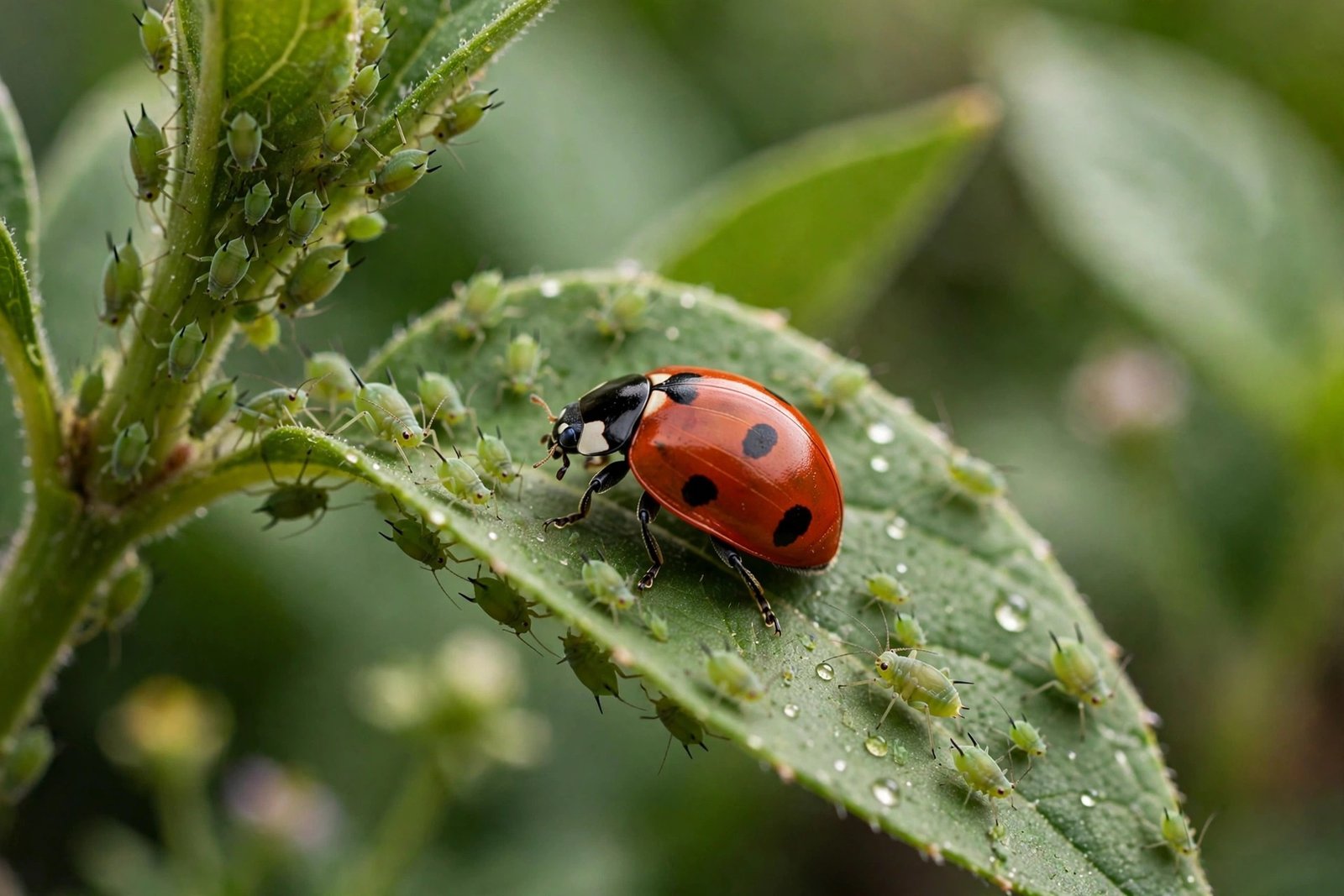
You check your roses one morning and the buds are crawling with small green insects. Aphids — greenfly, blackfly — have found your garden, and they work fast: colonies double in days, sucking sap, spreading viruses, and coating leaves in sticky honeydew. The instinct is to reach for the spray. Resist it — not from ideology, but because natural aphid control works better once you understand the system.
This guide gives complete beginners the full natural aphid toolkit: what aphids are, why sprays backfire, and the layered approach that keeps them manageable without chemicals.
Know Your Enemy (It Takes 10 Minutes)
Aphids are small (1–3mm), soft-bodied sap-feeders that cluster on new growth, buds, and leaf undersides. They reproduce with absurd speed — females give birth to live young without mating, and a single aphid can theoretically produce billions of descendants in a season. They damage plants three ways: sap-sucking (weakening growth, distorting leaves), virus transmission (the serious agricultural threat), and honeydew (the sticky excretion that grows sooty mould and attracts ants).
But here is the crucial ecological fact: aphids are the base of the garden food web. Ladybirds, lacewings, hoverfly larvae, parasitic wasps, and birds all eat them — a garden with no aphids has no predators, and a garden with no predators gets devastating aphid outbreaks. The goal is never eradication (impossible and counterproductive) but balance: enough aphids to sustain predators, few enough to protect plants. The RHS aphid guidance explains this ecology-first approach authoritatively.
Why Sprays Backfire (The Pesticide Trap)
Broad-spectrum insecticides kill aphids — and everything that eats them. Predators recover slower than pests (they breed slower, they need the prey base), so the sprayed garden enters a cycle: spray, brief relief, worse outbreak (no predators left), spray again. Each cycle deepens dependence. This is not ideology — it is population ecology, and it is why experienced organic growers pity the spray-dependent: they are fighting the garden’s own defences.
Even “natural” sprays (neem, pyrethrin, soap) kill beneficials indiscriminately. They have their place as targeted emergency tools, but routine use recreates the same trap. The beginner’s mindset shift: stop trying to kill aphids and start trying to build predators. Everything below follows from that inversion.
The Natural Toolkit (In Order of Impact)
1. Water jet (immediate, free). A strong blast from the hose knocks aphids off plants — most cannot climb back. Do this in the morning so foliage dries by evening. It is the highest-impact instant action, costs nothing, and harms nothing else. 2. Finger squishing (immediate, free). For small infestations on prized plants, gloved fingers are brutally effective — check leaf undersides and growing tips every few days through spring. 3. Beneficial habitat (weeks to establish). Plant alyssum, marigolds, and umbellifers (dill, fennel) to attract hoverflies, lacewings, and parasitic wasps — the aphid-eating specialists. A single hoverfly larva eats hundreds of aphids. 4. Ant control (ongoing). Ants “farm” aphids for honeydew, protecting them from predators — break the partnership by deterring ants (sticky barriers on stems, disrupting nests near prized plants) and predator access improves dramatically. 5. Sacrificial plants. Nasturtiums deliberately draw aphids away from crops — the trap-crop principle, genuinely effective.
For severe outbreaks on valuable plants, insecticidal soap or neem as a targeted spot-treatment (evenings, when beneficials are less active, aimed only at infested areas) is the proportionate emergency response — not routine warfare.
Biological Controls You Can Buy
Sometimes nature needs reinforcements. Commercially available beneficial insects — ordered online, posted to your door — are the organic grower’s cavalry. Ladybird adults and larvae (£8–£15 for 25–50): released onto infested plants in the evening, they feed immediately; larvae eat more than adults. Lacewing larvae (£10–£18): the “aphid lions” — ferociously effective, especially in greenhouses. Parasitic wasps (Aphidius species, £12–£20): tiny, stingless, they lay eggs inside aphids, which mummify into distinctive bronze husks — the wasps then emerge to parasitise more. Watching mummified aphids appear is the visible proof your garden’s food web is working.
The keys to success: release in the evening (beneficials settle overnight rather than flying off), onto existing aphid populations (no prey, no staying), in still, mild weather. Indoors and greenhouses, they are transformative — enclosed spaces concentrate the predators on the pests. Outdoors, they supplement the wild populations you are building with habitat planting. Think of bought beneficials as jump-starting the system your garden will eventually run itself — training wheels for the food web, typically needed only in the first year or two.
The Seasonal Strategy
Spring (the critical window): aphids explode as new growth emerges — this is when daily 5-minute inspections pay off enormously. Blast and squish early colonies before they establish; early action prevents 90% of later problems. Summer: predator populations peak — trust the system, intervene only for severe infestations on important plants. Autumn: leave some habitat undisturbed — overwintering ladybirds and lacewings in log piles and dense planting are next year’s army. Winter: plan beneficial plantings for spring.
The first year is the hardest — predator populations build slowly, and beginners panic at spring aphids. By year two, the garden’s defences are established and aphid pressure drops noticeably. Patience is the method. This ecological patience applies across the vegetable garden — small-space vegetable growing succeeds on the same principles, and low-maintenance gardening is largely about building systems that manage themselves.
When Natural Methods Are Not Enough
Honesty: sometimes aphids overwhelm — a bad year, a valuable crop, a new garden with no predator base yet. The escalation ladder: targeted soap/neem spot-treatment → horticultural fleece barriers on vulnerable crops → accepting some losses (not every plant must be perfect) → and only in extremis, considering whether the plant choice is wrong for the site (chronically aphid-devastated plants in the wrong place should be replaced, not defended forever). Garden Organic’s pest-management resources detail the organic-approved interventions for when nature needs a nudge.
The Bottom Line
Dealing with aphids naturally means: understand they are predator food (balance, not eradication), never start the spray cycle, blast and squish early colonies, build beneficial habitat, manage ants, use trap crops, and reserve targeted soap for emergencies. The first spring requires vigilance; by year two the garden largely defends itself. It is cheaper than chemicals, better for everything else alive in your garden, and — once the ladybirds arrive — deeply satisfying to watch work.
Frequently Asked Questions
What is the fastest natural way to get rid of aphids?
A strong water jet from the hose — knocks colonies off instantly, free, and harmless to beneficial insects. Follow up with finger-squishing on remaining clusters.
Why do ants protect aphids?
Ants harvest the aphids’ sugary honeydew excretion, so they defend aphid colonies from predators. Breaking this partnership (ant barriers, nest disruption) dramatically improves natural predator control.
Will ladybirds really control my aphids?
Yes — ladybird adults and especially larvae are voracious aphid predators, alongside hoverfly larvae, lacewings, and parasitic wasps. But they need habitat and a small aphid population to sustain them; plant accordingly.
Is neem oil safe for beneficial insects?
Safer than synthetic insecticides but not harmless — it affects beneficials on contact. Use as a targeted evening spot-treatment on infested areas only, never as a routine blanket spray.