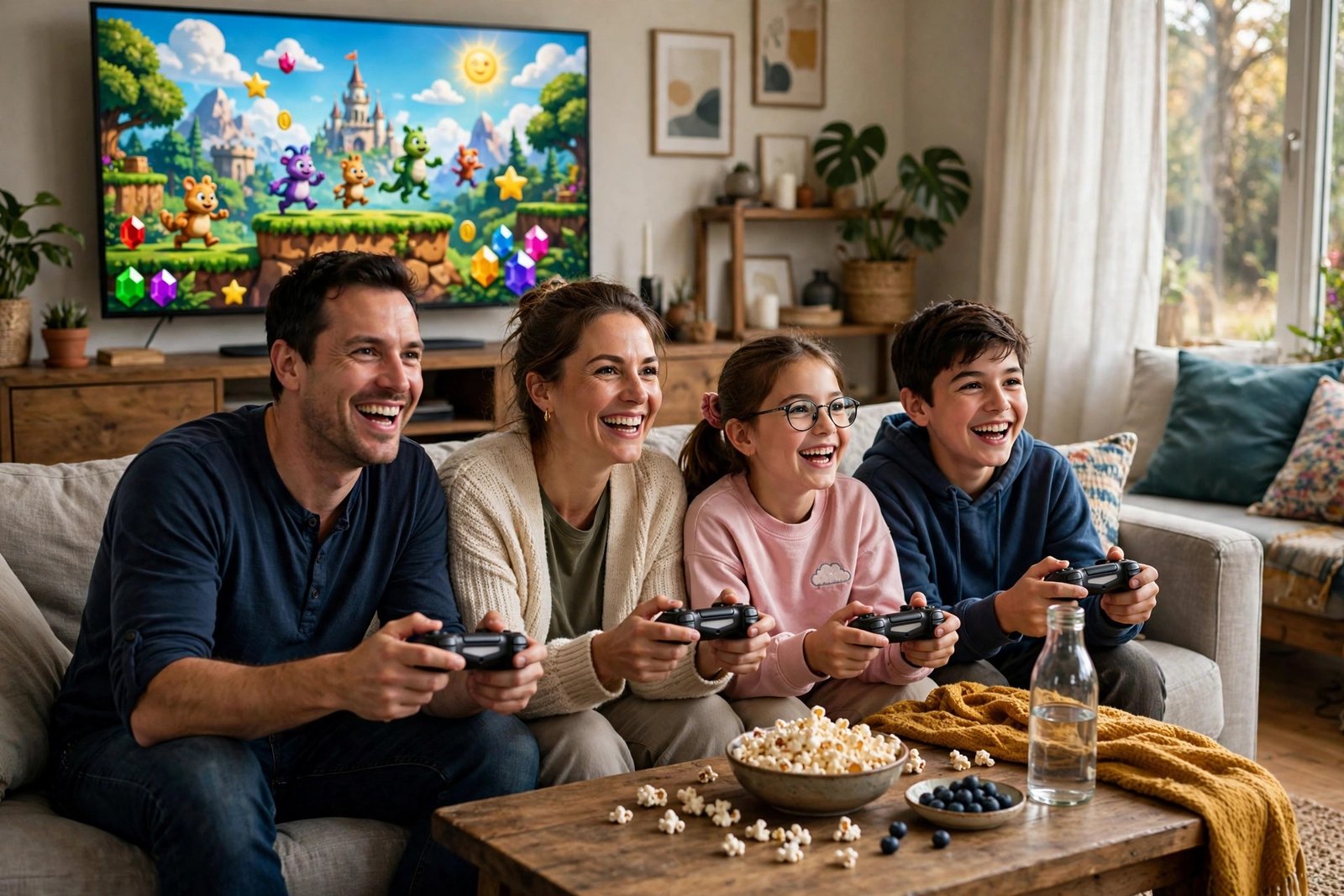
Choosing games for your family sounds simple until you try it. The kids want what their friends play (usually PEGI 16+), you want something everyone can enjoy together, the sheer number of options is paralysing, and one wrong purchase means £50 on a game nobody touches. Family-friendly gaming is a skill — part research, part psychology, part diplomacy — and it is entirely learnable.
This guide explains how choosing family-friendly video games actually works: what “family-friendly” really means beyond the label, the decision framework that prevents expensive mistakes, and how to build a household games collection that survives contact with real children of different ages.
What “Family-Friendly” Actually Means
The phrase covers three different things, and confusing them causes most bad purchases. Age-appropriate: content suitable for the youngest player — the PEGI rating question. Accessible: mechanics simple enough for varied skill levels — a game can be PEGI 3 and still too complex for a five-year-old. Enjoyable together: the hardest criterion — genuinely fun for both a 7-year-old and a 40-year-old, not merely tolerable for the adult.
The games that nail all three are rarer than marketing suggests, but they exist and they are wonderful: titles like Mario Kart 8 (racing forgiving enough for kids, deep enough for adults), Overcooked (cooperative chaos that scales with skill), Minecraft in creative mode (a digital Lego box), and Stardew Valley (gentle, absorbing, all-ages). Notice the pattern: the best family games are usually designed as family games, not adult games with the edges sanded off.
The Decision Framework: Four Questions
Run every candidate game through these four questions before buying:
1. Who is the youngest player, really? Not their age — their maturity and sensitivity. Some 8-year-olds handle mild peril fine; others have nightmares from cartoon ghosts. You know your child; the rating does not. Check the PEGI rating and content descriptors as the starting point, then adjust for the individual.
2. Can we play it together? Shared-screen multiplayer, cooperative modes, and “pass the controller” turn-taking all count. Games designed for solo play can still work for families — a story adventure played together, with children making the decisions, is a superb family activity — but be deliberate about it. The guide to planning a games night for mixed ages covers the logistics of multi-age play brilliantly.
3. What is the frustration profile? This is the question nobody asks and everybody should. Some games punish failure harshly (souls-likes, competitive shooters); others are endlessly forgiving (creative sandboxes, cosy sims). Young children need low punishment — every harsh failure risks tears and a permanently shelved game. Look for difficulty options, assist modes, and creative modes that remove failure entirely.
4. What is the total cost of ownership? The £50 disc is the beginning: online subscriptions for multiplayer, in-game purchases (check that PEGI descriptor), and DLC all add up. Free-to-play games deserve extra scrutiny — their business model is engineered engagement, and AskAboutGames has excellent parent-focused explainers on navigating them safely.
Building the Collection: The Starter Shelf
Think in categories, not titles — tastes vary, but the slots are universal. Every family collection wants: one party game (Mario Kart, Jackbox, or similar — the “visitors are coming” game); one creative sandbox (Minecraft, or Dreams/Terraria — the infinite game); one cooperative adventure (It Takes Two, LEGO games, Overcooked — the together game); one gentle solo game per child (Stardew Valley, Animal Crossing — the wind-down game). Four slots, thoughtfully filled, outperform forty impulse purchases.
Buy strategically: Nintendo Switch remains the family console champion by a distance — its library is the most family-dense in gaming. Buy physical discs where possible for resale and lending. Watch for sales — Nintendo games famously hold prices, but PlayStation and Xbox family titles discount deeply. And mine the past: retro games to play with kids are cheap, proven, and often better-designed for families than modern equivalents.
Navigating the Hard Parts
The “but everyone plays it” negotiation: when children lobby for age-inappropriate games their friends play, the answer is not just “no” — it is “no, and here is what we are playing instead, and here is when we will revisit it.” Offer the alternative in the same breath as the refusal. Watch gameplay videos together so the decision feels shared, not imposed.
Screen-time sanity: family gaming sidesteps much of the screen-time angst — it is active, social, and shared, closer to a board game than to solitary scrolling. Many families find that gaming together for an hour beats gaming apart under time limits. The medium is not the problem; the isolation sometimes is.
Different ages, one game: the eternal challenge. Solutions that work: asymmetric roles (younger child navigates, older one fights), assist modes for the younger player, or games with genuinely scalable difficulty. And sometimes the answer is simply taking turns with different games — togetherness does not require identical activities.
The First Month: Introducing Gaming Well
How you introduce gaming matters as much as what you choose. The families who thrive follow a pattern: start together — the first sessions are co-played, with the parent holding the controller alongside the child, narrating and laughing. This builds the association that gaming is a shared joy, not a solitary babysitter. Keep sessions short initially — 30 to 45 minutes, ending on a high note rather than dragging until boredom or frustration. Children remember endings; finish while it is still fun.
Let them struggle productively. The instinct to grab the controller when a child fails is strong and usually wrong — working through a tricky section is where the satisfaction lives. Offer hints, not takeovers. Establish the rhythm early: gaming as a regular, bounded part of the week (Sunday afternoon Mario Kart tournament, Friday co-op night) beats both unrestricted access and arbitrary-seeming limits. Rituals give children something to look forward to and remove the daily negotiation. Within a month, most families find their groove — and discover that the “which game” question, so stressful at the start, answers itself through play.
The Bottom Line
Choosing family-friendly video games works when you separate the three meanings of “family-friendly,” run candidates through the four questions (youngest player, togetherness, frustration, cost), build around the four collection slots, and handle the social negotiations with alternatives rather than just refusals. Done well, family gaming becomes one of the household’s best traditions — not despite the effort of choosing well, but because of it.
Frequently Asked Questions
What is the best console for family gaming?
The Nintendo Switch, by a clear margin — the largest library of genuinely family-designed games, simple controls, and portable play. PlayStation and Xbox both offer family options but skew older.
How do I know if a game is appropriate for my child?
Start with the PEGI rating and content descriptors on pegi.info, then adjust for your individual child — ratings describe content suitability, not your child’s maturity or sensitivity. Watching gameplay videos together is the best final check.
Are free-to-play games safe for kids?
They can be, with setup: enable spending controls, disable or supervise voice chat, and understand the game’s monetisation. Check the PEGI “in-game purchases” descriptor and AskAboutGames’ parent guides.
What age can children start playing video games?
There is no single right age — it depends on the child and the game. Simple creative games (PEGI 3) suit ages 4–5 with a parent; more complex games from 7–8. Co-playing with a parent works at any age.
How much should a family spend on games?
Less than you fear: a starter collection of 4–6 well-chosen games (£100–£200, much less second-hand or on sale) lasts years. Subscriptions like Game Pass or Nintendo Switch Online add variety cheaply.