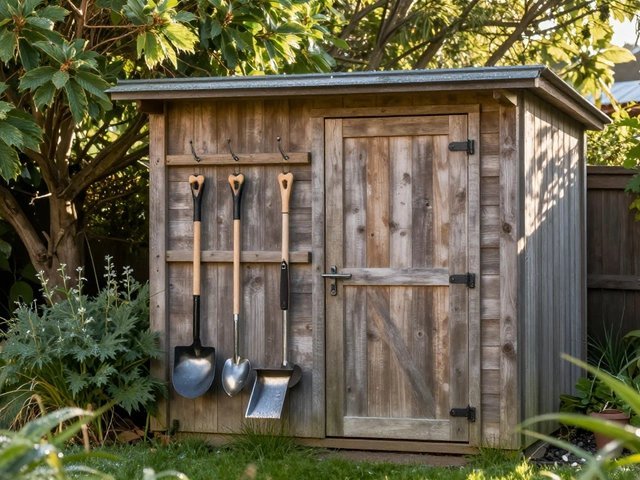
Small sheds have a natural tendency toward entropy: you open the door, something falls on your foot, and the strimmer is buried behind the Christmas decorations. When people ask what is the best way to store tools in a small shed, they’ve usually reached the point where the shed is technically full but functionally useless.
I’ve organised two tiny sheds (6×4 and 8×6), and the transformation from chaos to workshop is about walls, not floor space. Here’s the system: get everything off the floor, zone the space, and make every tool earn its place.
What is the best way to store tools in a small shed? Use the walls
The walls are 80% of a small shed’s storage potential, and most sheds waste them. Start with a pegboard or slatted wall panel on the main wall — a 1.2m x 1m pegboard (£25–£40) with hooks holds dozens of hand tools visibly and accessibly, which means you’ll actually put them back. For heavier tools, French cleats are the DIY gold standard: angled timber strips screwed to the wall studs, with matching cleats on custom holders for drills, saws and boxes. Strong, endlessly reconfigurable, and cheap (£20 of timber does a whole wall).
Magnetic strips (£10–£15) along a batten hold screwdrivers, chisels and spanners brilliantly. Screw short lengths of plastic guttering to the wall at an angle for spray cans and bottles — it sounds odd, it works perfectly. And hang the big awkward things: bikes on wall hooks, the ladder on horizontal brackets, the strimmer on a dedicated hook. The rule is absolute: nothing leans against anything. Everything hangs, and the floor stays clear for actually walking and working.
- Pegboard or slatted panels for hand tools — visible, accessible
- French cleats for heavy tools — strong, reconfigurable
- Magnetic strips for screwdrivers and spanners
- Guttering sections for spray cans and bottles
- Wall hooks for bikes, ladders and long-handled tools
- Nothing on the floor that can hang on a wall
Zones, overhead storage and the floor
Zone the shed like a tiny workshop: one wall for garden tools (spades, shears, strimmer), one for DIY tools (drill, saws, fixings), and one corner for consumables (paint, compost, fertiliser). This sounds fussy, but zoning means you find things in seconds and — critically — other people can find things too. Label the zones if you share the shed; a label maker (£20) is weirdly life-changing for shed harmony.
The ceiling is free real estate: overhead racks or simple 2×4 frames hung from the roof joists hold long timber, pipes, the rarely-used ladder and seasonal items (Christmas decorations, the paddling pool) that otherwise colonise the floor. Keep it light up there — shed roofs aren’t structural — and don’t block ventilation. On the floor itself, one sturdy workbench along the back wall (£80 DIY from timber and an old door, or £150 bought) doubles as storage underneath and a work surface on top. Everything else on the floor should be in stackable, lidded boxes — damp-proof and mouse-resistant.
Damp, security and maintenance
A shed’s enemies are damp and thieves, in that order. Raise everything off the floor where possible — even 5cm on battens prevents the rising damp that rots tool handles and rusts blades. Silica gel tubs or a small solar-powered vent reduce condensation; never store petrol or chemicals in sealed unventilated corners. Oil metal tool heads annually (a rag with 3-in-1 oil, five minutes) and the tools will outlive you.
Security: sheds are burgled constantly because they’re full of expensive tools behind a £5 padlock. Fit a proper hasp and closed-shackle padlock (£25–£40 total), hinge bolts on the door, and consider a battery-powered shed alarm (£20–£30, deafeningly loud). Don’t store the most valuable tools in the shed at all — the £300 drill lives in the house. Photograph your tools and record serial numbers for insurance; check your home policy covers shed contents (many cap it at £1,000–£2,500 unless you specify).
The budget workshop setup
A shed workshop needs four things: a workbench, light, power and organisation — all achievable cheaply. The workbench: a solid-core old door on 4×2 timber legs (£30–40 in timber, or free if you salvage the door) gives a 2m x 800mm bench that outlasts bought ones. Bolt a bench vice (£25–35) to one end and it’s a proper workshop. Light: a batten LED fitting (£15–20) wired to the shed’s supply, or a rechargeable LED work light (£25) if there’s no power — working in shed gloom is miserable and dangerous.
Power: if the shed’s within cable distance, an armoured cable on a dedicated circuit by an electrician (£200–300) is the proper job — don’t run extension leads across the garden permanently. Organisation is the wall system from the main guide, plus one addition: a small parts organiser (the £15 multi-drawer type) for screws, fixings and bits — the thing that turns ‘I know I have one somewhere’ into a 30-second retrieval. Total workshop setup: under £150 plus the electrical work. The shed stops being storage and starts being the place where things get made and fixed.
- Workbench: old door + timber legs (£30–40) + vice (£25–35)
- Proper lighting — batten LED or rechargeable work light
- Armoured cable by an electrician for permanent power
- Small-parts organiser for screws and fixings (£15)
- Wall storage system from the main guide
From chaos to workshop
Walls for tools (pegboard, cleats, magnets), ceiling for the rarely-used, floor for one workbench and stacked boxes, zones for sanity, and proper security for peace of mind. A weekend’s work turns the most chaotic 6×4 into a workshop you’ll actually enjoy opening.
For the bigger storage picture, best way to organise a garage on a budget organises the garage on a budget and maximise storage in a small uk bedroom maximises bedroom storage indoors. For storage product reviews, Which? home improvement guides is worth checking.
The shed-workshop truth: you don’t need a big shed, you need an organised one. Walls for tools, bench for work, light to see, power to run — and the discipline to put things back. The best workshop is the one you actually use, and you’ll use the one where everything has a place.