North-facing rooms get the cool, flat, indirect light that photographers love and homeowners curse — no direct sun, ever, just a soft grey glow that makes colours look dull. When people ask how can I brighten a north facing room without more windows, they’ve usually tried white paint, been disappointed, and assumed they’re stuck with the gloom.
I’ve brightened three north-facing rooms now, and the trick is working with the cool light rather than fighting it. Here’s the complete approach: colour strategy, reflective surfaces, layered lighting, and the small changes that add up to a transformed room.
How can I brighten a north facing room without more windows? Colour strategy
North light is blue-grey and cool, so it drains warmth from colours — which is why brilliant white goes dingy and cool greys turn icy. Fight back with warmth: whites and neutrals with yellow, pink or red undertones (think Farrow & Ball’s White Tie, Dulux’s Warm Pewter, Little Greene’s Portland Stone). These don’t add light physically, but they stop the room feeling cold, which is half the battle. Avoid anything with a blue or green undertone — in north light it will look muddy by 3pm.
Gloss levels matter more than people realise. A soft-sheen or satin finish on walls reflects measurably more light than dead matt — in a light-starved room, that 5–10% extra reflectance is visible. Paint the ceiling brilliant white regardless of wall colour (ceilings don’t suffer the undertone problem the way walls do), and keep woodwork the same warm white as the trim throughout. One more counterintuitive tip: a single warm accent wall in a sunny yellow or warm terracotta can make the whole room feel sunlit by association — colour psychology is real.
- Warm-undertoned whites and neutrals — never blue-grey
- Soft-sheen or satin wall finish to reflect more light
- Brilliant white ceiling, always
- Warm accent colours (ochre, terracotta) for psychological sunshine
- Test colours in the room’s actual light, morning and afternoon
Mirrors and reflective surfaces
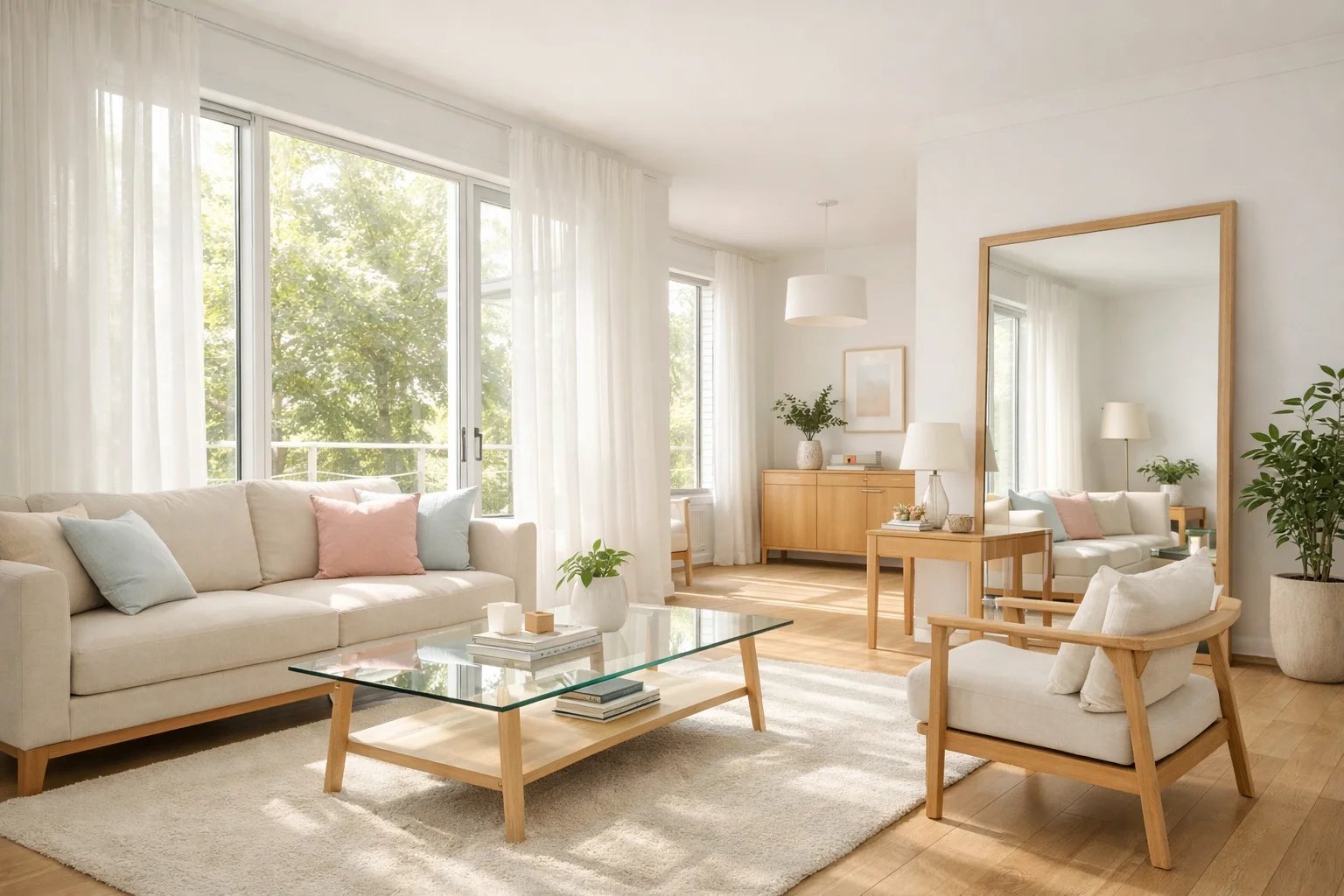
A well-placed mirror is the closest thing to adding a window. The rule: position mirrors to catch and throw existing light — opposite the window is the classic, but adjacent walls work too, bouncing light deeper into the room. Go big: a large leaning floor mirror does more than three small decorative ones, and mirrored furniture (a console, a side table) adds sparkle without visual weight. Even picture frames with glass rather than matte mounts contribute.
Beyond mirrors, audit the room’s surfaces for light absorption. Dark wood furniture, heavy patterned rugs and matte dark upholstery drink light; you don’t need to replace everything, but a pale rug over a dark floor, light-coloured throws, and glass or acrylic side tables instead of solid wood ones all help. Metallic accents — brass lamp bases, a copper pendant, mirrored trays — catch what light there is and scatter it. And keep windows maximally clear: clean the glass inside and out, ditch heavy curtains for light-filtering blinds or sheers, and never put tall furniture in front of the window wall.
Layered artificial lighting
In a north-facing room, artificial lighting isn’t backup — it’s a design feature you’ll use all day in winter. The magic formula is layers: ambient (ceiling light or floor-washing uplighters), task (reading lamps, desk lights), and accent (picture lights, shelf lighting, a warm glow in a dark corner). Aim for at least three light sources at different heights; a single central pendant creates harsh pools of light and gloomy corners, which is exactly what you’re trying to escape.
Colour temperature is critical: use warm white (2700K–3000K) everywhere to counteract the cool daylight — daylight bulbs (4000K+) in a north-facing room feel clinical. Put everything on dimmers so the room can shift from bright daytime to cosy evening. And don’t forget the dark corners: a small uplighter or LED strip behind furniture in the gloomiest corner eliminates the ‘cave’ effect that makes the whole room feel darker. Good lighting design can make a north-facing room the cosiest in the house — lean into it.
Furniture and layout for maximum light
Furniture placement is free brightness. The rules: keep the window wall clear — no tall bookcases or sofas blocking the glass, ever. Arrange seating to face the light rather than with backs to it; a reading chair angled toward the window gets the best of the daylight. Choose furniture with legs over blocky base units — visible floor underneath reads as space and lets light flow. Glass-topped tables, acrylic chairs and open shelving all keep sightlines clear where solid furniture would block light.
Scale matters in dark rooms: oversized dark furniture in a small dark room is oppressive; appropriately-scaled pieces in lighter finishes feel generous. If the sofa must be dark (pets, kids, life), balance it with pale companions — light rug, light curtains, pale wood side tables. And the layout trick that costs nothing: pull furniture slightly away from walls. Floating the sofa even 10cm off the wall creates shadow lines that add depth, paradoxically making the room feel larger and lighter than furniture shoved flat against every wall.
- Window wall stays clear — nothing tall blocking the glass
- Furniture with legs over blocky bases — light flows underneath
- Glass, acrylic and open shelving keep sightlines clear
- Balance dark essentials with pale companions
- Float furniture slightly off walls for depth
The north-facing room formula
Warm-toned paint in a soft sheen, white ceiling, big mirrors throwing light deep into the room, pale reflective surfaces, and three layers of warm artificial light. You can’t change the compass, but you can absolutely change how the room feels.
For the paint specifics, what colour should I paint a small dark living room covers colours for dark living rooms, and choose curtains or blinds for a bay window helps dress the windows to maximise light. For lighting product tests, Which? home improvement guides is the independent guide I recommend.
The dark-room layout principle: light is a material, like wood or fabric — arrange the room around it. Clear the window, reflect what comes in, layer warm artificial light, and choose furniture that gets out of the light’s way. The compass point doesn’t change; everything else can.