
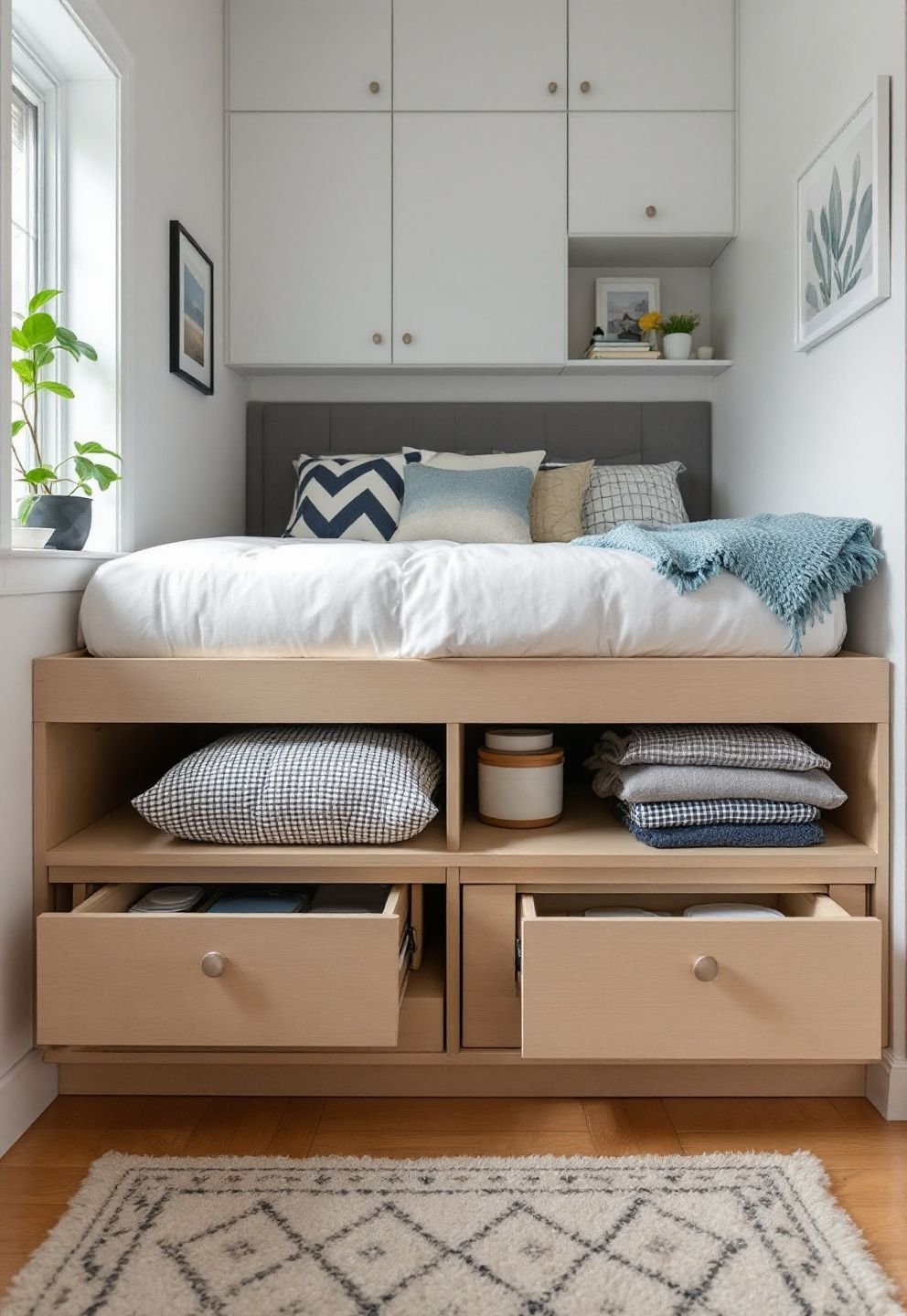
British bedrooms are small — the average new-build double is barely 11 square metres, and box rooms are smaller still. When people ask how can I maximise storage in a small uk bedroom, they’re usually drowning in stuff with nowhere to put it, in a room where a wardrobe door can’t fully open.
I’ve organised storage in five small bedrooms, including a box room that now sleeps guests, stores a wardrobe’s worth of clothes and still has floor space. The secret isn’t buying more storage — it’s using the volume you already have: under the bed, up the walls, behind the door, inside the furniture.
How can I maximise storage in a small UK bedroom? Think in 3D
The average bedroom uses about a third of its available storage volume — the floor footprint is full, but everything above waist height and below the mattress is wasted. Start with the bed: an ottoman bed (the whole mattress lifts on hydraulics) swallows an astonishing amount — duvets, suitcases, out-of-season clothes — in space that was doing nothing. At £300–£600 they’re pricier than divans, but they replace a chest of drawers. Divan drawers are the cheaper alternative, though the drawers only use half the under-bed depth.
Next, go vertical. Floor-to-ceiling wardrobes hold roughly 40% more than standard-height ones for barely more money — IKEA’s PAX system in the tallest size is the budget king here. Use the wall above the bed for shelves (boxed shelving looks tidier than open), the back of the door for hooks or a slim rack, and the awkward corners for corner shelving. The 30cm of wall above a door frame fits a shelf for the things you rarely need. Think of the room as a cube to fill, not a floor to arrange.
- Ottoman bed — the single biggest storage win in a small room
- Floor-to-ceiling wardrobes (IKEA PAX tall units)
- Shelving above the bed and above door frames
- Back-of-door hooks and slim racks
- Under-bed vacuum bags for out-of-season clothes
- Corner shelves for dead space
Furniture that works twice as hard
In a small bedroom, every piece of furniture should store something. Bedside tables with drawers instead of a bare table; a dressing table that’s also a desk with drawer units; a window seat with a lift-up lid. Wall-mounted bedside shelves free up floor space entirely — a £15 floating shelf each side of the bed replaces two tables. If there’s room for an armchair, make it a storage ottoman you can sit on.
The wardrobe itself deserves a rethink: most wardrobes waste their interiors. Add a second hanging rail below the first for shirts (doubling hanging space), stackable boxes on the top shelf, and slim pull-out drawers or hanging organisers for the awkward depths. A £30 investment in wardrobe organisers can genuinely double a wardrobe’s capacity. And be brutal about the one-in-one-out rule going forward — small bedrooms can’t absorb accumulation, so every new item should replace something.
Layout tricks and the declutter first step
Before buying anything, declutter — no storage system survives too much stuff. The method that works: empty the room’s storage completely, sort into keep/donate/bin, and only put back what earns its place. Most people remove a third. Then plan the layout on paper: bed against the longest wall (not blocking the window), wardrobe on the wall with the door swing accounted for, and a clear path from door to bed. In truly tiny rooms, consider the bed under the window — it frees the walls for wardrobes and feels surprisingly cosy.
Colour and light affect perceived spaciousness too: pale walls, a mirror opposite the window, and curtains hung high and wide make the room feel bigger, which makes the storage feel less oppressive. Keep the floor as clear as possible — visible floor is what makes a room feel spacious, so everything that can go up or under, should. Under-bed storage on wheels, shoes in over-door organisers, laundry in a lidded basket that doubles as a side table.
Kids’ rooms and shared bedrooms
Kids’ small bedrooms need a different storage logic: everything at kid height, everything visible, everything easy to put away — because a system a child won’t use is decoration. Open cubes and labelled bins beat wardrobes with doors (doors hide mess; open storage invites tidying). A low bookcase as a room divider in shared rooms gives each child a zone; under-bed drawers on wheels handle the toy overflow. The ‘one in, one out’ rule is doubly important with kids — birthdays and Christmases flood small rooms otherwise.
For teenagers, the priorities shift: desk space for homework (the wall-mounted drop-leaf from the home-office guide works brilliantly), charging stations (a power strip in a drawer — cable chaos solved), and storage that respects privacy (lockable drawer or box for the things that matter to them). Shared sibling rooms: vertical division works better than horizontal — bunk beds or high-sleepers with desk/storage underneath effectively double the room. IKEA’s loft-style beds with the workspace below have saved thousands of sibling relationships. Whatever the age, involve them in the system design — compliance follows ownership.
- Kids: open cubes + labelled bins at kid height — visible and easy
- Shared rooms: bunk/high-sleeper beds double the usable space
- Teens: desk space, charging drawer, one lockable private spot
- Under-bed drawers on wheels for toy overflow
- Involve them in designing the system — ownership drives tidying
Small bedroom, big storage
Declutter first, then think in 3D: ottoman bed, floor-to-ceiling wardrobes, walls and door-backs, furniture that stores. The goal is clear floors and clear surfaces — that’s what makes a small bedroom feel calm instead of cramped.
For turning a box room into a proper guest space, turn a box room into a guest bedroom is the perfect follow-up, and create a home office in a spare corner covers carving a home office from a spare corner. For clever storage buys, MoneySavingExpert’s household money-saving tips rounds up the best budget finds.
The small-bedroom truth at every age: the room isn’t too small, the system is wrong. Clear floors, vertical thinking, furniture that stores, and a ruthless intake policy. Get those right and even the box room feels generous — because spaciousness is a feeling, and feelings are designed.


