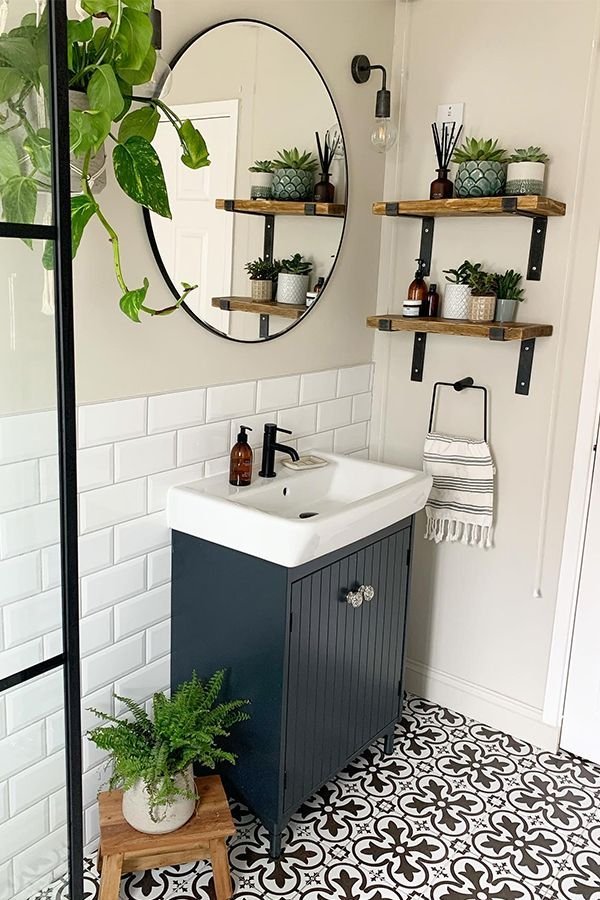
Small bathrooms are a fact of British housing life — the average UK bathroom is barely bigger than a king-size bed. When people ask how can I make a small bathroom look bigger, they’re usually hoping I’ll say ‘knock a wall down’. I won’t. The visual tricks designers use can make a poky bathroom feel genuinely spacious, and most of them cost less than a new suite.
I’ve renovated two tiny bathrooms (one was 1.8m x 2.1m — yes, really) and learned that perceived space is about sightlines, light and clutter, not square metres. Here are the twelve tricks that actually work.
How can I make a small bathroom look bigger? Tiles and surfaces
Large-format tiles are the single biggest visual win: 600x600mm floor tiles with minimal grout lines make the floor read as one continuous surface, which the brain interprets as bigger. Run the same tiles up the walls and the room’s boundaries blur beautifully. Keep grout lines thin and match the grout colour closely to the tile — contrasting grout chops the room into a grid and shrinks it visually. Gloss or polished finishes bounce light around; in a windowless bathroom they’re transformative.
Colour-wise, light and cohesive beats white-and-busy. An all-over soft white, pale grey or warm neutral — walls, ceiling, even the woodwork — removes the visual ‘stops’ that make small rooms feel cramped. If you crave colour, do it in one place: a single feature wall in a deep green or navy behind the basin, with everything else calm. And carry the flooring straight through from the hallway if you can — a continuous floor erases the threshold and borrows space from next door.
- Large-format tiles (600x600mm+) with thin, colour-matched grout
- Same tile on floor and walls to blur boundaries
- Light, cohesive colours throughout — one feature wall max
- Gloss finishes to bounce light in windowless rooms
- Continuous flooring from the hallway to borrow visual space
Mirrors, glass and light
A big mirror is the oldest trick in the book because it works: it doubles the perceived space and the light. Go as large as you dare — a full-width mirror above the basin, or even a mirrored wall — and position it to reflect the window or the brightest light source. Backlit mirrors add a soft glow that flatters and opens up the room; they’re £80–£200 and worth every penny in a dark bathroom.
Glass is your other ally. A frameless glass shower screen instead of a curtain or framed enclosure keeps sightlines open right across the room — a shower curtain visually halves a small bathroom. Wall-hung sanitaryware (floating WC and basin) reveals more floor, and visible floor equals perceived space. Lighting should be layered: bright task lighting around the mirror (daylight bulbs, 4000K, for accurate reflection) plus a softer ambient light. One dim central bulb is what makes small bathrooms feel like caves.
Layout, storage and the clutter cull
In a small bathroom, every centimetre of visible clutter shrinks the room. The fix is ruthless, hidden storage: a mirrored wall cabinet instead of open shelves, a vanity unit with drawers rather than a pedestal basin with products piled around it, and a tall narrow cabinet in any dead corner. Decant the daily essentials and bin the rest — if you haven’t used it in a month, it lives elsewhere. Clear surfaces are the cheapest space-creator there is.
Layout-wise, keep the sightline from the door clear all the way to the far wall — don’t put a tall cabinet or the WC directly in the eyeline. Corner basins and short-projection WCs (which save 10–15cm of depth) are made for this. And reconsider the bath: swapping a full bath for a walk-in shower in a tiny bathroom is the most transformative change possible, freeing up to a square metre of floor. If the bath must stay, a shower-bath with a glass screen keeps things open.
The suite: choosing fittings for small bathrooms
If you’re replacing the suite, choose for the space: wall-hung WCs (the cistern hides in the wall — more floor visible, easier cleaning, and modern), short-projection basins (450mm deep instead of 550mm — that 100mm is gold in a small room), and quadrant or walk-in showers instead of baths where possible. Back-to-wall WCs with concealed cisterns give the wall-hung look with simpler plumbing. Avoid: bulky vanity units that eat floor space, over-bath showers with curtains (the curtain closes the room in half), and dark-coloured suites that absorb light.
The tap and accessory choices matter visually too: wall-mounted taps free the basin edge and look sleek, large-format mirrors with demister pads stay clear after showers, and heated towel rails in a slimline design warm the room while holding towels off the floor. Keep the palette to two materials maximum (e.g., white ceramic + oak, or white + brushed brass) — visual simplicity reads as spaciousness. And the golden rule of small-bathroom suites: every centimetre of visible floor and every uninterrupted sightline is working for you. Choose accordingly.
- Wall-hung or back-to-wall WC — more visible floor
- Short-projection basin (450mm) — saves 100mm of depth
- Walk-in shower over bath where possible
- Wall-mounted taps — frees the basin edge
- Two materials max — visual simplicity reads as space
- Demister mirror — stays clear, adds light
The small bathroom formula
Big tiles, big mirror, glass screen, wall-hung fittings, hidden storage, clear surfaces, layered light. None of these require structural work, most cost under £300 each, and together they make a 2m x 2m bathroom feel twice its size. Perceived space is designed, not built.
If you’re retiling, tile a bathroom wall for the first time walks through tiling a bathroom wall for beginners, and remove mould from bathroom walls permanently tackles the mould that plagues small damp bathrooms. For product reviews, Which? home improvement guides is the independent source I trust.
The small-bathroom mindset: you’re not compensating for lack of space, you’re designing for the space you have. The best small bathrooms feel intentional — every fitting chosen, every surface clear, every sightline open. Guests won’t think ‘small bathroom’; they’ll think ‘lovely bathroom’. Design for the space you have, and the space rewards you.