Sinead O’Connor Net Worth, Biography, Age, Family and Career
Sinéad O’Connor was an Irish singer and songwriter whose voice and refusal to observe the conventions of the music industry made her one of the most discussed performers of her generation. Celebrity Net Worth puts her net worth at the time of her death at $1.5 million, a modest total beside the scale of her best-known recordings. She died in London on 26 July 2023, aged 56, and this profile is written posthumously.
A Dublin, Ireland Family Life
Her parents were John Oliver “Seán” O’Connor and Johanna Marie O’Connor (née O’Grady). Her father, who raised the family after the separation with support from his second marriage, lived to see her memoir published; her mother died in 1985, before the first album appeared. The account O’Connor gave of her mother, in Rememberings and in interviews over thirty years, was unflinching, and she connected it directly to the protest of 1992 and to her lifelong campaigning on child abuse.
She married four times. She married the producer John Reynolds in 1989; the marriage ended in divorce in 1991, though Reynolds remained a collaborator and was named executor of her will. She married the journalist Nick Sommerlad in 2001; that marriage ended in divorce in 2003. She married the musician Steve Cooney in July 2010; they separated in March 2011 and divorced that year. She married Barry Herridge, a therapist, in Las Vegas in December 2011; the two separated within weeks, reunited in January 2012, and stated in February 2014 that they had not divorced. No divorce was reliably reported before her death, so Herridge is recorded here as her partner in the table with that history attached: separated, not divorced, because the reliable record supports nothing stronger. The bank label of partner is carried on that basis.
She had four children. Jake Reynolds, born in June 1987, is her son with John Reynolds. Roisin Waters, born in March 1996, is her daughter with the journalist John Waters. Shane Lunny, born in March 2004, was her son with the musician Dónal Lunny; Shane died in January 2022, aged seventeen, an event from which, by her own public statements, she did not recover. Yeshua Bonadio, born in December 2006, is her son with Frank Bonadio. Her will, reported in January 2025, left her estate to her surviving children and directed that her unreleased recordings be issued after her death, in her words, to “milk it for what it’s worth”.
Religion was a central, documented part of her life. Raised a Catholic in Ireland, she was ordained as a priest in 1999 by Bishop Michael Cox of the Irish Orthodox Catholic and Apostolic Church, an independent church not in communion with Rome, taking the name Mother Bernadette Mary; the Roman Catholic Church does not ordain women and did not recognise the ordination. In August 2018 she asked, in an open letter, to be excommunicated. In October 2018 she announced that she had converted to Islam, describing it as the conclusion of her study of scripture, and took the name Shuhada’ Sadaqat, while continuing to perform under the name Sinéad O’Connor. Her funeral in Bray included a Muslim burial service led by Shaykh Umar Al-Qadri, who had conducted her conversion ceremony in 2018. Her nationality was Irish, and she held Ireland — its institutions, its church and its treatment of women and children — as the defining subject of her public life.
The Lion and the Years That Followed
1987–1989: The Lion and the Cobra
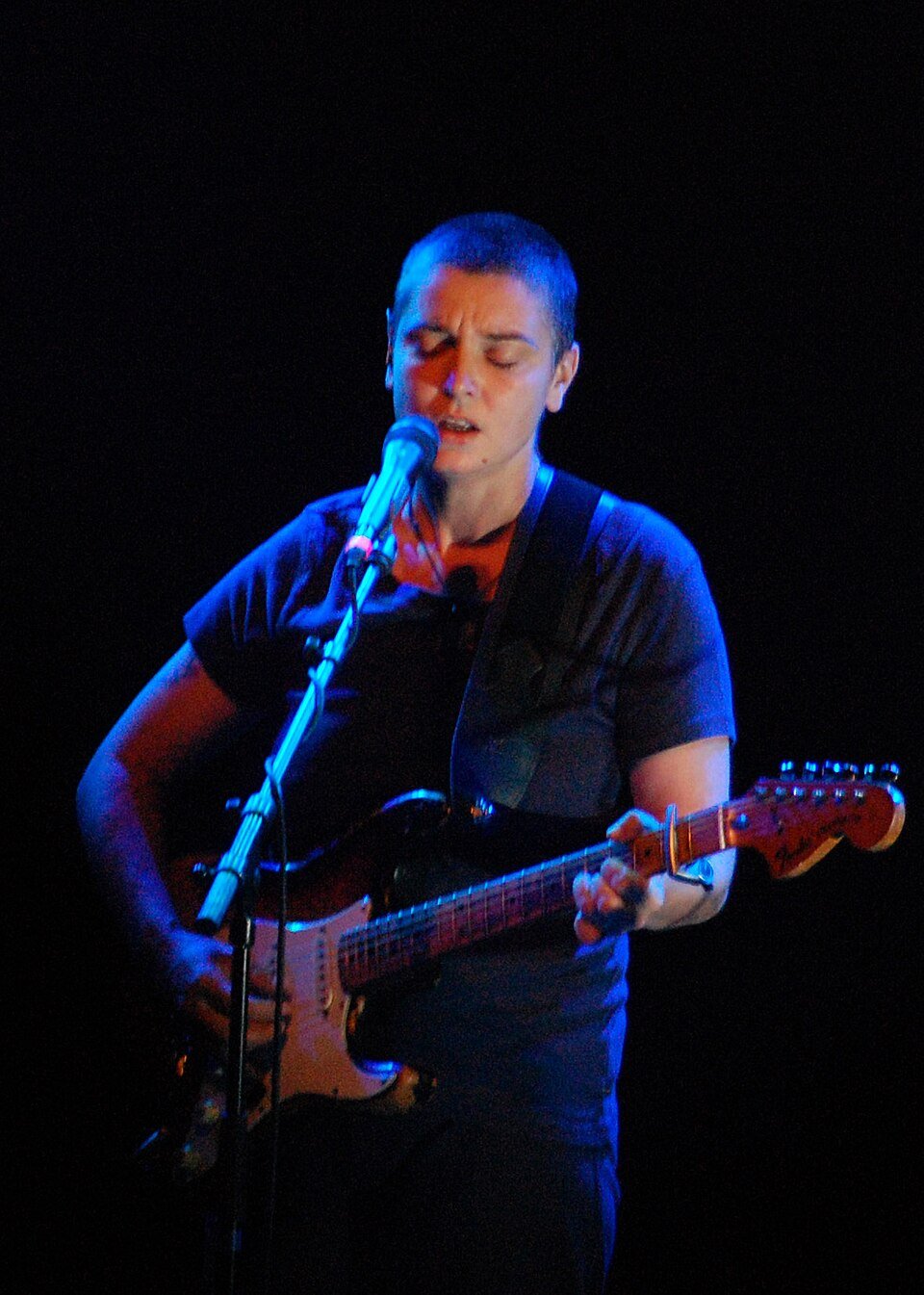
Her debut album, The Lion and the Cobra, was released in November 1987, when she was twenty. It was an unusually assured first record: “Troy”, a slow-building performance addressed to a faithless lover, and “Mandinka” became its best-known tracks, and the album reached the top forty in the United States and the United Kingdom. The presentation was as striking as the singing — a shaved head, adopted in part in reaction to label suggestions about her appearance, which became the image by which she was recognised worldwide. She received a Grammy nomination for the album, and a second recording, “Jump in the River”, followed in 1989.
1990–1991: I Do Not Want What I Haven’t Got
The second album, I Do Not Want What I Haven’t Got, released in March 1990, contained “Nothing Compares 2 U”, a composition by Prince that she recorded in a single, spare arrangement built around her voice. The recording reached number one in the United States, the United Kingdom, Ireland and more than a dozen other countries, and the album sold more than seven million copies worldwide. The record’s other material — “The Emperor’s New Clothes”, “Three Babies”, “Black Boys on Mopeds” — set out the range she intended to work in: personal, political and devotional subjects on the same album. It remains, by a wide margin, her best-selling work, and the recording on which her reputation principally rests.
1992–1999: Controversy and Its Consequences
In October 1992, performing on American television, she tore up a photograph of Pope John Paul II in protest at child abuse within the Catholic Church, saying “Fight the real enemy.” The reaction was severe and lasting: condemnation from church authorities and entertainers, the destruction of her records at public protests, and a sharp contraction of her American career. She did not retract the protest. A standards album, Am I Not Your Girl? (1992), and Universal Mother (1994), which included “Fire on Babylon” and “Thank You for Hearing Me”, followed, but the commercial position of 1990 was not recovered. An EP, Gospel Oak, appeared in 1997. The episode is now widely discussed as preceding, by some years, the public reckoning with clerical abuse in Ireland and elsewhere; at the time it was treated as the end of a career, and in commercial terms in the United States it largely was.
2000–2013: Faith and Courage to How About I Be Me
She continued to record steadily. Faith and Courage (2000) included “No Man’s Woman”; Sean-Nós Nua (2002) was a collection of traditional Irish material; Throw Down Your Arms (2005) recorded reggae standards in Jamaica; and Theology (2007) set scriptural texts, reflecting the religious preoccupations covered in the family part of this profile. How About I Be Me (and You Be You)? was released in 2012 to some of her strongest notices in years. Touring continued alongside the albums, though it was repeatedly interrupted by ill health, and the contrast between the quality of the later work and the scale of its audience is one of the settled judgements of her career: the voice, and the writing, remained; the machinery of promotion did not.
2014–2023: I’m Not Bossy, Rememberings and the Final Years
Her tenth and final studio album released in her lifetime, I’m Not Bossy, I’m the Boss, appeared in 2014. A further album, No Veteran Dies Alone, was announced and then postponed. Her memoir, Rememberings, was published in June 2021 to wide critical praise and became a bestseller; it is the fullest account she gave of her upbringing, her career and her illnesses, and it is written with a candour about money, treatment and the music business that few performers have matched. She spoke in those years about the routes by which people rebuild a working life after institutional care and interrupted education, themes familiar to anyone who has followed guidance on learning to code from scratch on a tight budget and other low-cost ways of acquiring a new trade as an adult. In January 2022 her son Shane died at seventeen, and she cancelled her remaining tour dates and withdrew from performance. She died in London the following year.
Her death was announced by her family on 26 July 2023. The Guardian, the BBC and The New York Times each reported the death that day, at the age of 56, and the Metropolitan Police confirmed that she had been found unresponsive at her flat in Herne Hill, south London. In January 2024 the coroner in London recorded that she had died of natural causes, and her death certificate, reported in July 2024, gave the cause as an exacerbation of chronic obstructive pulmonary disease and bronchial asthma together with a low-grade lower respiratory tract infection. Her funeral was held in Bray, County Wicklow, on 8 August 2023, and she was buried in Dublin.
The Singer From Dublin, Ireland in Brief
| The Singer From Dublin, Ireland in Brief | Details |
|---|---|
| Born | 8 December 1966, Dublin, Ireland |
| Age | 56 years old at her death on 26 July 2023 |
| Height | 5 ft 4 in (1.63 m) |
| Weight | No reliable published figure exists |
| Partner | Barry Herridge, married 2011; separated, with no divorce reliably reported before her death |
| Children | Four: Jake Reynolds, Roisin Waters, Shane Lunny and Yeshua Bonadio |
| Nationality | Irish |
| Religion | Islam — converted in October 2018, taking the name Shuhada’ Sadaqat |
| Net Worth | Estimated $1.5 million at her death (Celebrity Net Worth) |
How Sinead Built a $1.5 million Fortune
Celebrity Net Worth puts her net worth at the time of her death at $1.5 million. That estimate is consistent with the one hard figure in the public record: probate filings in Ireland reported in January 2025, a year and a half after her death, showed an estate of £1.7 million gross and £1.4 million net, after debts, legal costs and funeral expenses, left to her surviving children. No Forbes or Sunday Times Rich List total exists for her. The two figures — the tracker’s estimate and the probate outcome — are unusually close by the standards of this series, and together they describe an estate that was modest in relation to the sales of her best-known album.
The reasons are part of the documented record rather than speculation. She said repeatedly that she had been poorly advised and, at points, defrauded early in her career; she was declared bankrupt in Ireland in the 2010s over a tax debt; she sold her long-held property at Bray in 2021 for a reported €1.04 million; and in 2017 she described living for a period in a motel in New Jersey after losing much of what she had earned. “Nothing Compares 2 U”, her largest recording, was written by Prince, so its songwriting royalties were never hers; her income from it was as its performer. No verified schedule of her remaining assets beyond the probate reporting exists, and none is offered here.
O’Connor’s case is the clearest in this series of the distance between cultural weight and financial outcome. The recordings endure — “Nothing Compares 2 U” is routinely placed among the finest singles of its era, and Rememberings secured her standing as a writer — and the protest for which she was punished in 1992 is now generally discussed in the terms she herself used at the time. The estate of £1.4 million net, divided among her children with her instruction that the archive be used for their benefit, is the financial record that stands beside that reputation.
A Dublin, Ireland Childhood
Sinéad Marie Bernadette O’Connor was born on 8 December 1966 in Dublin, Ireland, the third of five in her family. Her parents were John Oliver “Seán” O’Connor, a structural engineer who later became a barrister and chaired the Divorce Action Group, and Johanna Marie O’Connor (née O’Grady). Her parents’ marriage ended when she was eight, and by her own account, given in interviews across her life and in her 2021 memoir Rememberings, her upbringing after the separation was marked by abuse at the hands of her mother, who died in a road collision in 1985.
As a teenager she was placed, after an episode of shoplifting, in a Magdalene institution run by a religious order in Dublin — an experience she described for the rest of her life as formative, both in her understanding of the institutions of the Ireland she grew up in and in her determination to speak about them. It was also there that her singing was encouraged: a volunteer heard her perform and connected her with people in the Dublin music scene, and she began singing in public in the city’s venues while still in her teens.
By the mid-1980s she was fronting a Dublin band, Ton Ton Macoute, and had attracted the attention of record companies in London. She signed with Ensign Records, was paired with experienced producers, and began work on a first album whose sessions she resisted when the direction offered to her did not match the record she intended to make. The stand-off delayed the album and established, early, the pattern of her career: the work would be done on her terms or not at all.