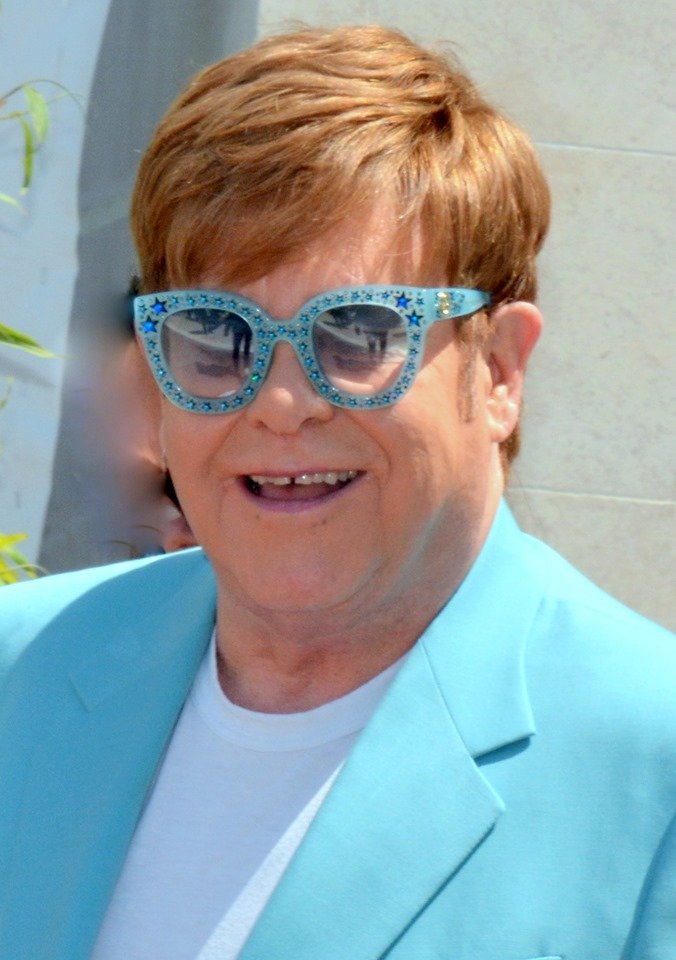
Elton John Net Worth, Biography, Age, Family and Career
Sir Elton John is an English singer, pianist and songwriter whose partnership with the lyricist Bernie Taupin produced one of the most successful catalogues in popular music, and whose farewell tour became the highest-grossing concert tour in history at the time it ended. The Elton John net worth estimates from the two sources that publish them are close to one another: Celebrity Net Worth estimates $650 million, while the Sunday Times Rich List 2026 valued him at £480 million, reported at approximately $645 million. Neither figure is an audited statement, but the agreement between the two methods is closer than is usual for fortunes of this size.
From Reginald Dwight to Sir Elton in a Few Lines
| From Reginald Dwight to Sir Elton in a Few Lines | Details |
|---|---|
| Full Name | Sir Elton Hercules John (born Reginald Kenneth Dwight) |
| Born | 25 March 1947, Pinner, Middlesex, England |
| Age | 79 years old |
| Height | 5 feet 7½ inches (172 cm) |
| Weight | Approximately 87 kg (192 lb); reported figures vary |
| Husband | David Furnish (civil partnership 2005; married 2014) |
| Children | Zachary Jackson Levon Furnish-John and Elijah Joseph Daniel Furnish-John |
| Parents | Stanley Dwight and Sheila Eileen Dwight (née Harris) |
| @eltonjohn |
Elton John age is 79, his birth date being March 1947. Elton John birthday is 25 March, as shown in the Born row. Elton John height is listed at 5 feet 7½ inches, or 172 centimetres; some listings round this to 5 feet 7 inches or 5 feet 8 inches. Elton John weight is not officially published, and figures in circulation range widely; approximately 87 kilograms, or 192 pounds, is a commonly given figure and is recorded in the table as approximate. The Elton John instagram account, under the handle @eltonjohn, publishes tour and archive material, family photographs, charity appeals connected with the Elton John AIDS Foundation, and personal messages, and has several million followers.
Your Song, Yellow Brick Road, and the Farewell Tour That Broke Records
1969–1973: Empty Sky, the American breakthrough and Goodbye Yellow Brick Road
His first album, Empty Sky, was released in 1969 and sold little. The second, Elton John, followed in 1970 and contained “Your Song”, which became his first substantial hit and remains one of the best known Elton John songs. In August 1970 he played his first American concerts at the Troubadour in Los Angeles, which were received with unusual enthusiasm by the Los Angeles press and established him in the United States before he was established at home. A remarkable run of albums followed in quick succession: Madman Across the Water in 1971, Honky Château in 1972, which gave him his first American number one album, Don’t Shoot Me I’m Only the Piano Player in 1973, and Goodbye Yellow Brick Road, a double album released in October 1973 that contained “Candle in the Wind”, “Bennie and the Jets” and “Saturday Night’s Alright for Fighting” and is generally regarded as his finest record.
1974–1979: Captain Fantastic, Wembley and a first retirement
Captain Fantastic and the Brown Dirt Cowboy in 1975 entered the American chart at number one, the first album to do so. He played two nights at Dodger Stadium in Los Angeles in 1975, performed with John Lennon at Madison Square Garden in November 1974 in what proved to be Lennon’s last major concert appearance, and topped the singles chart with “Philadelphia Freedom” and, in duet with Kiki Dee, “Don’t Go Breaking My Heart” in 1976, his first British number one single. Exhaustion led him to announce a retirement from live performance in 1977, and his partnership with Taupin was interrupted for several years. He returned to the stage in 1979, including concerts in the Soviet Union that attracted considerable attention at the time.
1980–1989: Recovery, “I’m Still Standing” and Live Aid
The 1980s began with a gradual rebuilding. Albums including 21 at 33, Jump Up! and Too Low for Zero, the last reuniting him fully with Taupin and with his original band, restored his commercial position; “I’m Still Standing” and “I Guess That’s Why They Call It the Blues” date from this period. He performed at Live Aid at Wembley Stadium in July 1985. He also became, in this period, closely involved with Watford Football Club, which he had supported since childhood and of which he became chairman, overseeing the most successful years in the club’s history under the manager Graham Taylor. In 1988 he sold the entire contents of his principal home at auction, an event that marked a turning point in a decade characterised by very high personal spending.
1990–1997: Sobriety, The Lion King and “Candle in the Wind 1997”
He entered recovery from alcohol and drug dependence in 1990, a change he has described as the foundation of everything that followed, and in 1992 he founded the Elton John AIDS Foundation, which has since raised several hundred million dollars for HIV prevention, treatment and care. In 1994 he wrote, with the lyricist Tim Rice, the songs for the Disney film The Lion King, including “Can You Feel the Love Tonight”, which won the Academy Award for Best Original Song, and the stage musical adaptation followed in 1997. In September 1997, following the death of Diana, Princess of Wales, he performed a rewritten version of “Candle in the Wind” at her funeral in Westminster Abbey. Released as a single, it became the best-selling single worldwide since chart records began, with the proceeds going to her charitable memorial fund.
2000–2023: Billy Elliot, Las Vegas residencies and the farewell tour
In the 2000s he composed for the stage musical Billy Elliot, which opened in London in 2005, and undertook two long residencies at Caesars Palace in Las Vegas, which together ran, with breaks, from 2004 to 2018. Elton John albums continued to appear at intervals, including collaborations with Leon Russell on The Union in 2010 and with Brandi Carlile on Who Believes in Angels? in 2025. In 2018 he began the Farewell Yellow Brick Road tour, intended as his final tour. Interrupted by the pandemic and by hip surgery, it concluded in Stockholm in July 2023 after 330 performances, with a Glastonbury headline appearance in June 2023 that was his last British concert. Its reported gross of approximately $939 million made it, at that point, the highest-grossing tour ever recorded, although a gross figure is not the same as personal income.
David Furnish, Two Sons, and the Family He Built Late in Life
Elton John parents were Stanley Dwight, a Royal Air Force officer who later worked in industry and who died in 1991, and Sheila Eileen Dwight, who died in 2017 at the age of 92. The Elton John family home in Pinner was, for much of his childhood, his grandparents’ council house. After his parents divorced, his mother married Fred Farebrother, a decorator, whom he has described warmly and who died in 2010. He has four younger half-brothers on his father’s side. His relationship with his father, who disapproved of his career and, by his account, showed him little affection, remained unresolved at his father’s death, and he has spoken about the effect of that on his own approach to fatherhood.
He married the recording engineer Renate Blauel in Sydney in February 1984; the marriage ended in divorce in 1988, and he subsequently spoke publicly about being gay, having first described himself as bisexual in an interview in 1976. In 1993 he began a relationship with David Furnish, a Canadian-born former advertising executive and film producer. On the Elton John husband question, the sequence is precise and is set out in full because the dates are often conflated: John and Furnish entered into a civil partnership on 21 December 2005, the first day on which civil partnerships could be registered in England, in a ceremony at Windsor Guildhall; after same-sex marriage became legal in England and Wales, they married on 21 December 2014, the ninth anniversary of the civil partnership. David Furnish is therefore correctly described, using the bank label, as his husband.
Elton John children are two sons, both born in California by surrogacy. Zachary Jackson Levon Furnish-John was born on 25 December 2010, and Elijah Joseph Daniel Furnish-John was born on 11 January 2013, through the same surrogate. Both boys are being brought up principally at the family’s home in Berkshire. In recent years his health has limited his work: he has spoken about severe sight loss in one eye following an infection in 2024, and about its effect on reading, watching his sons play sport and working in the studio.
A Pinner Council House, a Piano, and a Scholarship at Eleven
An Elton John biography begins in Pinner, Middlesex, then a suburb on the north-western edge of London, where he was born Reginald Kenneth Dwight on 25 March 1947. He was brought up largely by his maternal grandparents in a council house in Pinner, and later lived with his mother and stepfather in a flat in the same area. His father, a flight lieutenant in the Royal Air Force, was frequently absent on postings, and the relationship between father and son was distant, a subject he has addressed repeatedly in interviews and in his autobiography, Me, published in 2019.
Music was present from the start. His mother and grandmother were both musical, there was a piano in the house, and he began playing by ear as a small child, performing at family gatherings. At the age of eleven he won a junior scholarship to the Royal Academy of Music in London, where he studied on Saturdays for five years, receiving a classical training that he later combined with rock and roll. He has said that seeing and hearing Jerry Lee Lewis and Little Richard for the first time decided the direction he wanted to take. He attended Pinner County Grammar School, formed a band, Bluesology, while still at school, and left at seventeen, shortly before his examinations, to work in music publishing and to play in pubs and hotels.
Bluesology became the backing band for touring American soul artists and then for the singer Long John Baldry. In 1967 he answered an advertisement placed by Liberty Records and was given an envelope of lyrics by Bernie Taupin, a young writer from Lincolnshire who had also replied. The two began writing together by post, and then in person at the Dwight family home. He took his stage name from two members of Bluesology, the saxophonist Elton Dean and Long John Baldry, and later adopted it legally.
Two Estimates Agree: £480 Million on the Rich List
The Elton John net worth position is supported by two separate published estimates that arrive at similar totals by different routes. The Sunday Times Rich List 2026 placed him at £480 million and 277th in its ranking of British wealth, as reported in May and June 2026; the Sunday Times assesses identifiable wealth and has increased his figure gradually over successive years, from £475 million in the 2025 list. Celebrity Net Worth gives $650 million, modelling global assets in dollars. Forbes does not publish a current net worth figure for him, although it has published annual earnings estimates in the past, including an estimate of $84 million in pre-tax earnings in a single year during the farewell tour. It should be noted that part of the Sunday Times figure is attributed jointly in some reporting to the household rather than itemised to him alone, and no source publishes a schedule of assets and liabilities; the figures remain estimates, albeit consistent ones. As with any estimate of this kind, readers should be alert to the difference between a researched valuation and a copied one, much as our guide to the risks of spotting a crypto rug pull early sets out the warning signs that separate a genuine opportunity from a convincing imitation.
The largest single contributor in recent years was touring. He has also retained substantial interests in his catalogue: unusually for an artist of his generation, he held on to significant rights rather than selling them outright, although publishing and recording interests have been subject to various deals over the decades, including a large advance in the late 1990s that was widely reported at the time. Set against the income is a documented history of very high spending in the 1970s and 1990s; evidence given in a court case in 2000 recorded spending of approximately £30 million in a period of under two years in the late 1990s, and his fortune at around that time was reported at a much lower level than it is today.
The Elton John house at the centre of his domestic life is Woodside, in Old Windsor, Berkshire, a house on a large estate of some 37 acres overlooking the Thames valley towards Windsor, which he bought in 1974 following the success of Goodbye Yellow Brick Road. It is the family’s principal home and the base he refers to as the hub. He also owns a house in London, in Holland Park, bought in the early 1990s; a villa on Mont Boron in Nice, on the French Riviera; a flat in Venice, on the Giudecca; and property in Los Angeles, where he and Furnish bought a house in Beverly Hills in 2012 for a reported $7.2 million and a much larger property in the same area in 2015. He previously owned a large penthouse in Atlanta, Georgia, which he sold in recent years. Precise current values for the individual properties are not published on the basis of recent sales.
The Elton John car collection is largely a matter of historical record rather than present ownership. He accumulated many cars over the years, several bought new and driven very little. In June 2001 he sold twenty of them at auction through Christie’s in London, a sale that attracted wide attention precisely because several had covered minimal mileage. Cars documented as having been in the collection include a 1956 Bentley S1 Continental, a 1973 Rolls-Royce Phantom VI, a 1993 Jaguar XJ220, a Ferrari 365 GTB/4 Daytona, an Aston Martin V8 Vantage and a Maserati Quattroporte. As that dispersal took place more than two decades ago and no current inventory is published, this profile does not attribute a present-day collection or value to him.
In closing, his wealth is the product of an unusually long earning life at the highest level — more than fifty years of recording, and touring into his mid-seventies — combined with a decision, taken relatively late, to retain his rights and place his finances under professional management. The two published estimates agree closely enough to give a reasonable picture, while stopping short of the precision only an audited statement could provide.