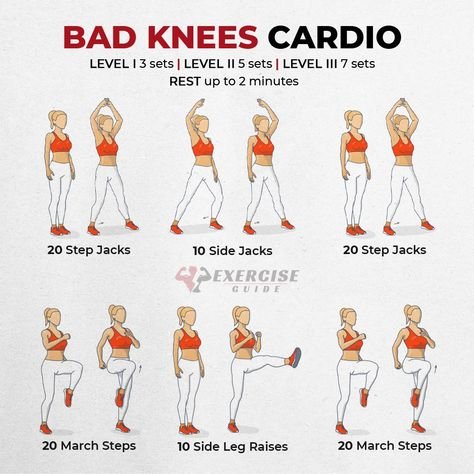
Finding what is the best exercise for bad knees feels like a contradiction — exercise hurts my knees, so how can exercise help my knees? I know the feeling: I spent two years avoiding anything beyond gentle walking because of an arthritic knee, and the avoidance made everything worse. The muscles supporting the knee weakened, the joint got stiffer, and everyday life got harder. Then a physiotherapist gave me the counterintuitive truth that changed everything: the right exercise doesn’t damage bad knees — it’s the most effective treatment for them, often outperforming painkillers.
The principle: knees need strong supporting muscles and regular gentle movement. What they don’t need is impact, deep bending under load, or complete rest (prolonged rest weakens the supports and stiffens the joint — the worst of both worlds).
What is the best exercise for bad knees?
The gold-standard exercises
- Straight-leg raises: lie on your back, one knee bent, the other leg straight — lift the straight leg to the height of the bent knee, hold, lower slowly. Strengthens the quadriceps without bending the bad knee at all. The foundation exercise physios prescribe first.
- Seated knee extensions: sit in a chair, slowly straighten the leg until horizontal, hold 5 seconds, lower. Start without weight; add ankle weights as you strengthen. Direct quad strengthening with zero impact.
- Glute bridges: lie on your back, knees bent, lift hips. Strong glutes stabilise the knee — weak glutes are a hugely underappreciated cause of knee pain.
- Step-ups (low step): a bottom stair or low platform — step up and down slowly, focusing on control. Functional strength for real life (stairs are where bad knees suffer most).
- Wall sits (shallow): slide down the wall only to a comfortable depth — never into pain. Builds endurance in the supporting muscles.
The best low-impact cardio
- Swimming/water aerobics: the gold standard — full cardio and resistance with virtually zero joint loading. Many UK leisure centres run GP-referral schemes with discounted access.
- Cycling (stationary or road): excellent knee-friendly cardio provided the seat is high enough — low seat = high knee stress. Get the setup right and it’s therapeutic.
- Walking: yes, really — on flat, forgiving surfaces, in supportive shoes. Start short and build gradually. The “walking damages knees” myth is backwards: studies show recreational walking protects against knee osteoarthritis progression.
- Elliptical/cross-trainer: gym-friendly option with minimal impact.
What to avoid (or approach carefully)
- Deep squats and lunges (especially weighted) — high patellar loading.
- Running on hard surfaces — though easy trail/grass jogging suits some people once strength is rebuilt.
- High-impact sports (football, basketball, squash) during flare-ups.
- “Pushing through” sharp pain: muscle fatigue is fine; sharp, catching, or swelling-inducing pain is your stop signal.
The pain-management toolkit alongside exercise
Exercise works best combined with: maintaining healthy weight (each kilo lost unloads the knee by roughly 4kg per step — the highest-ROI intervention for overweight sufferers); proper footwear (cushioned, supportive — replace worn trainers); heat before activity and ice after flare-ups; and topical NSAID gels, which the evidence supports well for knee osteoarthritis. Discuss oral painkillers and injections with your GP or pharmacist as part of a plan, not as the plan.
If your knee problems are severe enough to consider surgery, our guide to NHS knee replacement waiting lists covers timelines and how to get treated sooner — and pre-surgery strengthening (prehab) significantly improves surgical outcomes.
Footwear, weight, and the supporting cast
Exercise gets the headlines, but three supporting factors matter enormously for bad knees. Footwear: worn-out trainers with collapsed cushioning transmit shock straight to the knee — replace running shoes every 500–800km, and consider the surfaces you walk on (concrete is brutal; grass, tracks, and trails are kinder). For some people, over-the-counter insoles or orthotics correct alignment issues that load the knee unevenly — a podiatrist can assess whether you’re a candidate. Weight: the maths is unforgiving and motivating in equal measure — every kilo of body weight adds roughly 4kg of load per step on the knee. Losing 5kg unloads 20kg per step, thousands of times a day. It’s the highest-ROI intervention for overweight knee-pain sufferers, full stop.
Activity modification (not elimination): the goal is keeping you moving, not wrapping you in cotton wool. Love gardening? Use a kneeler and raised beds. Love football? Switch to walking football (a real and growing sport, brilliant for bad knees). Love hiking? Poles reduce knee loading on descents by up to 25%. The principle: adapt the activity to the knee, not the knee to inactivity — because the deconditioning from stopping is worse than the loading from a modified activity.
For structured guidance, ask your GP about an NHS physiotherapy referral or the NHS knee pain resources, which include exercise programmes. Many areas also offer ESCAPE-pain programmes — evidence-based group rehabilitation specifically for knee (and hip) osteoarthritis, combining education and exercise with excellent outcomes. And our guide to strength training timelines sets realistic expectations for the strengthening journey. The knee you have is the knee you’ll manage — and managed well, with strong supports and sensible loading, it can serve you well for decades.
One more thing worth knowing: the role of footwear beyond trainers. Most knee-pain sufferers think about exercise shoes but ignore everyday footwear — yet you spend far more hours in work shoes, boots, and casual shoes than in trainers. Worn-out soles, unsupportive flats, and high heels all alter knee loading. Audit your daily footwear with the same critical eye: replace what’s worn, favour cushioning and support for long standing days, and consider that the “smart” shoes you wear 10 hours daily matter more for your knees than the trainers you wear for 3 hours weekly. Small change, big cumulative effect.
Your practical takeaway
Start today with straight-leg raises and glute bridges — 2 sets of 10, both legs, no equipment, no knee bending required. Add seated extensions within a week. Build to 3 sessions weekly plus regular low-impact cardio (walking, swimming, or cycling). Expect meaningful improvement in 6–8 weeks of consistency. The rule to internalise: strong muscles protect bad knees, and the only bad exercise for knees is the one that causes sharp pain or prolonged swelling. Everything else is medicine.