
Every local business owner knows the maths: finding a new customer costs five to seven times more than keeping an existing one, yet most marketing effort goes to acquisition while existing customers get… nothing. No thank-you, no follow-up, no reason to return beyond habit. Getting more repeat customers for your local business isn’t about gimmicks — it’s about systematising the things that make people come back, then making sure they happen every time. Here’s the complete playbook.
More repeat customers local business: start with why they leave
Research consistently shows customers leave local businesses for depressingly fixable reasons: perceived indifference (“they didn’t seem to care”) tops the list, ahead of price or even quality issues. People don’t leave because a competitor was 5% cheaper; they leave because nobody remembered their name, the service was surly, or a problem went unacknowledged. The foundation of retention isn’t a loyalty scheme — it’s not giving people reasons to leave. Fix the basics first: greet people, remember regulars, resolve complaints gracefully, and follow up after problems. Our getting honest customer feedback guide helps you find the issues you’re too close to see.
The loyalty mechanics that work
Loyalty schemes (done right)
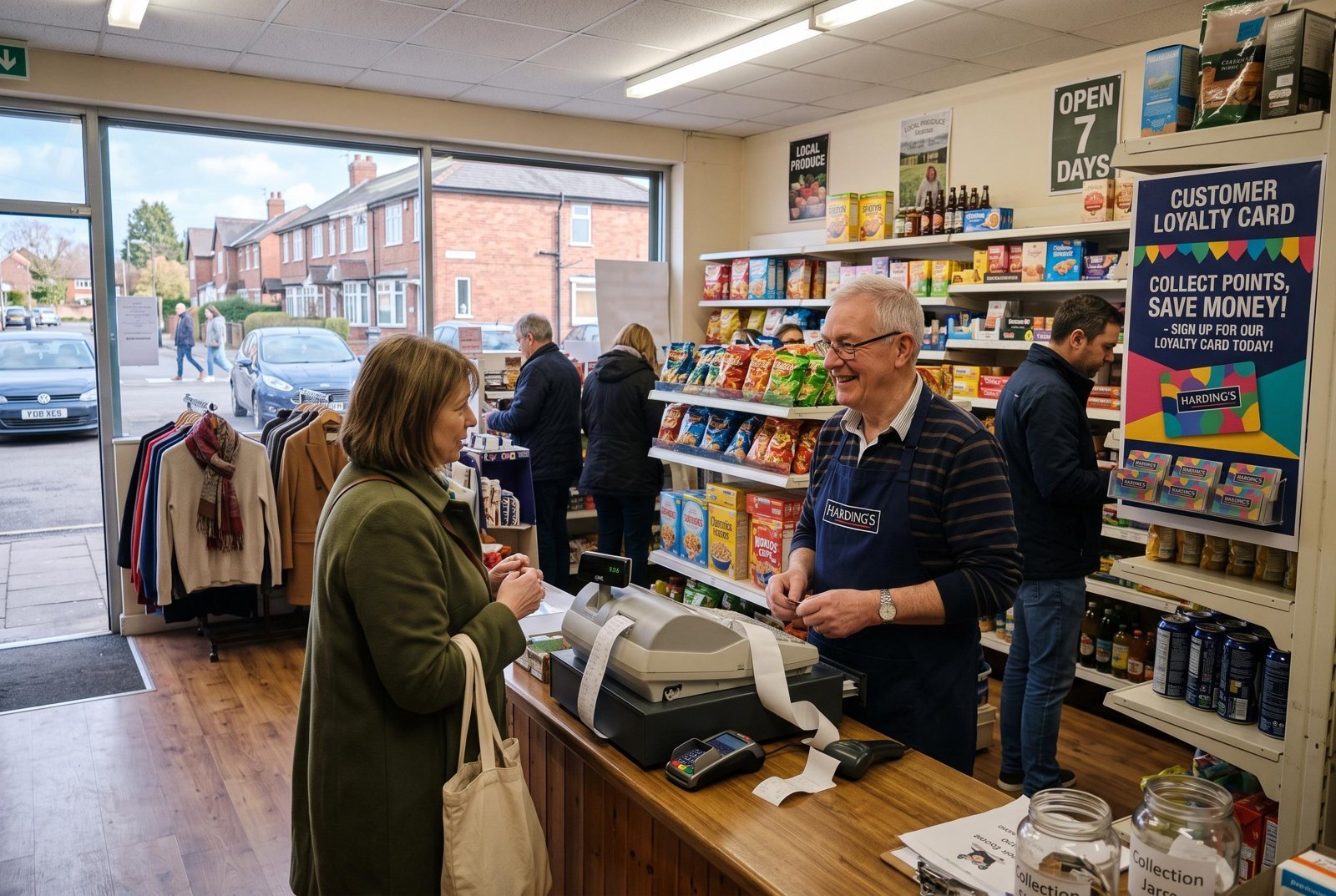
The classic “buy 9, get the 10th free” card works — but digital versions work better (no lost cards, automatic tracking, data on visit patterns). Our café loyalty scheme guide covers the setup in detail; the principles transfer to any local business: reward frequency, not just spend (the weekly £4 customer is worth more than the monthly £40 one), make the first reward achievable fast (3rd visit, not 10th — early gratification hooks people), and tier it if you can (regulars vs VIPs — status motivates).
The follow-up sequence
Most local businesses never contact customers after the sale — which is leaving money on the table. The simple sequence: thank-you message within 24 hours (text or email — personal, not templated), check-in at the natural rebuy point (“your MOT is due next month”, “it’s been 6 weeks since your haircut”), and win-back for lapsed customers (“we miss you — here’s 15% off your next visit”). This requires a customer list (with GDPR-compliant consent — ask at point of sale, “can we text you about offers?”), which is itself the asset. A list of 500 past customers is worth more than 5,000 Instagram followers.
Subscriptions and memberships
The ultimate repeat business: convert transactions into recurring relationships. The car wash monthly pass, the bakery’s bread subscription, the salon’s maintenance plan, the gym model applied to anything regular. Even informal versions work — “same time next month?” booked before they leave. Anything that makes the next visit the default rather than a decision multiplies retention.
The experience details that compound
- Remember things: names, usual orders, life events mentioned in passing. A notebook behind the counter (or CRM notes) turns good memory into a system. “The usual?” is the most powerful phrase in local business.
- Surprise and delight: the free extra, the birthday message, the “this one’s on us” for a regular’s bad day. Small, unexpected generosity creates stories people tell — the most valuable marketing there is.
- Handle complaints like gold: a well-resolved complaint creates more loyalty than no complaint at all (the service recovery paradox). Empower staff to fix problems on the spot — “let me sort that immediately” beats “I’ll have to check with the manager” every time.
- Be consistently good, not occasionally brilliant: regulars return for reliability. The café that’s excellent 95% of the time beats the one that’s transcendent 60% and closed-randomly the rest.
- Close the feedback loop: when customers suggest something and you act on it, tell them. “You asked for oat milk — we’ve got it now” turns a customer into a co-owner emotionally.
Measuring retention (so you can improve it)
Track two numbers monthly: repeat purchase rate (what % of this month’s customers had bought before?) and visit frequency (average days between visits per customer). Your POS system likely reports the first; a simple spreadsheet handles the second. Watch the trends, not the absolutes — and test one retention initiative at a time (the loyalty launch month vs baseline, the follow-up sequence vs control). Our tight-budget marketing guide and cheap local advertising cover the acquisition side; retention is where the profit lives.
The Federation of Small Businesses offers resources on customer retention and loyalty for members — worth exploring alongside their broader business support.
The referral engine: turning regulars into recruiters
Repeat customers are valuable; repeat customers who bring friends are transformative. Referrals convert at 3–5x the rate of cold marketing and cost almost nothing — but they don’t happen by accident. The system: ask directly at the moment of peak satisfaction (“Who do you know who’d love this too?”), make it rewarding for both sides (the referrer gets £10 credit, the friend gets 15% off — two-sided incentives outperform one-sided), and make it easy (referral cards at the till, a shareable link, a simple “forward this email”).
The psychology matters: people refer when it makes them look good — “you’ve got to try this place” is social currency. So the referral ask works best when the experience is remarkable enough to talk about, which loops back to the experience details above. Remarkable service → natural word-of-mouth → systematised referrals → compounding growth. It’s the oldest marketing in the world, and in the age of algorithms, it’s more powerful than ever — because a friend’s recommendation cuts through noise that no ad can.
Winning back lapsed customers
Your lapsed customers are cheaper to win back than strangers are to acquire. Someone who bought from you six months ago and vanished isn’t lost — they’re just distracted. A simple “we miss you” message with a small, time-limited incentive (10% off this week, a free coffee with your next visit) brings a surprising number back.
Timing matters more than the discount. Three to six months of silence is the sweet spot — long enough that they notice your absence, recent enough that they remember you fondly. Wait two years and you’re a stranger again.
And ask why they left. A two-question survey (“What would bring you back?”) sent to lapsed customers is the cheapest market research you’ll ever do. The answers are often embarrassingly fixable: parking, opening hours, a product you stopped stocking.
The practical takeaway
Fix the reasons people leave (indifference kills more customers than price), launch a simple loyalty scheme with fast early rewards, follow up systematically (thank → check-in → win-back), convert transactions to subscriptions where possible, and sweat the experience details (names, surprises, complaint recovery, consistency). Track repeat rate monthly. Retention isn’t a campaign — it’s the operating system of a healthy local business, and it’s the cheapest growth you’ll ever buy.


