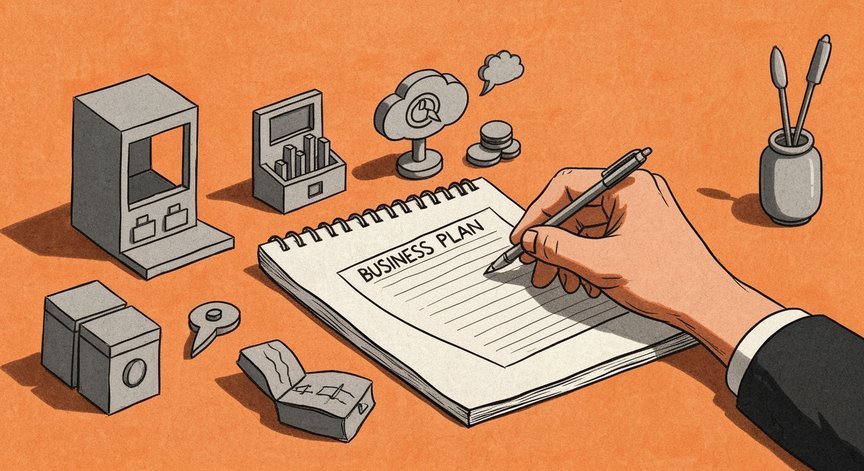
The words “business plan” conjure images of 40-page documents, financial consultants, and appendices nobody reads. For a small shop, that’s overkill — and it’s why most shopkeepers never write one, flying blind on the numbers that determine survival. A simple business plan for a small shop fits on one or two pages, takes an afternoon, and forces you to answer the questions that actually matter: who pays, what it costs, and whether the maths works. Here’s the template.
Simple business plan small shop: the one-page structure
1. The concept (3 sentences)
What you sell, to whom, and why they’ll choose you. Example: “A refill shop selling plastic-free groceries to environmentally conscious families in Chorlton, competing on price with the supermarket organic range and on experience with the farmers’ market.” If you can’t explain it in three sentences, it’s not clear enough yet. Our choosing a business name guide pairs well with this stage.
2. Customers: who, where, how many
Be specific: “parents aged 28–45 within 20 minutes’ walk” beats “local people”. Estimate footfall honestly — stand outside the prospective premises at different times and count passers-by. Then apply brutal conversion maths: of 1,000 passers-by, maybe 2–5% enter, and 30–50% of entrants buy. A shop needing 200 transactions a day in a location with 2,000 daily passers-by is fantasy; the plan must confront this.
3. The money: startup costs
List everything, then add 20% contingency (fit-outs always overrun):
- Premises: deposit (typically 3–6 months’ rent), first month’s rent, legal fees (£1,000–£2,000)
- Fit-out: shelving, till, signage, lighting, flooring (£5,000–£30,000 depending on ambition)
- Stock: initial inventory (£3,000–£15,000)
- Licences and registrations (food hygiene, alcohol licence if relevant)
- Professional fees: accountant, solicitor for the lease
- Marketing launch: signage, opening event, initial advertising
- Working capital: 3 months’ operating costs as a buffer (see below)
4. The money: monthly running costs
Rent, business rates (check small business rate relief — many small shops pay zero), utilities, insurance, wages (including your own — pay yourself in the plan, or the “profit” is fiction), stock replenishment, card processing fees, accounting, marketing. Total it. This number is your survival line.
5. The money: breakeven
The only calculation that really matters: monthly costs ÷ average transaction value × gross margin = transactions needed per day. Example: £6,000 monthly costs, £12 average transaction, 45% margin → £6,000 ÷ (£12 × 0.45) = 1,111 transactions/month ≈ 37/day. Now ask: is 37 paying customers a day realistic for this location? If the footfall maths says no, the plan just saved you £50,000. This is the entire point of writing it down.
6. Marketing: how customers find you
One paragraph on launch marketing and one on ongoing: Google Business Profile (free, essential — see our tight-budget marketing guide), local social media, opening event, loyalty scheme (our café loyalty guide principles apply to shops), and community presence. Budget a monthly figure — marketing isn’t free just because it’s DIY; your time has value.
7. Risks and what-ifs
Three scenarios: what if sales are 30% below forecast (can you survive six months?), what if a competitor opens nearby, what if costs rise 20%? Write the honest answers. Lenders and landlords take plans with contingency thinking far more seriously — and you’ll sleep better.
Using the plan (not filing it)
A plan in a drawer is decoration. Review it monthly for the first year: actual vs forecast sales, actual costs, and the breakeven recalculated with real numbers. The plan’s job isn’t to predict the future — it’s to give you an early warning when reality diverges, while there’s still time to act. Pair it with cashflow management discipline and cheap local advertising tactics, and you’ve got the operating system most small shops lack.
If you need funding, the plan becomes your loan application core — our startup funding guide explains what lenders look for. The Prince’s Trust offers free business plan templates and mentoring for 18–30s — an excellent resource regardless of age, since the templates work for everyone.
Worked example: one-page plan for a bakery
To make this concrete, here’s what the one-pager looks like filled in for a hypothetical artisan bakery in a market town:
- Concept: “Sourdough and pastries baked on-site daily for commuters and weekend shoppers in Stamford, competing with supermarket bread on quality and with the existing café on freshness — nothing else bakes on-site within 10 miles.”
- Customers: “Commuters 25–50 passing the station footpath (counted: ~800 weekday mornings), plus Saturday market shoppers (~3,000). Target: 120 transactions/day average.”
- Startup costs: “Deposit £9,000 + fit-out £25,000 (second-hand deck oven £6,000) + stock £2,000 + fees £2,000 + launch marketing £1,500 + working capital £18,000 (3 months) = £57,500 + 20% contingency = ~£69,000.”
- Monthly costs: “Rent £1,500 + rates £0 (small business relief) + wages £4,200 (2 staff) + utilities £400 + ingredients £2,800 + insurance/accounting £300 + marketing £200 = £9,400.”
- Breakeven: “£9,400 ÷ (£6.50 avg × 65% margin) = 2,224 transactions/month ≈ 74/day. Footfall counts suggest 90–110 achievable — viable with margin for error.”
- Marketing: “Google Business Profile, Instagram (bake process videos), opening weekend tasting event, loyalty card, wholesale to two local cafés for base income.”
- Risks: “If transactions hit only 50/day: cut to owner-plus-one staffing, push wholesale harder. Energy price rises: oven is the big cost — fixed tariff secured for 2 years.”
Notice how the numbers force honesty: the breakeven of 74/day against counted footfall is the entire decision. Everything else is execution detail. Your plan should read the same way — numbers first, adjectives later.
The financial projections (without the fear)
The bit that scares everyone is the financial projections, but for a small shop they can be gloriously simple. You need three numbers: your monthly fixed costs (rent, insurance, utilities, wages), your average gross margin per sale, and how many sales a day break even. Divide fixed costs by margin per sale, and you have your daily target.
Build it in a spreadsheet with one row per month for the first year. Be pessimistic about month one — new shops take time to find their rhythm — and show how the numbers improve as word spreads.
Lenders and landlords don’t expect precision; they want evidence you’ve thought about it. A one-page forecast with honest assumptions beats a 20-page fantasy every time.
The practical takeaway
One page, seven sections: concept, customers, startup costs, monthly costs, breakeven maths, marketing, and risks. The breakeven calculation (transactions needed per day vs realistic footfall) is the heart of it — if that doesn’t work on paper, it won’t work on the high street. Write it in an afternoon, review it monthly, and let it be the honest friend who tells you the truth before the money’s gone.