A full 50-litre keg — the standard size used in British pubs — weighs around 60 to 62kg, while the empty keg on its own weighs roughly 10 to 12kg. The beer inside accounts for most of the weight, at about 50kg, with the stainless steel container making up the rest. If you are planning an event, a home bar, or a delivery, that 60kg figure is the one to remember: a full keg is a genuine two-person lift.
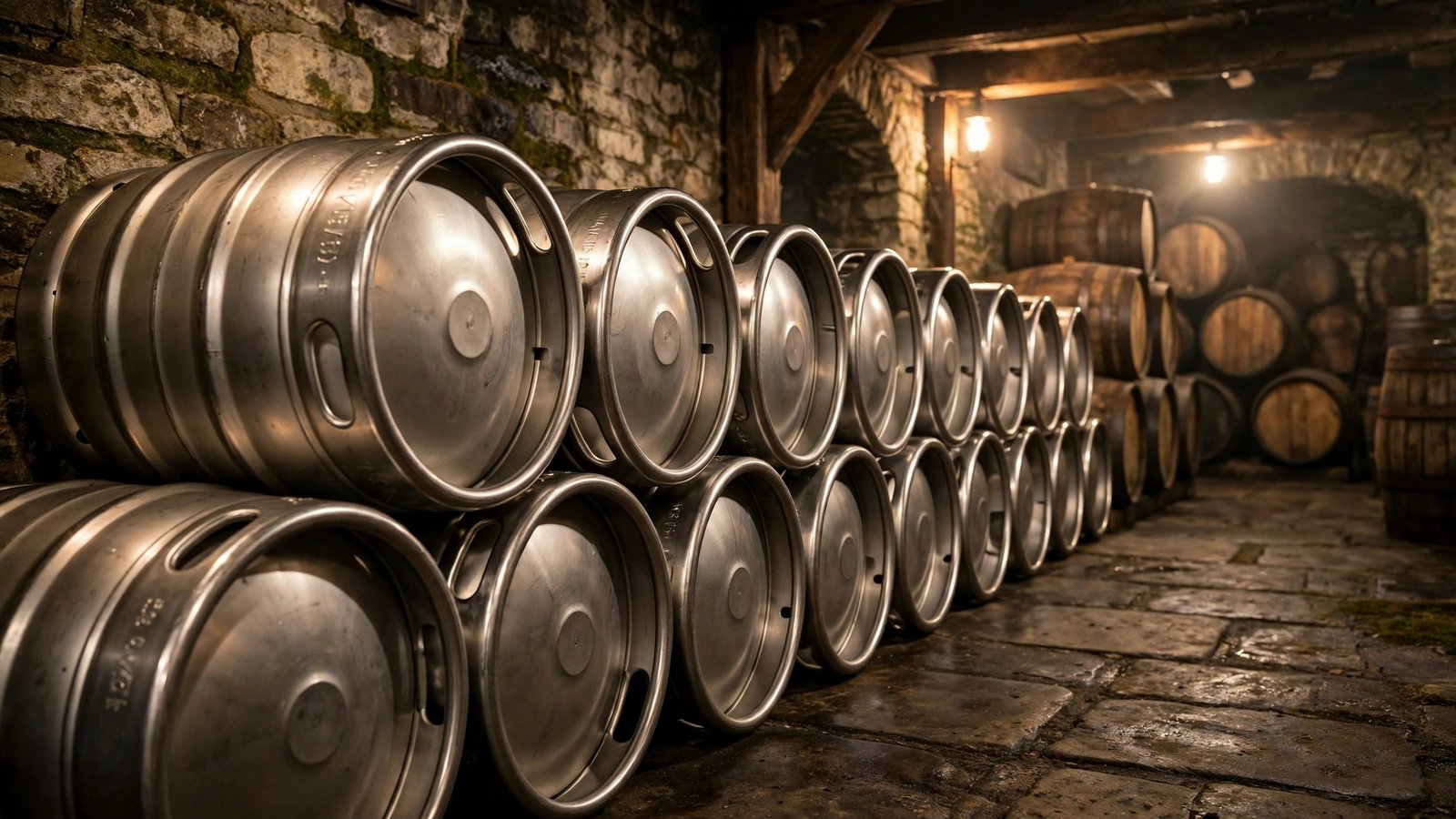
UK keg sizes and their weights
The 50-litre keg is the workhorse of the British pub trade, holding about 88 pints. But it is not the only size you will come across, especially if you are buying for a party or setting up a home bar. Here are the common sizes with their approximate full and empty weights:
- 50-litre keg (standard): full ~60–62kg, empty ~10–12kg — about 88 pints
- 30-litre keg (often called a “slim” or “euro” keg): full ~36–38kg, empty ~6–8kg — about 53 pints
- 20-litre keg (party keg): full ~24–26kg, empty ~4–6kg — about 35 pints
- 11-gallon (50L) firkin (cask, not keg): full ~55kg, traditionally used for cask ale
Weights vary slightly between manufacturers because the thickness of the steel differs, and a keg full of a dense stout weighs a touch more than one full of a light lager. But the figures above are close enough for any practical planning.
You may also see American sizes quoted online, particularly the US half-barrel at 58.7 litres, which weighs about 72kg (160lb) when full. These are rare in the UK trade, where metric sizes are standard, so double-check which system a supplier is using before you order.
Why keg weight matters
Sixty kilograms is heavier than most people expect — roughly the weight of an average adult. That matters in several very practical ways. First, manual handling: UK workplaces follow Health and Safety Executive guidance on lifting, and a full 50-litre keg exceeds what one person should lift alone. Pubs and venues train staff to move kegs with trolleys, keg lifters, or simply two people, and you should do the same at home.
Second, transport. A full keg will not fit comfortably in every car boot, and you need to think about how you will get it from the vehicle to wherever it is being served. Measure your boot, check the keg’s dimensions (a 50L keg is roughly 60cm tall and 38cm in diameter), and bring a sack truck if you have one. Kegs should travel upright and secured — a 60kg cylinder rolling around the boot on a roundabout is nobody’s idea of fun.
Third, flooring and furniture. If you are putting a keg on a raised platform, a table, or an upstairs room, remember you are placing 60kg on a small footprint. Most domestic floors cope fine, but flimsy tables and wobbly staging do not.
How to move a keg safely
Always treat a full keg as a two-person job. Lift with your legs, keep your back straight, and keep the keg close to your body. Better still, avoid lifting altogether: tilt the keg onto a sack truck or trolley and wheel it. Purpose-built keg trolleys grip the keg’s rim and make a 60kg load feel far more manageable.
Going up or down stairs? That is where injuries happen. One person above and one below, moving slowly, with the person below taking most of the weight — or better, use a stair-climbing trolley. If you are hiring kegs for a wedding or party, ask the supplier whether they offer delivery and collection; many do, and it is money well spent.
For workplace settings, the Health and Safety Executive publishes guidance on manual handling that covers exactly this kind of load. Even for a one-off event, the principles are worth a glance: plan the lift, clear the route, and never twist while carrying.
Keg vs cask: what is the difference?
People often use “keg” and “cask” interchangeably, but they are different containers for different beers. A keg is a sealed stainless steel container; the beer inside is kept under gas pressure (usually carbon dioxide or a mixed gas) and dispensed with a coupler and tap system. Lagers, stouts like Guinness, and most craft beers served fizzy come in kegs.
A cask, traditionally a firkin holding 9 imperial gallons (about 41 litres), contains live, unpasteurised ale that undergoes secondary fermentation in the container. It is served with a hand pump, at cellar temperature, with lower carbonation — the classic real ale experience. Casks are slightly lighter than the equivalent keg because there is no pressurised gas system, but they need careful stillaging and venting before serving.
If you are ordering for an event and not sure which you need, ask your supplier what dispense equipment each option requires. A keg needs a coupler, gas, and a tap; a cask needs a stillage, a tap, and a few hours to settle. Getting this wrong on the day is a classic party disaster.
What else do you need with a keg?
The keg itself is only half the story. To actually serve beer from it you will need a coupler that matches the keg’s valve type (the common ones in the UK are S-type and G-type, and your supplier will tell you which you have), a gas bottle with a regulator, and beer line with a tap. Many hire companies bundle all of this as a “party pack” with the keg, which is by far the simplest option for a first-timer.
You will also want to keep the beer cool. Kegs are best served at around 3–4°C for lager, a little warmer for ale. A large bucket of ice, a cool cellar, or a hired cooler jacket all work. And do not forget the glasses — or the knowledge of how to hold a wine glass for the wine drinkers, and our guide to how many beers are in a case if you are weighing up kegs against cans.
Frequently asked questions
- How much does an empty keg weigh?
- An empty 50-litre stainless steel keg weighs roughly 10–12kg depending on the manufacturer. Smaller 30-litre kegs are around 6–8kg empty, and 20-litre party kegs about 4–6kg.
- How many pints are in a 50-litre keg?
- About 88 pints, allowing for a little wastage in the lines. A 30-litre keg gives around 53 pints, and a 20-litre keg about 35 pints.
- Can one person lift a full keg?
- Not safely. At 60kg+, a full 50-litre keg is well beyond safe single-person lifting limits. Always use two people, a trolley, or a keg lifter. Smaller 20-litre kegs at ~25kg are manageable for one fit person with good technique.
- How much does a keg of Guinness weigh?
- The same as any other 50-litre keg — around 60–62kg full. The weight depends on the volume of liquid and the container, not the brand. Stout is marginally denser than lager, but the difference is negligible.
- Do I need a licence to buy a keg for a party?
- You do not need a licence simply to buy a keg for private consumption at home. You would need one if you are selling alcohol or charging for entry where alcohol is included. If in doubt, check the Drinkaware website or your local council’s licensing pages.